
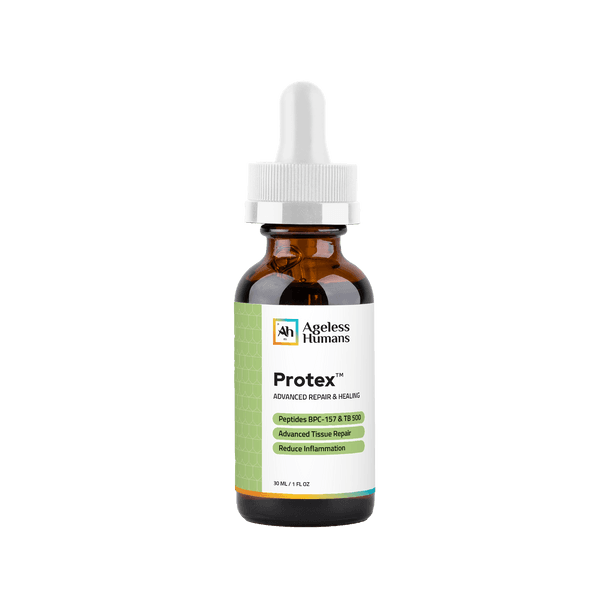
Protex™ Advanced Tissue Recovery & Repair
★★★★ 4 (16)BPC-157 + TB-500 oral sublingual — recovery support without needles
$89.99$71.99 subscribed
FDA-registered facility · Carlsbad, CA · Third-party lab testedUpdated 2026-11-14 · Reviewed by the Ageless Humans editorial team · Third-party tested products
TB-500 is a synthetic peptide based on thymosin beta-4, a protein found naturally in almost every human and animal cell. It is studied for its role in cell movement and tissue repair, but most of that research comes from lab and animal studies, and TB-500 is not an approved drug for human use. Here is what it is, what the evidence does and doesn't show, and how people approach recovery support responsibly.
BPC-157 + TB-500 oral sublingual — recovery support without needles
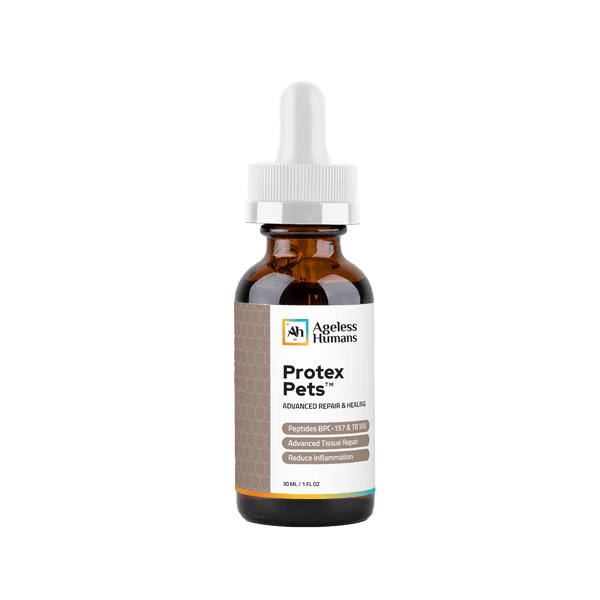
The same repair science, formulated for dogs
TB-500 is a lab-made peptide modeled on thymosin beta-4 (Tβ4), a small protein your body already produces. Thymosin beta-4 is one of the most abundant proteins inside cells. Its best-known job is binding actin, the building block of the cell's internal scaffolding. This helps control how cells change shape and move.
TB-500 is commonly described as a synthetic version of the most active region of thymosin beta-4, not the full protein. Product labeling varies between sellers, so the name "TB-500" does not always mean the same molecule.
If you're new to this category, start with our overview of [what peptides are and how they work](/blogs/news/what-are-peptides). It explains why short chains of amino acids get so much attention in recovery and longevity research.
Important: Ageless Humans does not sell TB-500 as a standalone product. This page is for education only.
TB-500 is popular because thymosin beta-4 sits at the center of the body's natural repair processes. Cells have to move, organize, and rebuild after physical stress, and actin regulation is part of how that happens.
Athletes, lifters, and active adults search for TB-500 because they want three things:
These are fair goals. But interest has moved much faster than the evidence. A lot of what you read online overstates what has actually been shown in people.
Most thymosin beta-4 research has been done in cell cultures and animals. Well-controlled human data on TB-500 itself is limited. That gap matters, because results in a petri dish or a lab animal often don't carry over to people.
In lab and animal settings, researchers have looked at thymosin beta-4 in relation to:
The honest takeaway is that thymosin beta-4 is a biologically interesting molecule with a clear role in normal cell function. Claims that TB-500 dramatically speeds up healing, builds strength, or grows hair in humans go beyond what the evidence supports. Treat any page that promises guaranteed results with skepticism. That includes older content that used to be on this one.
There is no established, approved human dose of TB-500. It is not an FDA-approved drug. The dosing schedules shared online come from informal use and anecdote, not from approved labeling. For that reason, we don't provide TB-500 dosing guidance.
If you're considering any peptide product:
Be wary of anyone who gives you a precise dose for an unapproved compound without knowing your health history.
Long-term safety of TB-500 in humans hasn't been well established. The research base is small, and products sold online vary in purity, labeling, and quality control.
Practical safety points:
A cautious approach is not fear-mongering. It is how you protect the training progress you've worked for.
TB-500 and BPC-157 are the two peptides people mention most for recovery, and they are often discussed together. They come from different sources and are studied in different ways.
Both share the same limitation: human research is still early. For a full breakdown, read our [BPC-157 peptide guide](/pages/bpc-157-peptide) or the plain-language explainer on [what BPC-157 is](/blogs/news/what-is-bpc-157).
The most reliable recovery support still comes from the basics. Peptide products are an add-on, not a replacement. Sleep, enough protein, smart training loads, and staying hydrated do most of the work.
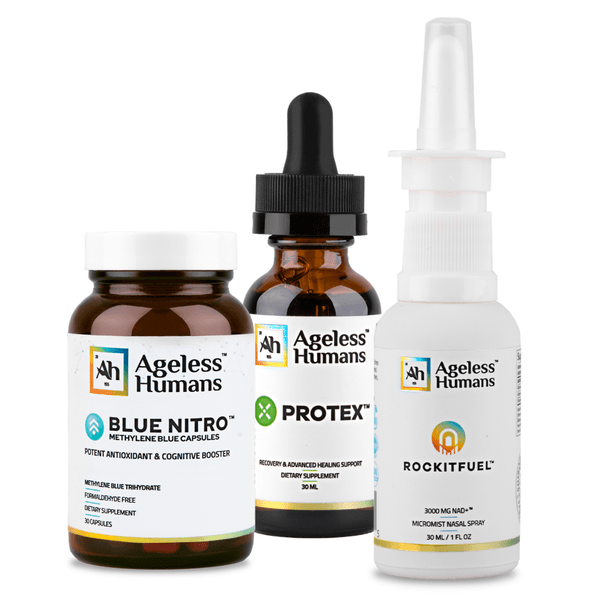
For people who want to add a peptide-based supplement to that foundation, we formulated Protex™ BPC-157 & TB-500 oral drops. They are made to support the body's natural recovery processes and healthy connective tissue after physical activity. Oral drops are easy to use. Follow the label directions.
Active dogs put in hard miles too. Protex Pets™ brings the same recovery-support approach to companion animals. Check with your veterinarian before adding any new supplement to your pet's routine.
Also exploring longevity-focused peptides? See our guides to [Epithalon and cellular aging research](/pages/epithalon-peptide-cellular-rejuvenation) and [the humanin peptide](/pages/humanin-peptide).
TB-500 is a synthetic peptide based on thymosin beta-4, a protein found naturally in nearly all human and animal cells. Thymosin beta-4 helps regulate actin, which controls how cells change shape and move. TB-500 is studied for its possible role in tissue repair, mostly in lab and animal research.
Not exactly. Thymosin beta-4 is the full natural protein. TB-500 is commonly described as a synthetic peptide modeled on its most active region. Labeling varies between sellers, so check exactly what a product contains.
Well-controlled human evidence for TB-500 is limited. Most findings come from cell culture and animal studies, which don't always translate to people. Claims of guaranteed or dramatic results in humans go beyond the current evidence.
There is no established, approved human dose of TB-500, because it is not an FDA-approved drug. Dosing schedules shared online are based on anecdote. Follow the label directions of any product you use, and talk with a qualified healthcare provider first.
The long-term safety of TB-500 in humans has not been well established, and product quality varies widely online. Choose transparent brands, follow label directions, and consult a healthcare provider before use. Stop use and seek advice if you notice anything unusual.
Yes. Thymosin beta-4 and related compounds are on the World Anti-Doping Agency's prohibited list. Athletes subject to drug testing should avoid products containing TB-500 and check with their governing body before using any peptide supplement.
TB-500 is based on thymosin beta-4, a protein found inside nearly all cells. BPC-157 is derived from a protein found in gastric juice. Both are studied for their roles in the body's recovery processes, and both have limited human research so far.
No. Ageless Humans does not sell TB-500 as a standalone product. TB-500 appears alongside BPC-157 in Protex™ BPC-157 & TB-500 oral drops, which are formulated to support the body's natural recovery processes.
Third-party tested longevity supplements, shipped from the USA within 24 hours. 60-day money-back guarantee.