
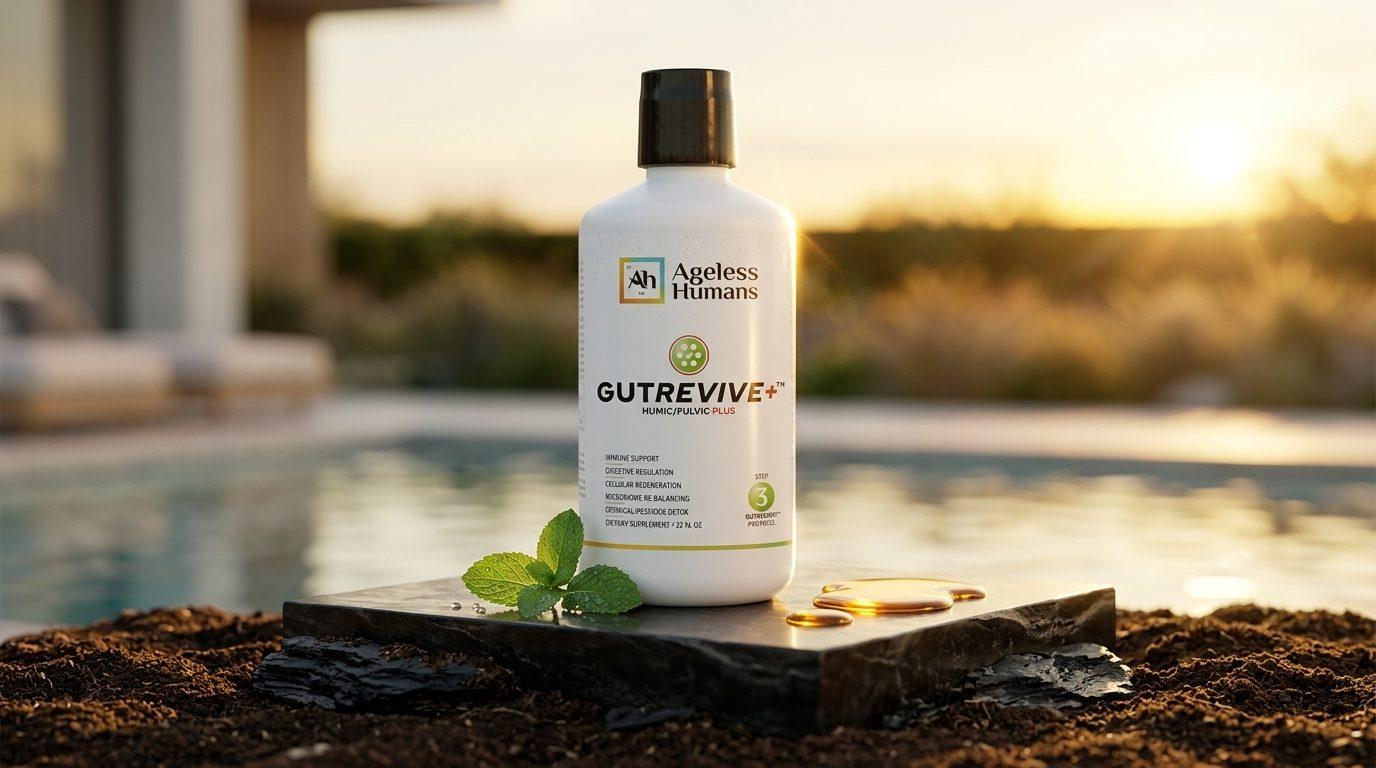
Fulvic acid and probiotics support gut health in different ways. Probiotics add specific live bacterial strains (the tenants), while fulvic acid is studied for its role in the gut environment those microbes live in (the terrain). Probiotics have far more human research behind them, though their effects depend on the exact strain. Fulvic acid research is earlier-stage and mostly lab and animal work, so the two are best seen as complementary rather than competing.
Terrain vs. Tenants: The Core Difference
Probiotics change who lives in your gut. Fulvic acid is aimed at the conditions they live in. That one distinction explains most of what you need to know when comparing them.
Think of your gut as a garden. Probiotics are seeds: specific, named organisms you add on purpose. Fulvic acid belongs to the soil-conditioning side. It's a compound studied for how it binds minerals, its antioxidant activity, and its possible interactions with the gut environment. One approach adds tenants. The other works on the terrain.
Your gut already hosts an enormous, highly individual microbial community. That matters for both approaches. A new strain has to coexist with residents that are already established. Any change to the environment affects the whole community, not one organism. Neither approach replaces the biggest terrain factor of all, which is what you eat every day.
What Probiotics Do and What the Research Really Shows
Probiotics are live microorganisms that, in adequate amounts, have been studied for supporting digestive comfort, regularity, and healthy immune function. Results depend heavily on the specific strain. They are one of the most researched supplement categories, but that research is narrower than the marketing suggests.
What to understand before buying:
- Effects are strain-specific. Research on one strain doesn't transfer to another strain, even within the same species. A label that lists only the genus and species, without strain codes, tells you less than you need.
- Most strains are visitors, not settlers. Research suggests many supplemented strains don't permanently colonize the gut. They tend to act while passing through, which is why benefits often fade after people stop taking them.
- Survival matters. Live organisms have to survive manufacturing, storage, and stomach acid. Formats and storage requirements vary for this reason.
- People respond differently. Because everyone's existing microbiome is different, the same product can feel noticeable to one person and do little for another.
The honest summary: probiotics have real human evidence for specific strains and specific goals. For generally healthy people taking a generic blend, results are more mixed.
What Fulvic Acid Is and What the Research Really Shows
Fulvic acid is a naturally occurring organic compound that forms as plant matter breaks down over long periods. It is studied mainly for mineral binding (chelation), antioxidant activity, and its interactions with the gut environment. It is one fraction of a larger group called humic substances, found in soil, ancient plant deposits, and shilajit.
Its chemistry is what draws scientific interest. Fulvic acid is small and water-soluble, and it carries many binding sites that attach to minerals and other compounds. That's why it's often discussed alongside trace minerals and nutrient transport. For a fuller breakdown, see our guide to fulvic acid benefits.
Now the honest part. Most fulvic and humic research is in vitro (lab) and animal work, including a long history of studies in animal nutrition. Human trials exist, but they are few and small. Researchers have studied humic substances for their effects on gut microbial balance and gut barrier function, and early findings are interesting. They are not conclusive.
So fulvic acid is a promising, plausible terrain-support tool with a thinner human evidence base than probiotics. Anyone who tells you otherwise is overselling it.
Side-by-Side: Fulvic Acid vs. Probiotics
The short version is that probiotics have more human evidence, while fulvic acid works on a different layer of gut health. Here's how they compare on the points that matter:
- What it is: Probiotics are live bacteria or yeasts. Fulvic acid is a non-living organic compound.
- Approach: Probiotics add tenants. Fulvic acid is studied for supporting the terrain.
- Human evidence: Probiotics have extensive research, but it is strain-specific. Fulvic acid has limited human research and mostly lab and animal data.
- What it's studied for: Probiotics are studied for digestive comfort, regularity, and immune support. Fulvic acid is studied for mineral binding, antioxidant activity, and gut environment interactions.
- Specificity: With probiotics, the strain choice is critical. With fulvic acid, source and purity are critical.
- Duration of effect: Probiotic effects often depend on continued use. Fulvic acid's long-term effects are not well studied.
- Quality red flags: For probiotics, watch for missing strain codes or counts listed only at manufacture. For fulvic acid, watch for an undisclosed source or no contaminant testing.
Neither column wins outright, because they answer different questions. If you want to add a specific organism studied for a specific goal, look at probiotics. If you're interested in the gut environment and mineral support, fulvic acid is the more relevant category.
Which Approach Fits Your Goal
Choose based on what you're trying to support, not on which category is trendier. A few practical scenarios:
- You have one specific goal, like regularity or occasional digestive comfort. Start with a probiotic whose exact strain has been studied for that goal. This is where probiotic research is strongest.
- You've tried several probiotics and noticed nothing. The tenants may not be the limiting factor. Look at terrain: fiber, plant variety, sleep, and possibly terrain-focused supplements like fulvic and humic acid.
- Your diet is low in mineral-rich whole foods, or you want broad daily gut and mineral support. Fulvic and humic acid with trace minerals fits this goal better than adding bacteria.
- You want to cover both layers. Use both, introduced one at a time (see below).
One caution applies across the board. If you're pregnant, nursing, managing a medical condition, have a weakened immune system, or take prescription medications, talk with your healthcare provider before starting either one.
Can You Take Fulvic Acid and Probiotics Together?
Yes. Many people use both, and because they act on different layers (environment vs. organisms), they aren't redundant. There's no widely recognized reason they can't share a routine. Still, a few habits make stacking smarter.
Introduce one at a time. Start one, give it two to three weeks, then add the other. If you start both on the same day, you won't know which one is doing what, or which one to drop if your stomach disagrees.
Space them if you like. Some people take fulvic acid and probiotics at different times of day. This is a reasonable personal choice, not an evidence-based requirement.
Mind your medications. Fulvic acid binds minerals and other compounds. If you take prescription drugs, ask your pharmacist whether to separate them by a few hours.
Follow label directions. More isn't better with either category. Stick to the serving size on the label.
There's also a third layer worth knowing about: the gut lining itself. The cells lining your gut are exposed to constant oxidative stress, and they rely on glutathione, your body's master antioxidant, as part of their defense. A glutathione precursor formula provides building blocks that support the body's own glutathione production. It complements both terrain and tenant strategies rather than replacing them.
Don't Skip the Foundations
No supplement outworks your daily habits. Diet, sleep, and stress shape the gut environment more than any capsule or drop. Both probiotics and fulvic acid work best as additions to a solid base.
The terrain tools with the strongest support are unglamorous:
- Fiber and plant variety. Fiber feeds the microbes you already have. A wide range of vegetables, legumes, whole grains, nuts, and seeds supports a more diverse community.
- Fermented foods. Yogurt, kefir, sauerkraut, kimchi, and similar foods are a food-based way to add microbes.
- Sleep and stress management. The gut and brain communicate constantly, and poor sleep and chronic stress are linked to changes in gut function.
- Movement. Regular activity is associated with healthy digestion and regularity.
If these aren't in place, start there. Our gut health foundations guide walks through each one step by step. Then add supplements to fill specific gaps.
How to Judge Quality in Either Category
Quality varies widely in both categories, so check the label and the testing, not the marketing.
For probiotics, look for:
- Full strain identification (genus, species, and strain code)
- Live organism counts guaranteed through the expiration date, not just at manufacture
- Clear storage instructions
For fulvic and humic acid, look for:
- A disclosed source material
- Testing for heavy metals and contaminants, because these compounds come from natural deposits
- A Certificate of Analysis (COA) you can actually access
At Ageless Humans, every product is made and manufactured in our FDA-registered facility in Carlsbad, California. Every lot is third-party lab tested, with a COA. Our fulvic and humic acid trace mineral formula was built around that standard. It is backed by a 60-day money-back guarantee, so you can judge for yourself how it fits your routine.
Frequently asked questions
Is fulvic acid better than probiotics for gut health?+
Neither is better across the board, because they work differently. Probiotics add specific live bacterial strains and have more human research behind them, though results depend on the strain. Fulvic acid is studied for supporting the gut environment, including mineral binding and antioxidant activity, but its research is mostly lab and animal work. Many people use both as complementary approaches.
Can I take fulvic acid and probiotics at the same time?+
Many people use fulvic acid and probiotics in the same routine, and there's no widely recognized reason they can't be combined. A smart approach is to start one at a time, a few weeks apart, so you can tell how each affects you. Follow label directions. If you take prescription medications, ask your pharmacist about spacing them from fulvic acid, since it binds minerals and other compounds.
What does 'terrain vs. tenants' mean for the microbiome?+
'Terrain vs. tenants' describes two ways to support gut health. Tenants are the microbes themselves, which probiotics add directly. Terrain is the environment those microbes live in, shaped by diet, fiber, sleep, and stress. Fulvic acid is studied as a terrain-support tool.
Does fulvic acid kill probiotics or good bacteria?+
There isn't good evidence that fulvic acid, used as directed, undermines probiotics or beneficial gut bacteria in people. Research on humic substances and gut microbes is mostly lab and animal work and is still developing. If you use both, introducing them one at a time helps you notice how your body responds.
Why didn't my probiotic seem to work?+
Probiotic effects are strain-specific, so a product without research on its exact strains may not match your goal. Many supplemented strains also don't settle in the gut permanently and work mainly while you take them. Individual microbiomes vary too. If probiotics haven't helped, look at terrain factors like fiber, plant diversity, sleep, and stress.
Is the research on fulvic acid strong?+
Fulvic acid research is promising but early. Most studies are in vitro or in animals, and human trials are few and small. It has been studied for mineral binding, antioxidant activity, and interactions with the gut environment. Treat it as a plausible terrain-support tool, not a proven replacement for diet or probiotics.