
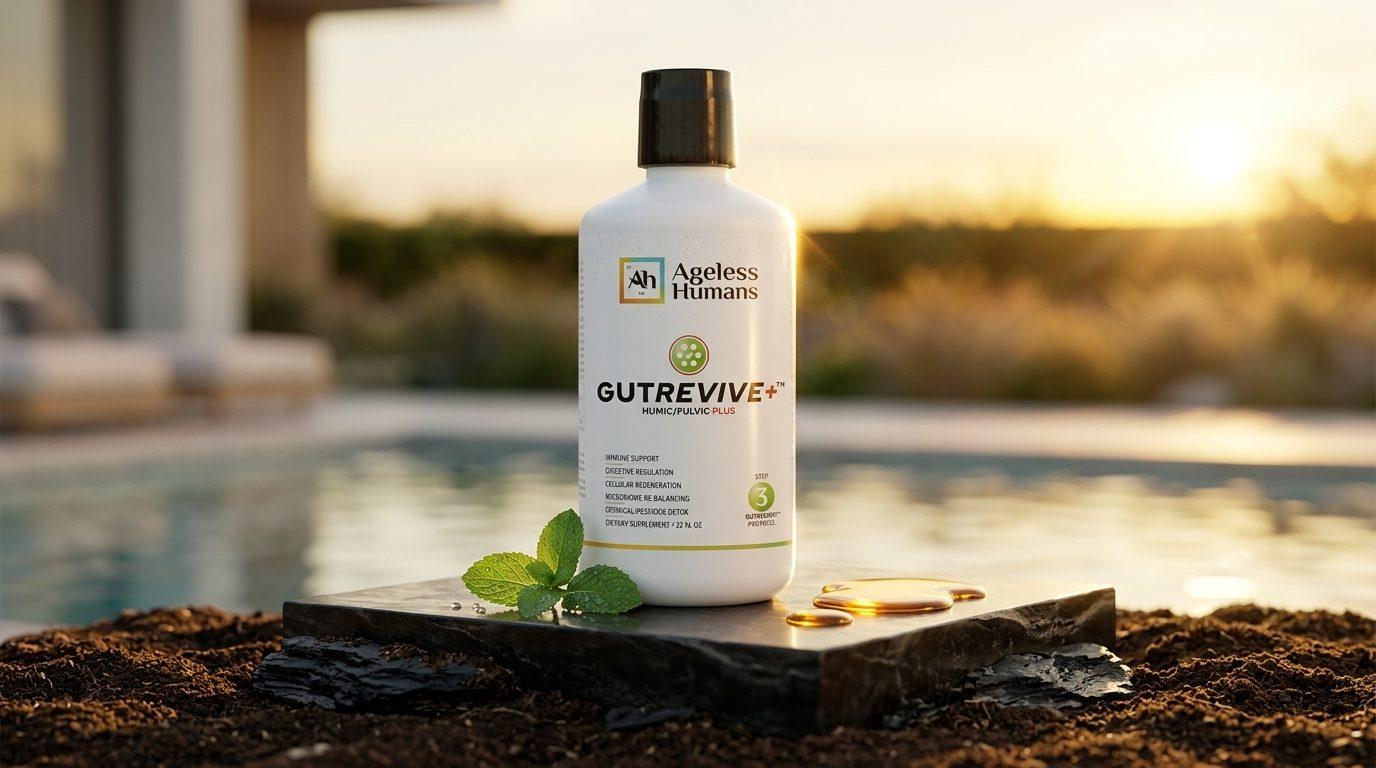
Fulvic acid and humic acid are both humic substances formed as plant matter breaks down, but they differ in size and role. Fulvic acid has small, light molecules that dissolve at any pH and are studied as carriers that help move minerals and nutrients. Humic acid has much larger molecules that work mostly inside the digestive tract, where research suggests they support gut health, so well-designed formulas pair the two.
The Short Answer: Same Family, Different Size, Different Job
Fulvic acid and humic acid are siblings, not rivals. Both come from humus, the dark organic matter that forms as plants decompose over very long periods. Scientists sort humus into fractions by how each one behaves in water, and fulvic and humic acid are two of those fractions.
The practical difference comes down to three things:
- Size: Fulvic molecules are small. Humic molecules are much larger.
- Solubility: Fulvic acid dissolves in water at any pH. Humic acid dissolves only in neutral to alkaline conditions.
- Role: Fulvic acid is studied mainly as a carrier that moves nutrients. Humic acid is studied mainly as a binder that works within the digestive tract.
Think of fulvic acid as the courier and humic acid as the gatekeeper. Neither replaces the other, which is why the strongest formulas include both.
Where Both Come From: Humic Substances 101
Fulvic and humic acid are defined by how they behave, not by a single fixed formula. Unlike a vitamin with one exact molecular structure, humic substances are complex mixtures of organic molecules. Soil scientists separate them with a pH-based extraction:
- Humic acid dissolves in alkaline solutions but separates out when the solution turns acidic.
- Fulvic acid stays dissolved whether the solution is acidic, neutral, or alkaline.
- Humin, the third fraction, does not dissolve at any pH and is rarely used in supplements.
Supplement-grade humic substances usually come from a few natural sources. These include leonardite (an oxidized, lignite-related deposit), ancient peat and humate deposits, and shilajit, the resin-like material that oozes from mountain rock and has a long history of traditional use.
Because these are natural mixtures, the source and the extraction method shape the final product. Two products labeled "fulvic acid" can differ a lot in purity and mineral content. That matters when you evaluate a supplement, which we cover below.
Molecular Size and Solubility: The Core Difference
Fulvic acid molecules are much smaller and lighter than humic acid molecules, and that one fact drives most of their differences. In the research literature, fulvic acid generally has a far lower molecular weight than humic acid. Humic molecules are large, complex structures that can clump together into even bigger assemblies.
Size affects behavior in a few concrete ways:
- Color: Fulvic acid solutions tend to look light yellow to golden. Humic acid looks dark brown to black.
- Solubility: Fulvic acid's smaller size and higher oxygen content help it stay dissolved across the full pH range, including the acidic environment of the stomach. Humic acid tends to separate out in strongly acidic conditions and dissolves again as pH rises further along the digestive tract.
- Reactivity: Fulvic acid carries many oxygen-containing functional groups (such as carboxyl and phenolic groups) relative to its size. These groups let it bind and hold mineral ions.
Why this matters for you: a molecule's size and solubility largely decide where it can go and what it can do once you swallow it. Small and soluble suggests a mobile, carrier-type role. Large and pH-sensitive suggests a role mostly within the gut itself.
Fulvic Acid's Role: The Small Carrier
Fulvic acid is studied mainly for its ability to complex with minerals and other nutrients, which may support how they are carried and used. Its small size and many binding sites let it form loose complexes with mineral ions. In soil science this is well established. Fulvic acid helps move minerals to plant roots in forms the plant can take up.
In human nutrition, researchers have explored whether a similar carrier effect applies. Research suggests fulvic acid may help support nutrient absorption and delivery, and it has also been studied for antioxidant activity and for supporting a balanced immune response. The evidence here is early. Much of it comes from lab and animal work, and human trials are limited.
Fulvic acid is also why many trace mineral supplements pair the two. Fulvic-bound minerals come naturally from the same humic sources, so a fulvic-rich extract often brings a spectrum of trace elements along with it.
For a deeper look at what fulvic acid has been studied for, see our full guide to fulvic acid benefits.
Humic Acid's Role: The Larger Binder in the Gut
Humic acid works mostly inside the digestive tract, where research suggests its large molecules support gut health and help maintain a healthy intestinal environment. Because humic molecules are big, they are not thought to pass into circulation the way smaller compounds might. That is not a weakness. It points them toward a different job.
Research on humic acid, largely from animal nutrition and lab studies, has looked at a few gut-focused roles:
- Binding: Humic acid's large, sticky structure can bind various compounds in the digestive tract. Researchers have studied this as a way to support the body's natural processes for handling unwanted substances.
- Gut lining support: Some research suggests humic substances may form a protective layer along the intestinal lining, which may help support normal gut barrier function.
- Microbial balance: Humic acid has been studied for its possible role in supporting a balanced gut microbiome.
As with fulvic acid, the human research is still developing. The animal and lab findings are consistent enough that researchers keep studying it, but they are not the final word.
For more detail, read our dedicated breakdown of humic acid benefits.
Why Serious Formulas Include Both
The best fulvic and humic supplements combine both because each one covers a job the other does not. Fulvic acid is the small, mobile carrier that stays dissolved throughout digestion. Humic acid is the larger binder that does most of its work within the gut. Together they cover more ground than either alone.
There are three practical reasons formulators pair them:
1. They mirror nature. In soil, peat, and shilajit, fulvic and humic acid occur together. A combined formula keeps the full humic profile instead of isolating one piece. 2. They act in different places. One supports nutrient delivery and the other supports the gut environment where absorption happens. A healthy gut environment and efficient nutrient carriage go hand in hand. 3. They are complementary, not redundant. Taking only fulvic acid means skipping humic acid's gut-focused role. Taking only humic acid means skipping fulvic acid's small-molecule carrier role.
One honest caveat: research on the combination specifically, compared with each one alone, is limited. The case for pairing rests on their distinct, well-described chemistry and their natural co-occurrence. It does not rest on head-to-head human trials.
How to Evaluate a Fulvic and Humic Supplement
Judge a fulvic and humic supplement by its source, its transparency, and its testing, not by the label's adjectives. Because these are natural mixtures pulled from the earth, quality varies widely. Here is what to look for:
- A named source. The label or brand should say where the humic material comes from, such as a humate deposit or shilajit. Vague phrases like "ancient earth minerals" are a red flag.
- Both fractions disclosed. If a product claims to contain fulvic and humic acid, it should identify both rather than burying them in a proprietary blend.
- Third-party testing with a Certificate of Analysis (COA). Earth-derived ingredients can carry unwanted elements from their environment. Independent testing for purity and heavy metals is the single most important quality check. Ask to see the COA.
- Where and how it is made. Look for manufacturing in an FDA-registered facility that follows good manufacturing practices.
- Clear label directions. Follow the directions on the label and talk with your healthcare provider if you are pregnant, nursing, taking medication, or managing a health condition.
At Ageless Humans, every product is made in our own FDA-registered facility in Carlsbad, California. Every lot is third-party lab tested with a COA, and every purchase is backed by a 60-day money-back guarantee.
What the Research Does and Doesn't Show
The research on fulvic and humic acid is promising but early, and honest buyers should know both sides. Here is a straight summary.
What is well established:
- Fulvic and humic acid differ in molecular size, solubility, and chemistry. This is standard soil and environmental science.
- Both bind minerals and other compounds, and fulvic acid acts as a mineral carrier in soils and plants.
- Humic substances have a long track record in animal nutrition research.
What is suggested but not settled:
- Whether fulvic acid meaningfully supports nutrient absorption in humans.
- How much humic acid supports gut lining function and microbial balance in people, as opposed to in animals.
- Whether the combination outperforms either compound alone.
What is not supported: Claims that either compound treats, cures, or prevents any disease. You will see these claims online. Treat them as a reason to shop elsewhere.
The fair takeaway: fulvic and humic acid have distinct, complementary chemistry and a real body of research worth following. Choose a product that respects that by being transparent and tested, and keep your expectations grounded.
Frequently asked questions
What is the main difference between fulvic acid and humic acid?+
The main difference is molecular size. Fulvic acid has small molecules that dissolve in water at any pH, while humic acid has much larger molecules that dissolve only in neutral to alkaline conditions. Because of this, fulvic acid is studied as a nutrient and mineral carrier, and humic acid is studied mainly for supporting gut health within the digestive tract.
Is fulvic acid better than humic acid?+
Neither is better. They do different jobs. Fulvic acid is the smaller, more mobile molecule studied for supporting nutrient delivery, and humic acid is the larger molecule studied for supporting a healthy gut environment. That is why many quality supplements include both instead of choosing one.
Can you take fulvic acid and humic acid together?+
Yes, and they naturally occur together in sources like humate deposits and shilajit. Many supplements combine them so you get both the small-molecule carrier role of fulvic acid and the gut-focused role of humic acid. Follow the label directions and check with your healthcare provider if you take medication or have a health condition.
Where do fulvic acid and humic acid come from?+
Both come from humus, the organic matter that forms as plants break down over long periods. Supplement-grade sources include leonardite, ancient peat and humate deposits, and shilajit. Because the source affects purity, look for products that name their source and provide third-party test results.
Why is fulvic acid yellow and humic acid dark brown?+
The color difference reflects molecular size and structure. Fulvic acid's smaller, lighter molecules produce a light yellow to golden color in solution. Humic acid's larger, more complex molecules absorb more light and look dark brown to nearly black.
How do I know if a fulvic or humic acid supplement is good quality?+
Look for a named source, clear disclosure of both fulvic and humic acid, and third-party testing with a Certificate of Analysis that covers purity and heavy metals. Manufacturing in an FDA-registered facility is another strong quality signal. Skip any product that claims to treat or cure disease.