
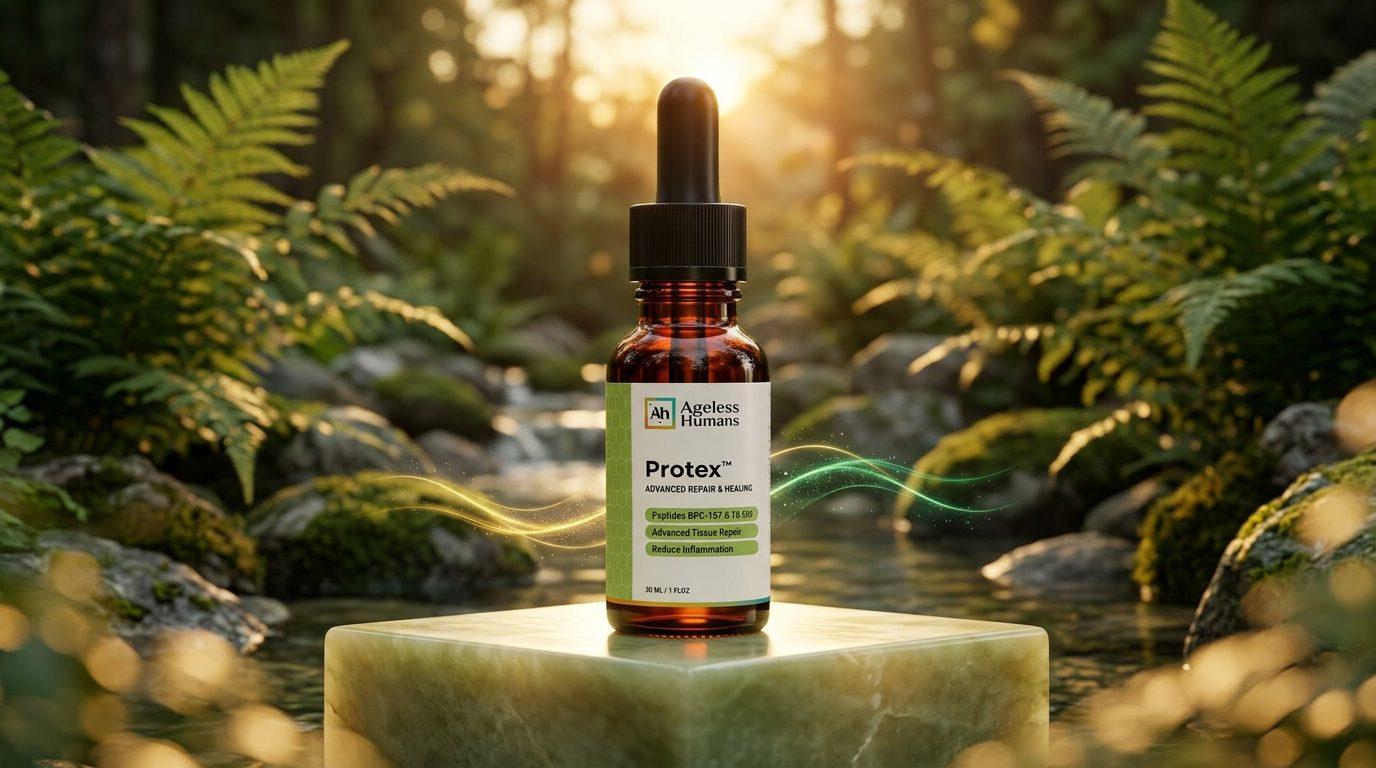
Bioregulators are a subclass of peptides. Every bioregulator is a peptide, but most peptides are not bioregulators. The term usually refers to the very short peptides, typically 2 to 4 amino acids, developed by Russian gerontologist Vladimir Khavinson, which are theorized to support specific organs by influencing gene expression. General peptide research is broader and covers longer chains such as BPC-157 that are studied mainly for how they signal through receptors and pathways across the whole body.
The Short Answer: Bioregulators Are a Subclass of Peptides
Think of "peptide" as the category and "bioregulator" as one specific branch inside it. Both are chains of amino acids. What separates them is origin, size, and the theory behind how they work.
- Peptides include any short chain of amino acids. That covers hormones your body makes, collagen fragments in food, and research compounds like BPC-157 and TB-500.
- Bioregulators (in the Khavinson sense) are ultra-short peptides, usually two to four amino acids. They are associated with a particular tissue and are proposed to help that tissue maintain normal protein synthesis.
People often treat the two words as interchangeable online. They aren't. If you remember one thing, make it this: calling something a bioregulator is a claim about organ-specific action. Calling something a peptide is only a claim about chemical structure.
What Counts as a Peptide?
A peptide is a chain of amino acids linked by peptide bonds. It is generally shorter than about 50 amino acids. Longer chains are usually called proteins. That's the whole chemical definition. It says nothing about what a peptide does.
Your body runs on peptides. Many hormones are peptides. So are signaling molecules involved in appetite, sleep, immune communication, and tissue maintenance. Peptides also show up in food and supplements, such as the collagen peptides added to coffee.
In the supplement and longevity world, "peptides" usually means research-driven compounds studied for specific functions. Common examples include:
- BPC-157: a 15-amino-acid sequence derived from a protein found in gastric juice, studied mainly in animal models for tissue recovery and gut-related functions.
- TB-500: a synthetic fragment related to thymosin beta-4, a naturally occurring protein studied for its role in cell migration and tissue repair processes.
- GHK-Cu: a copper-binding tripeptide studied for skin and connective tissue support.
These compounds are generally thought to act by binding receptors or influencing signaling pathways. Their effects are studied at the level of the whole system, not tied to one organ of origin.
What Makes a Peptide a "Bioregulator"?
A bioregulator is a short peptide that is tied to a specific tissue and proposed to support that tissue's normal function. The concept comes from Vladimir Khavinson and colleagues at the St. Petersburg Institute of Bioregulation and Gerontology. Their work began in Soviet-era research programs in the 1970s and 80s. For a full background, see our guide on what bioregulators are.
The work developed in two phases:
1. Tissue extracts (sometimes called Cytomaxes). Researchers isolated peptide complexes from animal organs such as the thymus and pineal gland. These were mixtures, not single molecules. 2. Synthetic short peptides (sometimes called Cytogens). The team then identified and synthesized specific two-to-four amino acid sequences thought to carry the activity of those extracts. This made them precise and reproducible.
Well-known examples include Epitalon (Ala-Glu-Asp-Gly), a tetrapeptide modeled on a pineal gland extract. Others are Vilon (Lys-Glu), associated with the thymus, and Pinealon (Glu-Asp-Arg), associated with brain tissue. Our deep dive on Epitalon benefits and research covers the most studied of these.
So a bioregulator is defined by more than its size. It is defined by a tissue association and a specific theory of action.
The Organ-Specific Theory, Explained Plainly
Khavinson's central idea is that short peptides help "switch on" the right genes in the right tissue. The hypothesis runs like this:
- Because they are so small, these peptides may be able to enter cells and reach the nucleus, where DNA is stored.
- Once there, they are proposed to interact with specific DNA regions or the proteins that package DNA. That interaction could influence which genes are expressed.
- The result, in theory, is that aging tissue is nudged back toward normal, youthful patterns of protein synthesis. The word that matters is "normal." The goal is regulation, not stimulation.
This is why bioregulators are matched to organs. A thymus-associated peptide is thought to act mainly on thymus-related gene expression. A pineal-associated peptide is thought to act on pineal-related function. The idea is that each sequence carries a kind of address.
Here is the honest part. This mechanism is proposed, not established. Much of the supporting work comes from cell culture, animal studies, and human observational research. Most of it was published by Khavinson's own group and collaborators. That body of work is large. Independent replication by unrelated labs, especially rigorous controlled human trials, remains limited. The theory is interesting and internally consistent. It is not settled science.
How General Peptide Research Differs
General peptide research asks a different question. It doesn't ask which organ a peptide came from. It asks what this molecule does in the body, and through which pathway. That changes the science in a few important ways.
Mechanism. Most studied peptides are thought to act on the outside of cells. They bind receptors, trigger signaling cascades, or influence processes like blood vessel formation and cell migration. The bioregulator theory emphasizes action inside the nucleus.
Scope. A peptide like BPC-157 is studied for effects across several tissues, including tendon, gut, and muscle. Researchers don't expect it to target one organ by design.
Size. General research peptides range widely. Some are as short as three amino acids (GHK-Cu), and others run to dozens. Length alone doesn't make something a bioregulator. GHK-Cu is a tripeptide, but it isn't part of Khavinson's organ-specific framework.
Evidence profile. The evidence varies by compound. Collagen peptides have a meaningful body of human research. BPC-157 and TB-500 are studied mostly in animal and cell models, with limited published human data. Bioregulators have extensive literature, but much of it comes from one research school. No category has a monopoly on strong evidence. Judge each compound on its own data.
Bioregulators vs Peptides: Side-by-Side
| Khavinson Bioregulators | General Research Peptides | |
|---|---|---|
| Relationship | A subclass of peptides | The broader category |
| Typical length | 2–4 amino acids | A few to ~50 amino acids |
| Defining idea | Tissue-specific support | Pathway or function-specific activity |
| Proposed mechanism | Nuclear entry; influence on gene expression | Receptor binding and cell signaling |
| Origin | Animal tissue extracts, then synthetic copies | Varied: natural proteins, fragments, synthetic designs |
| Examples | Epitalon, Vilon, Pinealon | BPC-157, TB-500, GHK-Cu, collagen peptides |
| Research base | Extensive, concentrated in one research school | Varies widely by compound |
The practical takeaway: when you see "bioregulator" on a label, you're being told a story about a specific organ. When you see "peptide," you need to ask which peptide, studied for what, and in whom.
How to Evaluate Any Peptide or Bioregulator Product
The label category matters less than five practical checks. Use these whichever term a product uses.
1. Is the exact sequence or ingredient disclosed? "Peptide blend" tells you nothing. Look for named compounds. 2. Is every lot third-party tested? Ask for a Certificate of Analysis (COA) that confirms identity and purity. At Ageless Humans, every lot is third-party lab tested with a COA available. 3. Where is it made? Manufacturing standards vary across the industry. Our products are made in our own FDA-registered facility in Carlsbad, California. 4. Does the delivery form match the research? Some peptides have been studied in oral form, and others mostly in other forms. BPC-157, for example, has been studied orally in animal research, partly because of its reported stability in gastric juice. Ask whether a product's form reflects how the compound has actually been studied. 5. Are the claims honest? Credible brands say "supports" and "studied for." Be wary of anything promising to fix, cure, or reverse a condition.
Follow label directions, and talk with a qualified healthcare professional before adding any peptide product. This matters most if you take medications, are pregnant or nursing, or manage a health condition.
Where Each Fits in a Longevity Routine
Neither bioregulators nor peptides replace the fundamentals. Sleep, strength training, protein intake, movement, and stress management do the heavy lifting for healthy aging. Peptide-based products are best seen as targeted additions to that foundation.
People usually come to them with different goals in mind:
- Bioregulators tend to appeal to people interested in a whole-body approach to aging that is organized organ by organ. Epitalon and pineal support are a common starting point.
- Research peptides like BPC-157 and TB-500 tend to appeal to active people focused on training recovery and tissue resilience.
If you're putting together a broader plan, a structured approach like the Metamorphic Anti-Aging Protocol is designed to support healthy aging as a coordinated routine rather than a pile of single products. Whatever you choose, give it a fair trial and track how you feel. Every Ageless Humans product comes with a 60-day money-back guarantee.
Frequently asked questions
Are bioregulators and peptides the same thing?+
No. Bioregulators are a subclass of peptides. All bioregulators are peptides, but most peptides are not bioregulators. The term "bioregulator" usually refers to Vladimir Khavinson's ultra-short peptides (2–4 amino acids), which are associated with specific organs and theorized to support normal gene expression in those tissues.
Is Epitalon a bioregulator or a peptide?+
Epitalon is both. It is a four-amino-acid peptide (Ala-Glu-Asp-Gly) and one of the best-known Khavinson bioregulators. It was modeled on a peptide extract from the pineal gland and has been studied for its role in supporting healthy aging processes, mostly by Khavinson's research group.
Is BPC-157 a bioregulator?+
Not in the Khavinson sense. BPC-157 is a 15-amino-acid peptide derived from a protein found in gastric juice. It is studied for effects across several tissues through signaling pathways, not for organ-specific gene regulation. Most BPC-157 research to date comes from animal and cell studies.
Do bioregulators actually work?+
Research suggests short peptide bioregulators may influence gene expression and tissue function, but the evidence has clear limits. Much of the published work comes from Khavinson's institute and collaborators. Independent, large controlled human trials are limited. The organ-specific theory is plausible and well documented by its originators, but it is not yet established by broad independent replication.
Are bioregulators natural or synthetic?+
They come in both forms. The original bioregulators were peptide complexes extracted from animal organs such as the thymus and pineal gland. Researchers later identified and synthesized specific short sequences like Epitalon and Vilon, which are made in a lab and are chemically precise.
Can you use bioregulators and other peptides together?+
Some people include both in a longevity routine because the two categories are studied for different purposes. Any combination should follow each product's label directions. Speak with a qualified healthcare professional before combining peptide products, especially if you take medications or manage a health condition.