
Tesamorelin is a synthetic peptide that mimics growth hormone-releasing hormone (GHRH), signaling the pituitary gland to release more of the body's own growth hormone. It is an FDA-approved, prescription-only injectable studied mainly for reducing visceral (deep abdominal) fat. Researchers have also explored its effects on liver fat, IGF-1 levels, and cognition in older adults. The strongest evidence remains in specific clinical populations, not in healthy people using it for anti-aging.
What Is Tesamorelin?
Tesamorelin is a lab-made version of growth hormone-releasing hormone (GHRH), the signal your hypothalamus uses to tell the pituitary to release growth hormone (GH). It contains the full 44-amino-acid GHRH sequence, plus a small chemical modification at one end. That change helps the peptide resist breakdown by enzymes, so it stays active longer than natural GHRH.
Tesamorelin is not a supplement or a research chemical in its approved form. It is a prescription drug, sold under the brand name Egrifta, and given as a subcutaneous injection. In the U.S., its approved use is to reduce excess abdominal fat in adults with HIV-associated lipodystrophy. That is a narrow clinical use, and it is where most of the human data comes from.
If you're new to the category, it helps to understand what peptides are first. Our primer on what peptides are covers how short amino acid chains act as signaling molecules. For a compound-level reference, see the tesamorelin peptide profile.
How Tesamorelin Works: The Mechanism
Tesamorelin binds to GHRH receptors on the pituitary gland and prompts it to release growth hormone in its natural, pulsing rhythm. That GH then signals the liver to produce insulin-like growth factor 1 (IGF-1), which carries many of growth hormone's downstream effects on fat, muscle, and metabolism.
This upstream approach is the key difference from taking growth hormone directly:
- It works through the body's own system. The pituitary still makes the hormone. Tesamorelin turns up the signal; it doesn't replace the output.
- Feedback loops stay mostly intact. When GH and IGF-1 rise, the body's normal braking signal (somatostatin) still applies. Researchers see this as a built-in limit that direct GH injections bypass.
- Release stays pulsatile. GH is naturally released in bursts, especially during deep sleep. GHRH analogs are thought to amplify those pulses rather than create a flat, constant level.
Growth hormone helps break down stored fat (lipolysis), especially in visceral fat tissue. That is the main reason tesamorelin has been studied so closely for abdominal fat. It also explains why its effects largely fade after stopping: the signal goes away, and so does the extra GH release.
What Research Has Studied Tesamorelin For
The best-studied use of tesamorelin is reducing visceral adipose tissue, the deep fat packed around abdominal organs. Beyond that, researchers have looked at several related areas, with varying depth of evidence.
1. Visceral (abdominal) fat. This is the core of the evidence. Randomized, placebo-controlled trials in people with HIV-associated lipodystrophy led to FDA approval. In those trials, visceral fat dropped compared to placebo, while subcutaneous fat (the pinchable layer under the skin) changed much less.
2. Liver fat. Researchers have studied whether tesamorelin affects fat stored in the liver, mainly in people living with HIV. Research suggests it may help lower liver fat in these groups. This remains an active area of study, not an approved use.
3. IGF-1 and body composition. Trials consistently show that tesamorelin raises IGF-1. Some studies have also looked at lean mass and muscle quality, with findings that are interesting but less consistent than the visceral fat data.
4. Cognition in older adults. A smaller line of research has explored GHRH therapy and cognitive measures in older adults, including those with and without mild memory concerns. Results have been encouraging enough to draw attention, but the studies are limited in size and length.
5. Metabolic markers. Some trials have tracked triglycerides and other lipid markers. The changes reported tend to be modest and closely tied to visceral fat loss.
What the Evidence Does and Doesn't Show
The evidence for tesamorelin is strong in one specific population and thin almost everywhere else. That gap is the most important thing to understand before taking any online claim at face value.
What the research supports:
- Tesamorelin reliably raises GH and IGF-1 in people who receive it.
- In adults with HIV-associated lipodystrophy, it reduces visceral fat versus placebo in controlled trials.
- Effects depend on continued use. When people stop, visceral fat tends to return over time.
What the research does not yet show:
- Anti-aging or lifespan benefits. No human trials show that tesamorelin extends lifespan or slows aging in healthy adults.
- Muscle building in healthy people. Fitness forums make strong claims here, but well-controlled human data in healthy, active adults is lacking.
- Long-term safety outside approved use. Most trials ran for months, not years, and focused on specific patient groups.
- Clear results in the general population. Studies outside HIV populations exist, but they are smaller and earlier-stage.
In short, tesamorelin is a well-characterized drug for a narrow purpose. Extending those results to wellness or longevity use is speculation, not established science.
Safety, Side Effects, and Who Should Avoid It
Tesamorelin is a prescription medication with known side effects, and it should only be used under a doctor's care. Because it raises GH and IGF-1, it carries the same general considerations as other therapies that boost the growth hormone axis.
Side effects reported in clinical trials and on the prescribing label include:
- Injection-site reactions such as redness, itching, or pain
- Joint pain and muscle aches
- Fluid retention and swelling in the hands or feet
- Tingling or numbness, sometimes in the hands
- Changes in blood sugar handling, which is why glucose is typically monitored
The prescribing information lists situations where it should not be used, including pregnancy and certain pituitary or hormonal conditions. Clinicians also weigh a person's history carefully because IGF-1 is a growth signal. Anyone considering it needs a full medical evaluation, not a forum protocol.
One more practical note for athletes: anti-doping organizations prohibit growth hormone-releasing factors in competitive sport. Tesamorelin falls into that category.
Tesamorelin vs. Other Growth Hormone Peptides
Tesamorelin is the GHRH analog with the most rigorous human trial data and a current FDA approval, which sets it apart from most peptides discussed in the same breath. Here's how it compares to the names you'll see alongside it:
- Sermorelin: A shorter GHRH fragment (the first 29 amino acids). It works on the same receptor but breaks down faster. It was previously FDA-approved and later discontinued as a branded product.
- CJC-1295: A modified GHRH analog designed for a much longer half-life. It has far less human clinical data than tesamorelin.
- Ipamorelin and other GHRPs: These work through a different receptor, the ghrelin receptor, rather than the GHRH receptor. They are often stacked with GHRH analogs in wellness circles, mostly without controlled human data on those combinations.
- Recombinant HGH: This is growth hormone itself, injected directly. It bypasses the pituitary and the body's feedback controls entirely.
It's also worth separating these signaling peptides from bioregulators, which are short peptides studied for tissue-specific gene expression rather than hormone release. Our guide on what bioregulators are explains the difference.
A Warning About Gray-Market Tesamorelin
Tesamorelin sold online as a research chemical is not the same as the pharmaceutical product, and there's no reliable way for a consumer to verify what's in the vial. Vendors often label these products not for human consumption to sidestep regulation.
The risks are concrete. Unregulated peptides may be underdosed, mislabeled, contaminated, or degraded from poor storage. Injectable products also carry sterility risks that oral products don't. And without a prescriber, no one is monitoring IGF-1, blood sugar, or side effects.
If tesamorelin interests you for a real clinical reason, the honest path is a conversation with a licensed physician who can prescribe the approved product and monitor you properly.
Where Ageless Humans Fits In
Ageless Humans does not sell tesamorelin, and none of our products are substitutes for it. We wrote this guide because people deserve straight answers about peptides, including the ones we don't make.
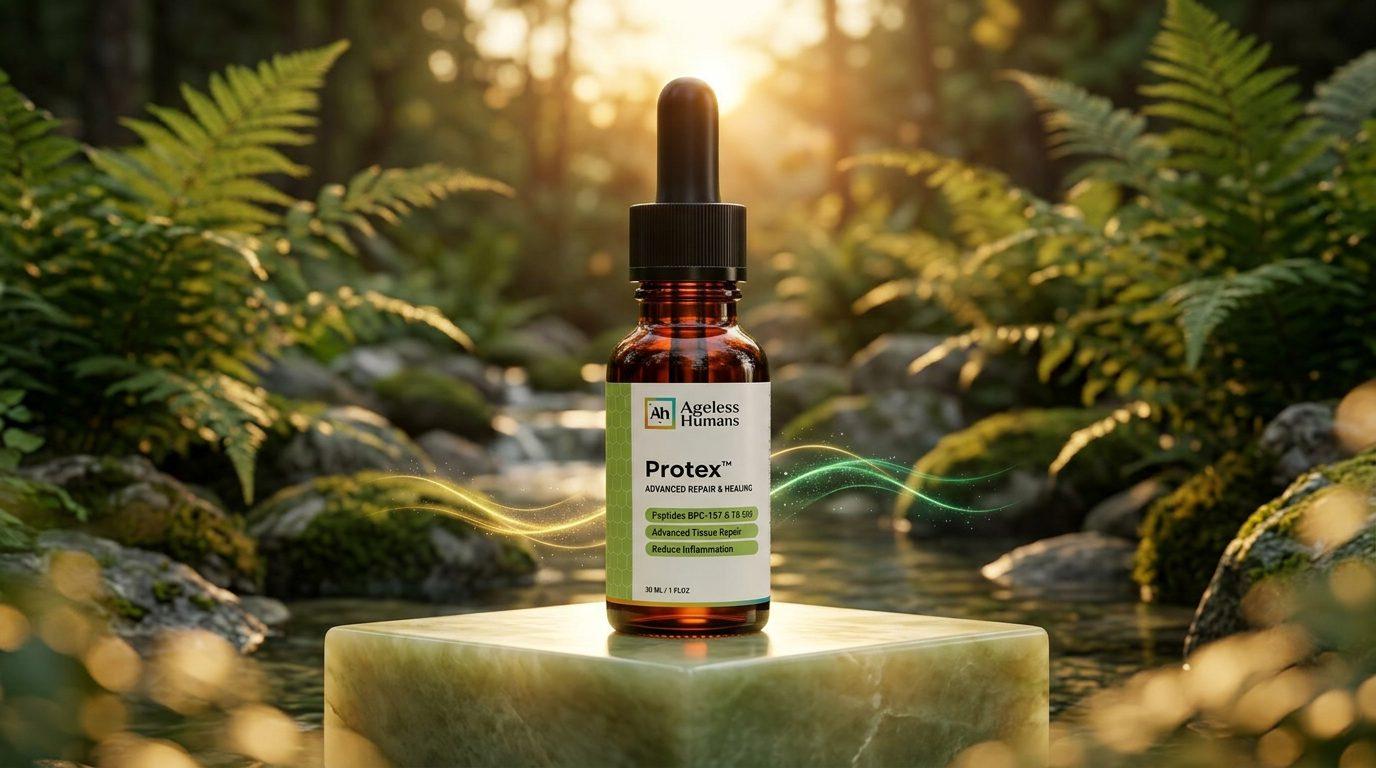
What we do make are oral daily formulas built around structure/function support. For example, our Protex BPC-157 and TB-500 oral peptides are designed to support the body's natural recovery processes. They are not GHRH analogs and do not act on growth hormone the way tesamorelin does. For people who want a broader daily routine, the Metamorphic Anti-Aging Protocol brings together supportive formulas for energy and healthy aging in one system.
Every Ageless Humans product is made in our FDA-registered facility in Carlsbad, California. Every lot is third-party lab tested with a Certificate of Analysis (COA), and every order is backed by a 60-day money-back guarantee.
Frequently asked questions
What is tesamorelin used for?+
Tesamorelin is an FDA-approved prescription injection used to reduce excess abdominal fat in adults with HIV-associated lipodystrophy. It works by signaling the pituitary gland to release more of the body's own growth hormone. Researchers have also studied it for liver fat, IGF-1 levels, and cognition, but those are not approved uses.
Is tesamorelin the same as HGH?+
No. Tesamorelin is a growth hormone-releasing hormone (GHRH) analog, which prompts the pituitary to release its own growth hormone in natural pulses. HGH is growth hormone itself, injected directly, which bypasses the body's normal feedback controls. Their mechanisms, regulation, and risk profiles differ.
Does tesamorelin help with fat loss in healthy people?+
The strongest evidence for tesamorelin's effect on visceral fat comes from clinical trials in adults with HIV-associated lipodystrophy. Data in healthy adults is much more limited. Claims about fat loss or body recomposition in the general population run ahead of the current research.
What are the side effects of tesamorelin?+
Reported side effects include injection-site reactions, joint pain, muscle aches, fluid retention, tingling in the hands, and changes in blood sugar handling. Because it raises growth hormone and IGF-1, it requires medical supervision and monitoring. It should not be used during pregnancy or without a prescriber's evaluation.
Is tesamorelin an anti-aging peptide?+
Tesamorelin is often discussed in anti-aging circles because it raises growth hormone, which naturally declines with age. However, no human trials show it extends lifespan or slows aging in healthy adults. Its established evidence is limited to reducing visceral fat in a specific clinical population.
Can you buy tesamorelin legally without a prescription?+
In the U.S., pharmaceutical tesamorelin requires a prescription. Products sold online as research chemicals are unregulated, often labeled not for human use, and can't be verified for purity, dose, or sterility. Anyone interested in tesamorelin should speak with a licensed physician.