
Vilon is a synthetic dipeptide made of two amino acids, lysine and glutamic acid (Lys-Glu). Research has studied it mainly for its effects on thymus and immune cell activity, gene expression, and markers of cellular aging. Most of that research comes from one research tradition and uses animal and cell models, so any "benefits" should be read as early, promising, and unconfirmed in large independent human trials.
What Is Vilon?
Vilon is the shortest peptide in the bioregulator family: just two amino acids, L-lysine and L-glutamic acid, joined into the dipeptide Lys-Glu (often written KE). It was developed as a synthetic, simplified version of compounds found in thymus extracts. The goal was to keep the activity researchers linked to those extracts in a molecule small enough to make precisely and study cleanly.
That small size is what makes Vilon unusual. Most peptides people hear about, like BPC-157, are chains of a dozen or more amino acids. Vilon is so short that some researchers think it can reach the cell nucleus and interact with DNA and the proteins packed around it. That idea underpins almost all of the research interest.
If you're new to the category, start with our primer on what peptides are. For a compound-level summary, see the Vilon peptide reference page.
Where Vilon Came From: The Bioregulator Research Program
Vilon came out of a Russian research program on "peptide bioregulators," short peptides thought to help maintain normal function in specific tissues. The work is closely tied to Professor Vladimir Khavinson and the St. Petersburg Institute of Bioregulation and Gerontology. That group spent decades studying tissue extracts and then the short synthetic peptides derived from them.
The starting point for Vilon was thymus-derived material. The thymus is a small gland behind the breastbone where T-cells mature, and it shrinks noticeably with age. Researchers analyzed the amino acid makeup of a thymus extract and designed short synthetic peptides to copy its activity. Vilon (Lys-Glu) was one result. A related thymic dipeptide, Glu-Trp, came from the same line of work.
This history matters for two reasons. First, it explains why Vilon is studied mostly for immune and aging topics. Second, much of the published evidence comes from this one group and its collaborators, often in Russian-language journals. That is a real limitation, covered below. For the broader concept, read what bioregulators are.
What Research Has Studied Vilon For
Vilon has been studied mainly in four areas: thymus and immune cell activity, gene expression and chromatin, lifespan in animal models, and markers of cellular aging. Here is what each area has looked at, in plain terms.
- Thymus and immune function. Animal and cell studies have looked at whether Vilon influences how thymus cells grow and differentiate, and how lymphocytes (a type of white blood cell) behave. This connects directly to its thymic origins.
- Gene expression and chromatin. Lab studies have examined whether Vilon changes how tightly DNA is packed in cells taken from older donors. Some reports describe a loosening of chromatin that may allow genes to be read more actively. Other work has looked at shifts in the expression of specific genes.
- Lifespan in model organisms. Studies in rodents and fruit flies have looked at whether long-term Vilon exposure is associated with changes in lifespan and age-related outcomes. Some published results report favorable findings. These are model-organism results, not human data.
- Cellular aging markers. Cell culture work has looked at how Vilon relates to cell growth, renewal, and stress responses in aging tissue.
The pattern is consistent: Vilon has been studied for support of healthy immune and cellular function during aging. It has not been shown to do any of these things reliably in people through large, independent clinical trials.
How Vilon Is Proposed to Work
The leading hypothesis is that Vilon, because it is so small, can enter cells and interact directly with DNA or chromatin to influence which genes are switched on. This is the core "bioregulator" idea: short peptides act as signaling molecules that help adjust gene activity toward a more youthful pattern.
Three mechanisms come up most often in the literature:
1. Chromatin interaction. Researchers propose that Lys-Glu binds to certain DNA sequences or to histone proteins. That could affect how tightly sections of DNA are coiled. Coiling helps determine whether a gene is easy or hard for the cell to read. 2. Gene expression signaling. Changes in chromatin could shift the expression of genes involved in cell growth, differentiation, and immune signaling. This is how Vilon is thought to connect to thymus and lymphocyte activity. 3. Oral uptake via peptide transporters. Dipeptides and tripeptides can be absorbed in the gut through dedicated transporters, such as PEPT1. That offers a plausible route for an orally taken dipeptide to reach circulation. It is a reasonable mechanism, but it is not confirmed proof that Vilon reaches target tissues in active form in people.
These mechanisms are plausible and partly supported by lab data. They have not been fully mapped or independently replicated. Treat them as working hypotheses, not settled biology.
The Honest Evidence State: What We Know and Don't
What we know: Vilon is a well-defined molecule with decades of preclinical study and a coherent proposed mechanism. What we don't know: whether it reliably benefits healthy humans, at what amounts, and with what long-term safety profile. That gap is the most important thing to understand before believing any marketing claim.
Strengths of the evidence:
- The molecule is simple, synthetic, and easy to define. There is no ambiguity about what was studied.
- The research program is long-running and internally consistent.
- Its focus on immune aging and gene expression matches active questions in mainstream longevity science.
Weaknesses of the evidence:
- Concentration of sources. Much of the work comes from one group and its network. Independent replication is limited.
- Model systems. Most findings come from cell cultures, rodents, and fruit flies. Results in these models often do not carry over to humans.
- Few rigorous human trials. There are no large, independent, randomized, placebo-controlled human trials of Vilon published in major Western journals.
- Access and translation. Many papers are in Russian, which makes outside review of methods harder.
The fair summary: Vilon is an interesting research compound with a plausible story. It is not a proven human supplement. Anyone who presents it as established is overselling.
Safety, Legal Status, and How Vilon Is Sold
Vilon is not an FDA-approved drug, and in the U.S. it is mostly sold as a "research chemical" labeled not for human consumption. That label is a legal signal. It means the seller is not making claims about human use and often is not following dietary supplement manufacturing standards.
On safety, the available literature has not flagged major problems. But absence of reported harm in a small, concentrated body of research is not the same as proven long-term safety. Long-term human data is thin. Product quality is a separate risk: research-chemical peptides can vary in purity, identity, and accuracy of dose, and sterility can also vary for injectable forms.
If you are considering any peptide, practical guardrails help:
- Talk with a qualified healthcare provider first, especially if you take medication, are pregnant or nursing, or manage a health condition.
- Ask for an independent certificate of analysis (COA) for the specific lot.
- Be skeptical of sellers who pair "not for human consumption" labels with human-use marketing.
How to Evaluate Vilon Claims You See Online
Judge any Vilon claim by asking three questions: what model was studied, who ran the study, and has anyone independent replicated it? Most overstated claims fall apart on one of these.
Use this quick filter:
- "Proven to reverse aging" — No peptide has earned this claim. Treat it as a red flag.
- "Studies show it extends lifespan" — Ask which species. Rodent and fruit-fly findings are early signals, not human outcomes.
- "Restores the thymus" — Research has studied thymus and immune cell activity. That is not the same as a demonstrated human effect.
- Specific percentages with no citation — If you can't trace a number to a named, accessible study, discount it.
Good sources describe Vilon the way this article does: a promising bioregulator dipeptide with an interesting mechanism and limited human evidence. Our Vilon peptide reference page keeps the facts in one place.
Where Ageless Humans Fits In
Ageless Humans does not make or sell Vilon. This article is education only, because we think people deserve a clear, honest picture of compounds they hear about, including ones we don't carry.
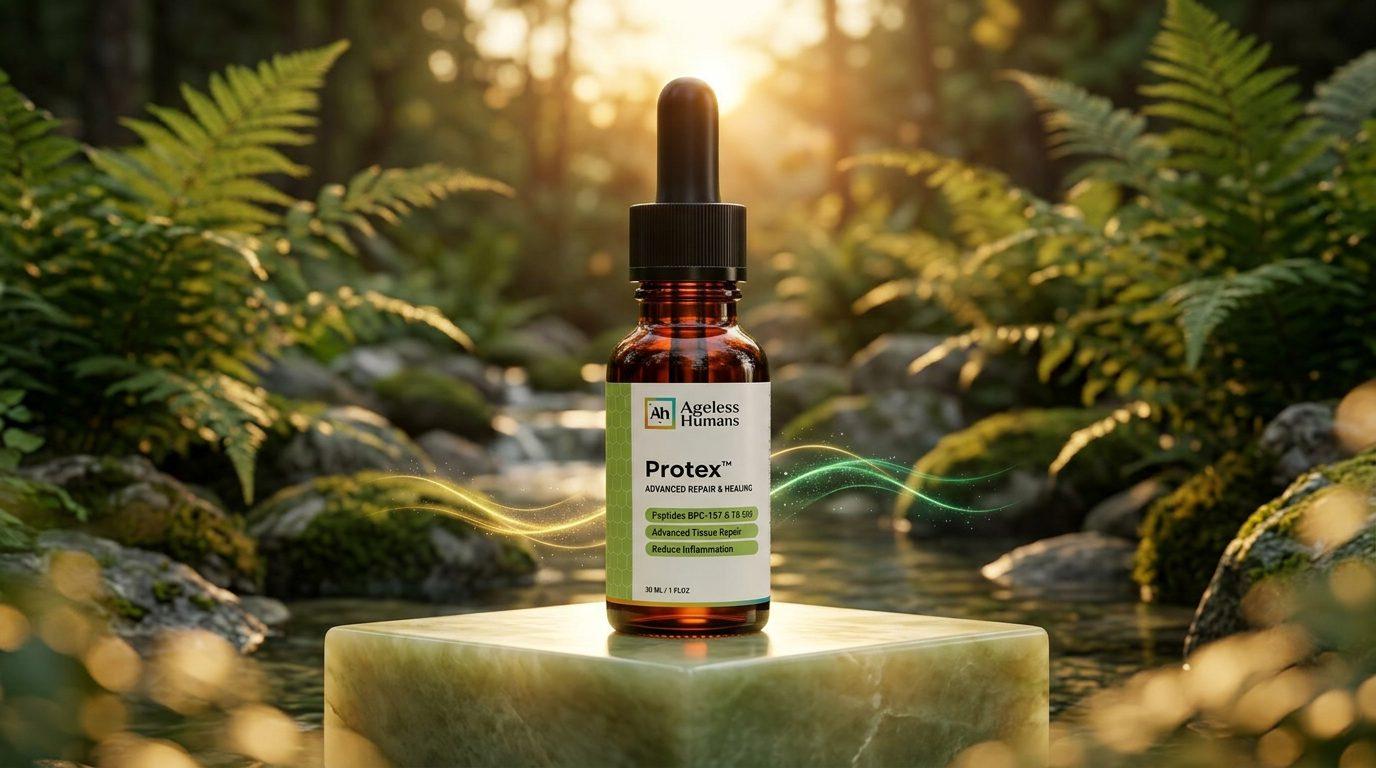
If what draws you to Vilon is the broader idea of peptide-based support, our catalog takes a different approach. Protex is an oral peptide formula built around BPC-157 and TB-500, designed to support recovery and tissue resilience. It is a different set of peptides with a different research background, not a Vilon substitute. If you want a broader daily routine aimed at healthy aging, the Metamorphic Anti-Aging Protocol brings multiple support pathways together in one system.
Every Ageless Humans product is made in our FDA-registered facility in Carlsbad, California. Every lot is third-party lab tested with a COA, and every product is covered by a 60-day money-back guarantee. Follow label directions, and check with your healthcare provider before starting anything new.
Frequently asked questions
What is the peptide Vilon?+
Vilon is a synthetic dipeptide made of two amino acids, lysine and glutamic acid (Lys-Glu). It was developed within a Russian peptide bioregulator research program as a simplified version of compounds found in thymus extracts. It has been studied mainly for its relationship to immune cell activity, gene expression, and markers of cellular aging.
What are the benefits of Vilon?+
Research has studied Vilon for supporting thymus and immune cell function, influencing gene expression and chromatin structure, and its effects on lifespan in animal models. These findings come mostly from cell, rodent, and fruit-fly studies by one research group. Benefits in healthy humans have not been confirmed by large, independent clinical trials, so any claimed benefits should be treated as preliminary.
How does Vilon work?+
The leading hypothesis is that Vilon is small enough to enter cells and interact with DNA or the histone proteins around it. That interaction may change how tightly DNA is packed and which genes are active. This mechanism is supported by some lab data but has not been fully mapped or independently replicated.
Is Vilon safe?+
Published research on Vilon has not highlighted major safety concerns, but long-term human safety data is limited. Vilon is not FDA-approved and is usually sold as a research chemical labeled not for human consumption, so product purity and identity can vary. Anyone considering it should consult a qualified healthcare provider first.
Is Vilon the same as other bioregulator peptides?+
Vilon belongs to the bioregulator family of short peptides, but each bioregulator has a different amino acid sequence and research focus. Vilon (Lys-Glu) is linked to thymus and immune research. Others in the family were studied in connection with different tissues. They should not be treated as interchangeable.
Does Ageless Humans sell Vilon?+
No. Ageless Humans does not make or sell Vilon, and its articles on Vilon are purely educational. The brand offers different products, such as an oral BPC-157 and TB-500 peptide formula for recovery support. Those products are not equivalent to or substitutes for Vilon.