
Thymogen is a synthetic dipeptide made of two amino acids, glutamic acid and tryptophan (Glu-Trp). Researchers in the Soviet Union and later Russia developed it from thymus research and studied it mainly as an immune modulator, especially for its effects on T-cell activity. Its reported benefits rest almost entirely on Russian-language studies, so the evidence is real but narrow. It is not FDA-approved and has not been confirmed by large independent Western trials.
What Is Thymogen?
Thymogen is the dipeptide L-glutamyl-L-tryptophan, a two-amino-acid chain originally modeled on activity found in thymus extracts. It is one of the smallest bioactive peptides ever developed as a therapeutic, and in Russia it is a registered pharmaceutical. In the West it is a research compound, not a supplement or an approved drug.
To see why something this small draws interest, it helps to know what peptides are. Peptides are short chains of amino acids that often act as signals between cells. Our primer on what peptides are covers the basics. Thymogen sits at the extreme short end of that range. It has two amino acids, compared with dozens in hormones like insulin.
Thymogen belongs to a family Russian scientists call bioregulators. These are short peptides proposed to help regulate the tissue they were first linked to. For a quick reference card on this compound, see our thymogen peptide profile.
Where Thymogen Came From
Thymogen came out of Soviet military-medical research in the 1980s, led by Vladimir Khavinson and colleagues in Leningrad (now St. Petersburg). The team first worked with thymalin, a complex mix of polypeptides extracted from calf thymus. They then searched for the smallest active piece. Glu-Trp was the result: a fully synthetic, easy-to-reproduce dipeptide meant to capture part of thymalin's activity.
The thymus is the logical starting point. This small gland behind the breastbone is where T cells mature. It also shrinks steadily from adolescence onward, a process called thymic involution. That age-related decline is why thymic peptides keep coming up in longevity conversations. Researchers have long asked whether signals from the thymus could help maintain immune function as the gland fades.
The same Khavinson research program produced a whole catalog of short peptides tied to different organs. If you want the bigger framework, read our explainer on what bioregulators are.
What Research Has Studied Thymogen For
Most thymogen research has focused on immune modulation, meaning its potential to help normalize T-cell activity rather than simply boost or suppress it. Russian investigators describe it as an immunomodulator, and the published work falls into a few main areas:
- T-lymphocyte function: cell and animal studies looking at T-cell differentiation and activity.
- Immune balance after stress: studies in settings such as recovery from physical stress, radiation exposure research, and other immune challenges, often in military or clinical populations in Russia.
- Aging models: animal work within the broader bioregulator program exploring immune markers in older subjects.
- Supportive use alongside standard care: Russian clinical reports in which thymogen was given in addition to conventional treatment, not in place of it.
In research literature, the same Glu-Trp sequence has also been studied in the West under a separate drug-development name. Those programs looked at different questions and did not produce an approved product.
The key point: "studied for" is not "proven for." A long research history shows sustained interest. It does not, on its own, show reliable benefit in healthy people.
How Thymogen Is Thought to Work
The proposed mechanisms are plausible but not settled. They center on immune cell signaling and, more speculatively, on gene expression. Researchers have put forward three main ideas:
1. Cell signaling balance. Early studies reported that thymogen influenced the balance of cyclic nucleotides (cAMP and cGMP), the messengers that relay signals inside immune cells. Shifting that balance could affect how T cells mature and respond. 2. Cytokine modulation. Some work describes changes in cytokine signaling, the chemical messages immune cells use to coordinate. The direction of the change appears to depend on the starting state, which is why researchers use the word "modulator." 3. Gene-level regulation (hypothesis). Khavinson's bioregulator theory proposes that very short peptides can enter cells and interact with DNA or chromatin to influence which genes are expressed. It is an intriguing idea. However, it has seen limited independent replication, and many peptide scientists treat it as unproven.
There is also a practical question. Short peptides are often broken down quickly in the body, so how much intact Glu-Trp reaches target tissues is a real issue. That is one reason Russian protocols have used injectable and intranasal forms rather than relying only on oral delivery.
The Honest Evidence State
Thymogen has decades of published research behind it, but that evidence is concentrated, mostly older, and largely unconfirmed by independent groups outside Russia. Here is a fair way to weigh it.
What the research does show:
- A consistent line of cell, animal, and clinical work suggesting immune-modulating activity.
- A long history of use within the Russian medical system, with a generally favorable reported tolerability profile in that literature.
- A coherent scientific rationale tied to well-established thymus biology.
What it does not show:
- Large, modern, randomized, placebo-controlled trials published in major international journals.
- Independent replication by research groups unconnected to the original developers.
- Evidence that healthy adults gain measurable longevity or immune benefits from using it.
Much of the literature is in Russian, which makes outside review harder. Many studies are small, and some lack the controls Western reviewers expect. None of this means thymogen does nothing. It means the honest answer is "promising signals, unresolved questions." Anyone claiming certainty in either direction is ahead of the data.
Thymogen vs. Thymosin Alpha-1 and Other Thymic Peptides
Thymogen is not the same as thymosin alpha-1 or thymalin, even though all three trace back to thymus research. People mix these up all the time, so here is a quick comparison:
- Thymogen: a 2-amino-acid synthetic dipeptide (Glu-Trp), developed in Russia.
- Thymalin: a natural mix of thymic polypeptides extracted from animal thymus, also Russian. Thymogen was derived from research on it.
- Thymosin alpha-1: a 28-amino-acid peptide first isolated from a thymus fraction in the United States. It has its own separate research and approval history in various countries.
These compounds differ in size, origin, mechanism, and evidence base. Findings for one should not be transferred to another. If an article or vendor treats them as interchangeable, take that as a sign to read more carefully.
Legal Status, Safety, and Sourcing Reality
In the United States, thymogen is not FDA-approved, is not a legal dietary supplement ingredient, and is sold only through the gray-market "research chemical" channel. That has real consequences for anyone curious about it.
Research-chemical products are labeled "not for human consumption" and sit outside both drug and supplement manufacturing rules. Purity, identity, and sterility are not guaranteed. Injectable products from unverified sources carry added risk. Russian tolerability reports come from pharmaceutical-grade material used under medical supervision, and they cannot be applied to unregulated vials.
If you are interested in immune or thymic peptides, talk with a qualified clinician. This is especially important if you have a medical condition, take medications, or are pregnant or nursing. This article is educational and is not a recommendation to use thymogen.
Supporting Healthy Aging With Verified Formulas
If thymogen interests you because you want to support resilience as you age, focus on fundamentals and on products with verified quality. Sleep, protein intake, resistance training, and stress management have the strongest track record for supporting healthy immune and recovery function over time.
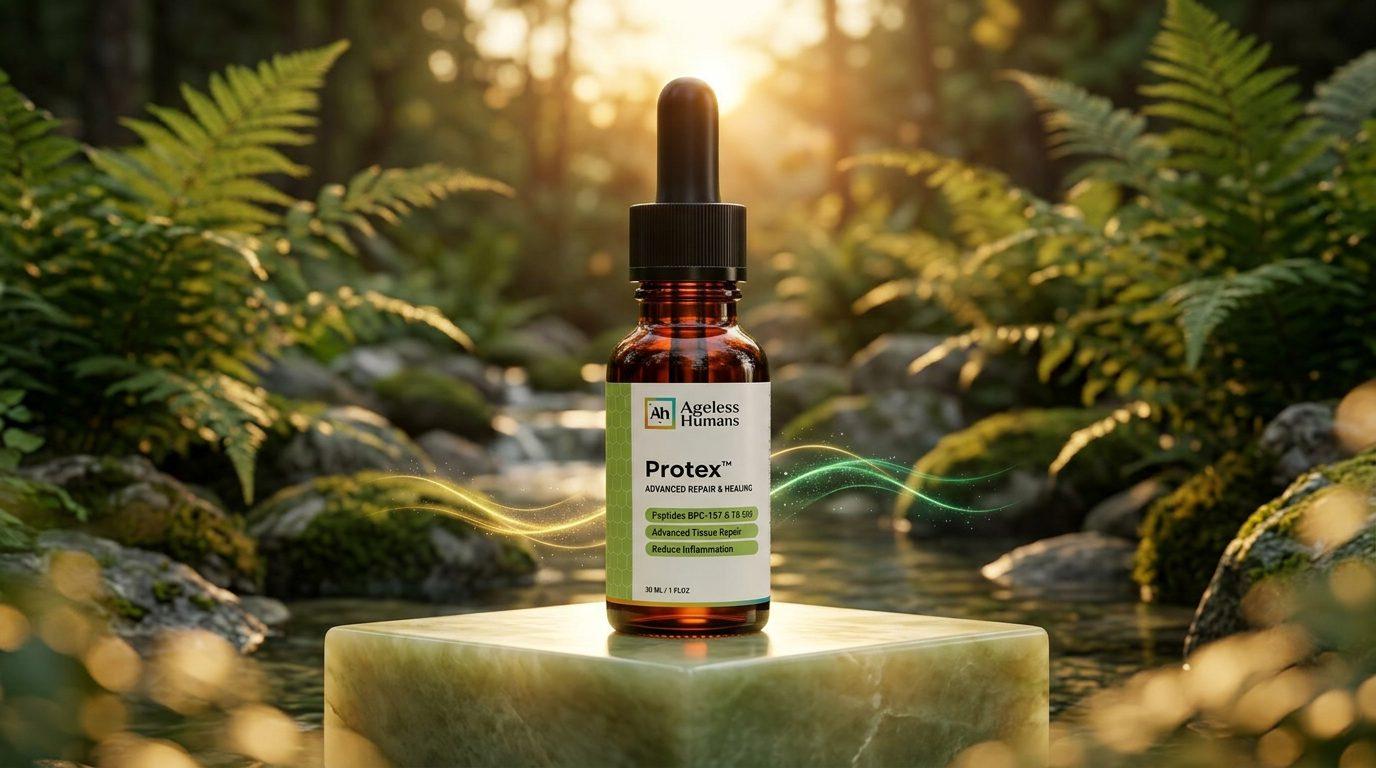
For people exploring peptides in supplement form, quality control matters most. Ageless Humans makes every product in our FDA-registered facility in Carlsbad, California. Every lot is third-party lab tested with a COA, and every order is covered by a 60-day money-back guarantee. Our oral Protex BPC-157 and TB-500 peptide formula is designed to support recovery. It is a different compound with a different purpose than thymogen, not a substitute for it.
If you would rather follow a structured plan than piece one together yourself, the Metamorphic Anti-Aging Protocol brings several of our formulas together into one system for daily energy and healthy aging. Use all products as directed on the label.
Frequently asked questions
What is thymogen?+
Thymogen is a synthetic dipeptide made of two amino acids, glutamic acid and tryptophan (Glu-Trp). Russian researchers led by Vladimir Khavinson developed it from thymus extract research in the 1980s. It is registered as a pharmaceutical in Russia but is not FDA-approved in the United States.
What are the claimed benefits of thymogen?+
Thymogen has mainly been studied as an immune modulator, with research focused on T-cell function and immune balance after physical stress. Most of this research comes from Russian studies, many of them small or older. Large independent trials confirming benefits in healthy adults have not been published.
Is thymogen the same as thymosin alpha-1?+
No. Thymogen is a 2-amino-acid synthetic peptide developed in Russia. Thymosin alpha-1 is a 28-amino-acid peptide first isolated from thymus tissue in the United States. They share a thymus research background but differ in structure, mechanism, and evidence, so findings for one do not apply to the other.
How does thymogen work?+
Researchers propose that thymogen influences immune cell signaling, including the balance of cAMP and cGMP messengers and cytokine activity, which may affect how T cells mature and respond. A more speculative theory holds that short peptides like thymogen influence gene expression. These mechanisms remain unconfirmed by broad independent research.
Is thymogen legal in the United States?+
Thymogen is not FDA-approved and is not a permitted dietary supplement ingredient in the United States. It is generally sold only as a research chemical labeled not for human consumption, so purity and identity are not guaranteed. Anyone considering it should consult a qualified clinician.
Does Ageless Humans sell thymogen?+
No. Ageless Humans does not sell thymogen, and this content is for education only. The brand offers oral peptide and longevity formulas made in its FDA-registered Carlsbad, California facility, with third-party lab testing on every lot. These are different products and are not substitutes for thymogen.