
Testagen is a synthetic four-amino-acid peptide (Lys-Glu-Asp-Gly, often written KEDG) that belongs to the Russian bioregulator family and is associated with testicular and male reproductive tissue. Research has studied it for its possible role in gene expression and tissue function, mostly in cell and animal models. Controlled human data is thin, so any claimed benefit should be treated as early-stage and unconfirmed.
What Is Testagen?
Testagen is a short synthetic peptide, a tetrapeptide made of lysine, glutamic acid, aspartic acid, and glycine (KEDG), classified as a peptide bioregulator. It was developed within the research program led by Vladimir Khavinson and colleagues in St. Petersburg, Russia, which spent decades studying short peptides believed to have tissue-specific activity.
The name signals its intended target: "Test-" refers to the testes. In the bioregulator framework, each peptide is linked to a specific organ or tissue, and Testagen is the one associated with male reproductive tissue.
If you're new to the category, it helps to understand the basics first. Peptides are short chains of amino acids, smaller than proteins, that act as signaling molecules throughout the body. Our primer on what peptides are covers the foundations, and the Testagen peptide overview offers a quick-reference summary.
Key facts at a glance:
- Type: Synthetic tetrapeptide bioregulator
- Sequence: Lys-Glu-Asp-Gly (KEDG)
- Associated tissue: Testes and male reproductive system
- Research origin: Russian gerontology and bioregulation research
- Regulatory status: Not approved by the FDA for any use
Where Testagen Comes From: The Bioregulator Research Tradition
Testagen is a second-generation bioregulator, a lab-made short peptide designed to mimic the activity researchers attributed to extracts from animal organ tissue. To understand Testagen, you need to understand the tradition it came from.
The bioregulator concept started with tissue extracts. Researchers isolated peptide fractions from specific animal organs, such as the thymus, pineal gland, and others, and studied whether those fractions influenced the matching tissue. The working theory was that each organ produces signaling peptides that help regulate its own function, and that this signaling may decline with age.
The next step was to identify short, defined peptide sequences that could be synthesized in a lab instead of extracted. That produced a family of synthetic short peptides, each paired with a tissue. Testagen is one of them, alongside better-known names in the same family associated with other organs.
This lineage matters for evaluating Testagen. Much of the foundational research was published by a relatively small group of investigators, often in Russian-language journals, and the overall framework has not been broadly replicated by independent labs worldwide. For a fuller explanation of the category, see our guide to what bioregulators are.
What Has Research Studied Testagen For?
Research on Testagen has focused on its possible influence on gene expression and cellular function in testicular and reproductive tissue, mostly in laboratory and animal settings. It has also been looked at within broader studies on how short peptides might relate to aging at the cellular level.
The main research themes include:
- Tissue-specific gene expression: Studies within the bioregulator program have examined whether Testagen influences the activity of genes in cells from its associated tissue.
- Cellular aging models: Short bioregulator peptides as a class have been studied in cell cultures to see whether they affect markers associated with cellular aging.
- Male reproductive tissue function: Because of its tissue association, Testagen has been studied for its potential role in supporting normal function of testicular cells.
- Peptide-DNA interaction: Some work has explored whether short peptides like KEDG can bind to specific DNA regions, which is central to the proposed mechanism.
What's missing is just as important. There are no large, independently replicated, randomized controlled trials in humans that establish Testagen's effects on hormone levels, fertility, energy, or longevity. Claims you see online about testosterone, libido, or vitality usually go well beyond what published research supports.
How Testagen Is Proposed to Work
The leading hypothesis is that Testagen, like other short bioregulator peptides, enters cells and interacts with DNA or chromatin to influence which genes are switched on or off in its target tissue. This idea is a hypothesis, not established mechanism.
Here's the proposed model in plain terms:
1. Small size allows cell entry. At only four amino acids, Testagen is tiny. Researchers in the bioregulator field propose that peptides this short can cross cell and nuclear membranes. 2. Binding to specific DNA regions. Some studies suggest short peptides may bind to particular DNA sequences or to histone proteins that package DNA. 3. Changing gene activity. By interacting with these regions, the peptide may help regulate the expression of genes tied to the tissue's normal function. 4. Tissue specificity. The framework holds that each bioregulator's sequence fits best with genes active in its matching tissue, which is why Testagen is linked to the testes.
The honest caveat: tissue-specific action by a four-amino-acid peptide is a bold claim. Mainstream molecular biology has not broadly confirmed that peptides this short can reliably target specific genes in specific organs. The mechanism is interesting and worth further study, but it should not be presented as settled science.
The Honest Evidence State: What We Know and Don't Know
Testagen's evidence base is early-stage: there is preclinical research and a proposed mechanism, but not the human clinical data needed to confirm specific benefits. Here's a clear breakdown.
What research does show:
- Testagen is a defined, synthesizable peptide with a known sequence.
- It has been studied in cell and animal models within the bioregulator research program.
- Researchers have proposed a plausible-sounding mechanism involving gene expression.
What research does not show:
- Confirmed effects in humans from large, well-controlled trials.
- Independent replication by research groups outside the original program.
- Established long-term safety data.
- Reliable evidence that oral or injected Testagen reaches target tissue intact in humans.
- Any proven effect on hormone levels, fertility, or lifespan.
This doesn't mean Testagen is worthless. It means the research is at a stage where curiosity is reasonable and confident claims are not. Anyone telling you Testagen definitively boosts testosterone or reverses aging is selling certainty the science hasn't earned.
Safety, Legality, and Quality Concerns
Testagen is not approved by the FDA for any use, and it is typically sold online as a research chemical with no verified purity, dosing, or safety standards. That creates real risks for anyone considering it.
The main concerns:
- Unknown purity. Research-chemical vendors are not held to dietary supplement or drug manufacturing standards. Contamination, mislabeling, and underdosing are all possible.
- No established safety profile. Without robust human trials, side effects and interactions are not well characterized.
- Route of use. Some products are injectable, which adds sterility and handling risks when sourced outside clinical channels.
- Hormonal context. Because Testagen is associated with reproductive tissue, anyone with existing health conditions or taking medications should be especially cautious.
If you're curious about Testagen or any bioregulator, talk with a qualified healthcare provider before using it. Ask whoever sells it for third-party testing documentation, and treat the absence of a certificate of analysis as a red flag.
How to Evaluate Testagen Claims You See Online
The fastest way to judge a Testagen claim is to check whether it cites specific human research or just repeats confident promises. Most online content about this peptide overstates what is known.
Red flags to watch for:
- Claims that Testagen "raises testosterone" or "restores fertility" without human trial evidence.
- Before-and-after testimonials presented as proof.
- Precise dosing protocols with no source.
- Language like "proven," "clinically shown," or "reverses aging."
- Vendors that sell it "for research only" while marketing personal benefits.
Signs of a more trustworthy source:
- It explains that most research is preclinical.
- It names the research origin and acknowledges limited replication.
- It separates the proposed mechanism from proven outcomes.
- It recommends consulting a healthcare provider.
Holding Testagen content to this standard will protect both your health and your wallet.
Where Peptides Fit in a Practical Longevity Routine
For most people, the strongest longevity foundation is still sleep, training, nutrition, and stress management, with well-made supplements used to support those habits rather than replace them. Peptides are an exciting research area, but they work best as one piece of a broader plan.
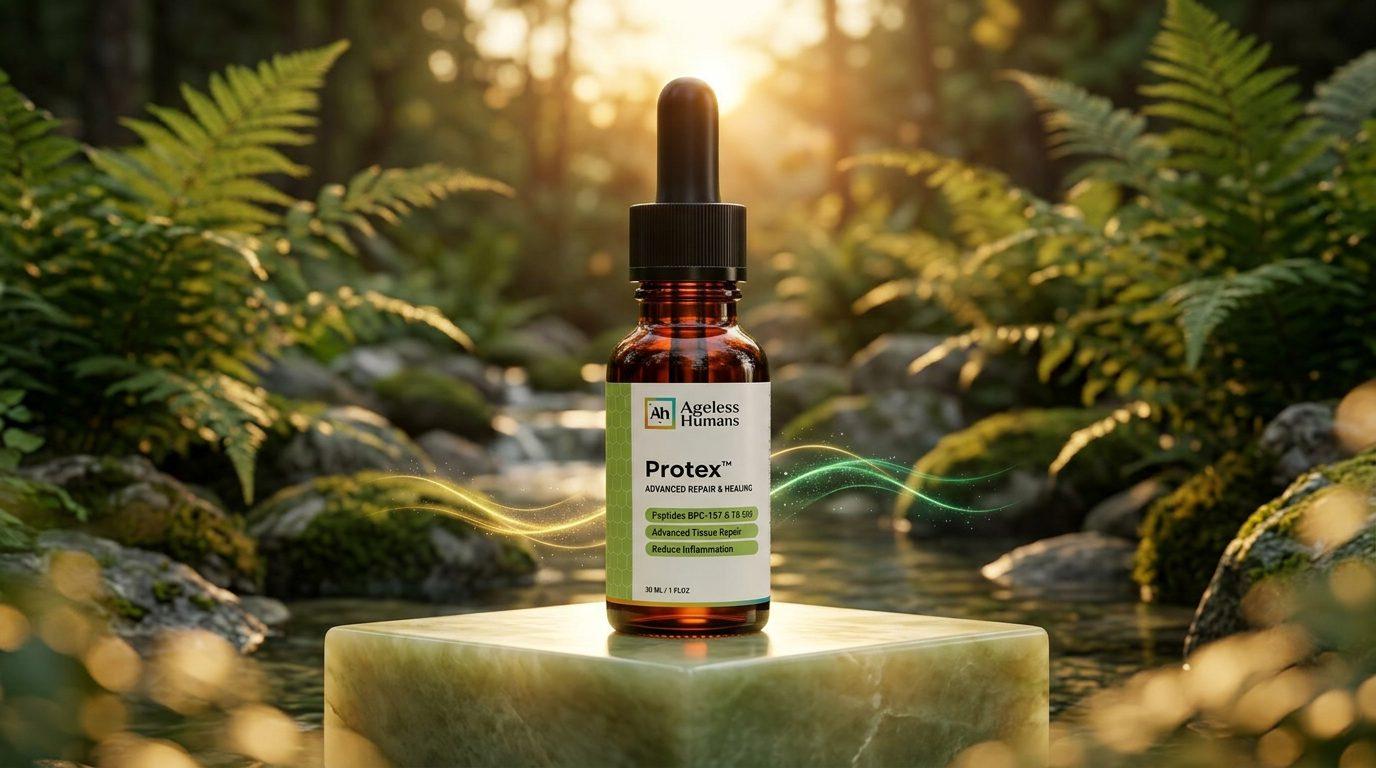
If the peptide category interests you, there are quality-controlled oral options that don't require research-chemical sourcing. For example, Protex BPC-157 and TB-500 Peptides (Oral) is formulated to support recovery and help maintain healthy tissue as part of an active lifestyle. It is a different compound with a different purpose than Testagen, not a substitute for it.
For people who want a structured approach rather than single ingredients, the Metamorphic Anti-Aging Protocol brings multiple products together into one system designed to support healthy aging, energy, and daily vitality.
Every Ageless Humans product is made in our FDA-registered facility in Carlsbad, California, with each lot third-party lab tested and backed by a certificate of analysis, plus a 60-day money-back guarantee.
Frequently asked questions
What is Testagen?+
Testagen is a synthetic tetrapeptide made of four amino acids: lysine, glutamic acid, aspartic acid, and glycine (KEDG). It belongs to the bioregulator family of short peptides developed in Russian gerontology research and is associated with testicular and male reproductive tissue. It is not approved by the FDA for any use.
What are the benefits of Testagen?+
Testagen has been studied for its possible role in supporting gene expression and cellular function in male reproductive tissue, mainly in cell and animal models. No large, independently replicated human trials have confirmed specific benefits. Claims about testosterone, fertility, or anti-aging effects go beyond what current research shows.
How does Testagen work?+
The leading hypothesis is that Testagen, because it is very small, may enter cells and interact with DNA or histone proteins to influence gene activity in its target tissue. This tissue-specific mechanism was proposed by researchers in the bioregulator field. It remains a hypothesis and has not been broadly confirmed by independent research.
Does Testagen increase testosterone?+
There is no strong human clinical evidence that Testagen increases testosterone. Its association with testicular tissue has led to that claim online, but published research is mostly preclinical. Anyone concerned about hormone levels should speak with a qualified healthcare provider.
Is Testagen safe?+
Testagen's safety in humans is not well established because large controlled trials are lacking. It is usually sold as an unregulated research chemical, so purity and contents can vary. Consult a healthcare provider before using it, and avoid any source that cannot provide third-party testing documentation.
Does Ageless Humans sell Testagen?+
No. Ageless Humans does not sell Testagen, and this content is for education only. The brand offers separate oral peptide and longevity products made in its FDA-registered Carlsbad, California facility, but these are different compounds and are not equivalent to Testagen.