
Thyrotropin-releasing hormone (TRH) is a three-amino-acid peptide made in the hypothalamus. It signals the pituitary to release thyroid-stimulating hormone (TSH), which sits at the top of the body's thyroid hormone chain. Research has studied TRH mainly for its role in endocrine physiology and as a neuromodulator in the brain, but it is a research compound, not an approved supplement, and its 'benefits' outside the lab remain largely unproven.
What Is TRH?
TRH is the smallest known hypothalamic releasing hormone: a tripeptide built from glutamic acid (in a cyclized pyroglutamyl form), histidine, and prolinamide. Its sequence is often written pGlu-His-Pro-NH2. Those end modifications cap the molecule so it doesn't break down instantly, though, as you'll see, it still doesn't last long in circulation.
TRH is made by nerve cells in the hypothalamus, a small region at the base of the brain that links the nervous system to the hormone system. From there it travels a short distance through a dedicated blood supply to the anterior pituitary gland, where it does its best-known job: prompting the release of TSH.
TRH was one of the first hypothalamic hormones ever isolated and sequenced. That discovery, made in the late 1960s, helped prove that the brain directly controls the pituitary through chemical messengers. The work was later recognized with a Nobel Prize. In that sense, TRH is foundational to modern endocrinology.
If you're new to this class of molecules, our primer on what peptides are explains how short amino acid chains act as signals throughout the body.
TRH vs. Thyrotropin: Clearing Up the Name Confusion
"Thyrotropin" and "TRH" are not the same thing. Thyrotropin is another name for TSH, the hormone released by the pituitary. TRH is the releasing hormone that tells the pituitary to send TSH out. Searches for "thyrotropin TRH" usually mean TRH itself.
Here's the chain in plain order:
- TRH (hypothalamus) signals the pituitary
- TSH / thyrotropin (pituitary) signals the thyroid gland
- T4 and T3 (thyroid) act on nearly every tissue to help regulate metabolic rate, temperature, and energy use
You may also see TRH called protirelin, the name used for its pharmaceutical form, or thyroliberin, an older scientific name. All three refer to the same tripeptide.
How TRH Works: The Mechanism
TRH works by binding to a specific receptor on pituitary cells, which triggers a calcium-driven signal that releases TSH and also prolactin. The TRH receptor is a G-protein-coupled receptor. When TRH binds, it activates an enzyme pathway (phospholipase C) that raises calcium inside the cell. That calcium spike drives the release of stored hormone.
The thyroid feedback loop. Once TSH reaches the thyroid, the gland releases T4 and T3. Rising thyroid hormone levels then signal back to the hypothalamus and pituitary to dial TRH and TSH down. This negative feedback loop, called the hypothalamic-pituitary-thyroid (HPT) axis, keeps thyroid output inside a tight range. TRH is the accelerator; circulating thyroid hormone is the brake.
The prolactin effect. TRH also stimulates prolactin release from the pituitary. Researchers consider this a real physiological effect, though TRH is not thought to be the main controller of prolactin day to day.
Beyond the pituitary. TRH and its receptors are found well outside the hypothalamus: in other brain regions, the spinal cord, and parts of the gut and pancreas. In the brain, TRH appears to act as a neuromodulator, a signal that tunes the activity of other nerve circuits rather than carrying a hormone message. This is the part of TRH biology that has drawn the most research interest beyond endocrinology.
What Research Has Studied TRH For
Research on TRH falls into three main areas: thyroid axis physiology, brain neuromodulation, and the development of longer-lasting analogs. Here's what each has looked at.
1. Endocrine physiology and clinical testing. For decades, injected TRH was used in clinical settings as a stimulation test: give TRH, then measure how the pituitary's TSH and prolactin respond. This made TRH a standard research tool for understanding how the HPT axis behaves. Its routine clinical use declined as more sensitive TSH blood tests became available.
2. Brain and nervous system research. Because TRH is spread throughout the central nervous system, researchers have studied it for roles in arousal and wakefulness, mood, body temperature regulation, and nerve cell protection. Animal studies suggest TRH can influence alertness and counter sedation, and it has been explored in early human research related to mood and neurological function. These findings are intriguing but mostly preliminary, often based on small studies, animal models, or delivery methods (like direct spinal or nasal administration) that don't reflect casual use.
3. TRH analogs. Natural TRH breaks down fast and doesn't cross into the brain efficiently, so scientists have designed modified versions meant to last longer and reach the central nervous system better. At least one analog, taltirelin, has been approved in Japan for a neurological indication. That approval applies to that specific drug, not to TRH itself, and it doesn't translate into general wellness benefits.
The Honest Evidence State: What's Shown and What Isn't
TRH's role in the thyroid axis is firmly established. Its potential as a wellness or longevity compound is not. It's worth keeping those two claims separate, because online sources often blur them.
Well supported:
- TRH stimulates TSH and prolactin release from the pituitary
- TRH is the top signal in the HPT feedback loop
- TRH is widely distributed in the brain and acts as a neuromodulator
Studied, but not established for practical use:
- Effects on mood, alertness, and cognition in humans
- Nerve-protective effects seen in animal and lab models
- Any role in healthy aging, energy, or metabolism in people who aren't under medical supervision
Not supported:
- Claims that TRH is a proven energy, fat-loss, or anti-aging peptide
- Claims that oral TRH reliably reaches the brain or meaningfully changes thyroid function in healthy adults
The gap between "interesting mechanism" and "proven benefit" is large here. A molecule that moves a hormone axis in a lab is not automatically something a healthy person should take. Messing with the thyroid axis without medical oversight is exactly the kind of thing that can throw a finely tuned feedback system off balance.
Why TRH Is Hard to Use Outside the Lab
TRH has three practical problems: it breaks down within minutes, it crosses into the brain poorly, and it isn't sold as a legal dietary supplement.
Short half-life. Enzymes in the blood degrade TRH rapidly, so its circulating effect is brief. This is useful for a quick stimulation test but a problem for anything requiring sustained action.
Delivery barriers. As a small, water-loving peptide, TRH doesn't pass the blood-brain barrier efficiently. Much of the brain-focused research has relied on injection, spinal delivery, or experimental nasal formulations. Oral TRH faces digestion on top of that.
Regulatory status. In the U.S., TRH (protirelin) has a pharmaceutical history, not a supplement one. Products marketed online as "TRH peptide" are typically sold as research chemicals, which means no guarantee of identity, purity, or dose. That's a meaningful risk for any compound that acts on a hormone axis.
For a fuller profile of the compound itself, see our TRH peptide reference page.
Where TRH Fits in the Peptide and Longevity Conversation
TRH is best understood as a master signaling peptide, a reminder that tiny molecules can steer whole organ systems, rather than as a do-it-yourself longevity tool. That's also why it belongs in a peptide encyclopedia: it shows how the body uses short amino acid chains to coordinate function from brain to gland to tissue.
That idea connects to a broader research area. Scientists have studied short peptides called bioregulators for their potential to support specific tissues and cellular signaling. Our guide to what bioregulators are covers that category and how it differs from hormones like TRH.
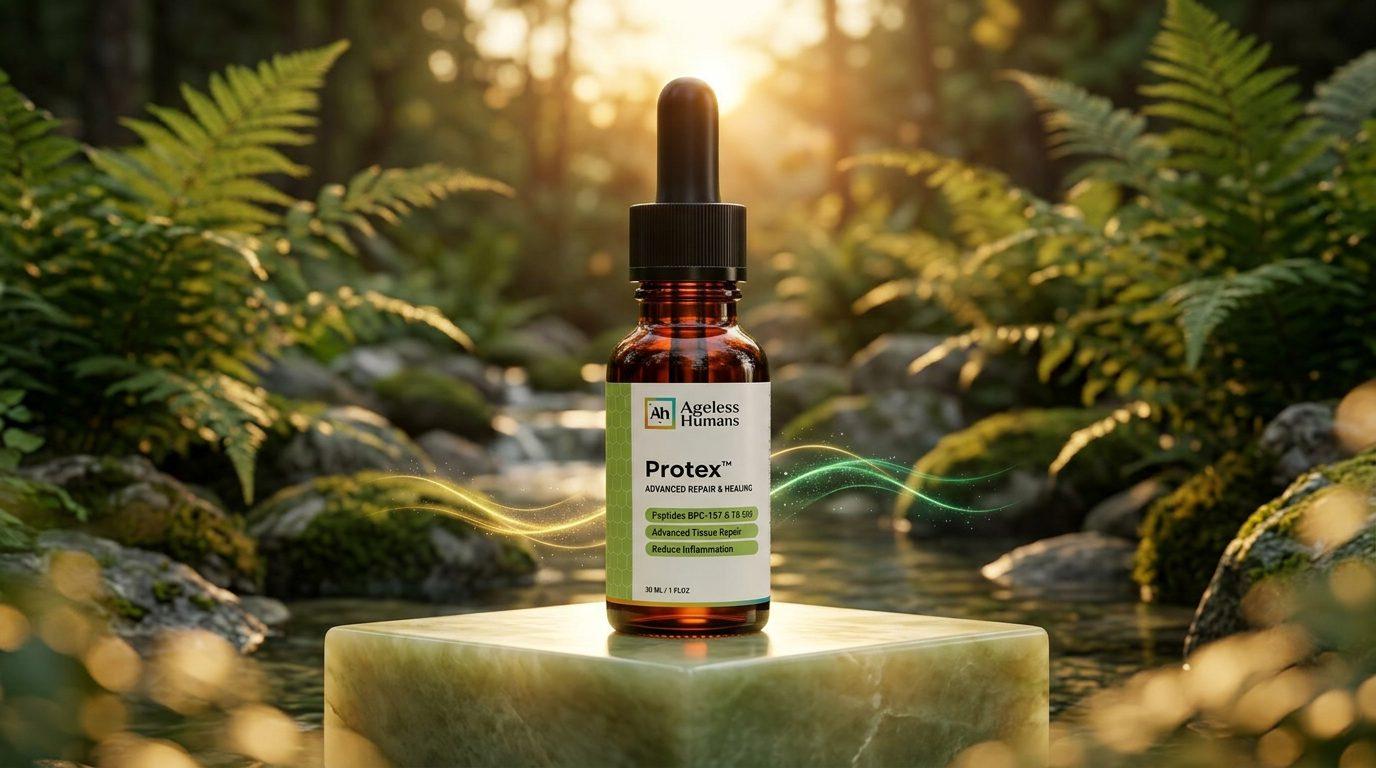
If what draws you to TRH is the broader interest in peptides for recovery, the more practical path is a product built for oral use and made to a verified standard. Ageless Humans does not sell TRH. Our PROTEX oral BPC-157 and TB-500 peptides are a different compound family, formulated to help support the body's natural recovery processes, and they are not a substitute for TRH. For people building a structured daily routine around healthy aging, the Metamorphic Anti-Aging Protocol offers a multi-part approach designed to support energy and cellular health.
Every Ageless Humans product is made in our FDA-registered facility in Carlsbad, California, and every lot is third-party lab tested with a Certificate of Analysis, backed by a 60-day money-back guarantee. That level of verification is exactly what's missing from the grey-market TRH sold online.
Frequently asked questions
What is TRH (thyrotropin-releasing hormone)?+
TRH is a three-amino-acid peptide produced in the hypothalamus. It signals the pituitary gland to release thyroid-stimulating hormone (TSH) and prolactin. It sits at the top of the hypothalamic-pituitary-thyroid axis, which helps regulate thyroid hormone levels.
Is thyrotropin the same as TRH?+
No. Thyrotropin is another name for TSH, the hormone released by the pituitary gland. TRH is thyrotropin-releasing hormone, the hypothalamic peptide that tells the pituitary to release thyrotropin. TRH is also known as protirelin or thyroliberin.
What are the benefits of TRH?+
TRH's established role is physiological: it drives TSH and prolactin release and helps regulate the thyroid axis. Researchers have also studied it as a brain neuromodulator for effects on alertness, mood, and nerve cell protection, but that research is mostly preliminary. There is no solid evidence supporting TRH as an energy, weight, or anti-aging supplement for healthy people.
Does TRH work if taken orally?+
Oral TRH faces major barriers. The peptide is degraded quickly by enzymes, has a very short half-life in the blood, and crosses into the brain poorly. Most TRH research has used injection or specialized delivery methods, so results from those studies don't apply to oral products.
Is TRH safe or legal to buy as a supplement?+
TRH is not sold as a legal dietary supplement in the U.S.; it has a pharmaceutical history under the name protirelin. Products sold online as TRH are usually labeled research chemicals with no guarantee of purity or dose. Because TRH acts directly on a hormone axis, anyone curious about it should talk with a qualified healthcare professional.
What are TRH analogs?+
TRH analogs are modified versions of the peptide designed to last longer in the body and reach the brain more effectively than natural TRH. At least one analog, taltirelin, has been approved in Japan for a neurological indication. Analog approvals apply to those specific drugs, not to TRH itself.