
B7-33 is a short, single-chain peptide derived from the hormone relaxin-2. It was designed to activate relaxin's receptor (RXFP1) in a more selective way. Research has studied it mainly in cell and rodent models of tissue fibrosis, especially in the heart, lungs, and kidneys. Those early results are promising, but B7-33 has no published human clinical trials and is not approved for human use.
What Is B7-33?
B7-33 is a lab-designed fragment of relaxin-2, a natural human hormone, built to keep relaxin's most useful signaling while being far simpler to make. Researchers at Australia's Florey Institute first described it in the mid-2010s. Its name comes from the part of relaxin's B-chain it is based on.
The parent hormone matters here. Relaxin-2 is best known as a pregnancy hormone. It helps loosen connective tissue and relax blood vessels. Outside pregnancy, scientists became interested in it because it appears to influence how tissues lay down and break down collagen. Collagen is the structural protein that builds up when tissue becomes stiff and scarred.
The problem is that native relaxin is hard to work with. It has two chains held together by three disulfide bonds. That makes it difficult and costly to synthesize, and it does not last long in the body. B7-33 solves part of that problem. It is a single chain, so it is much easier to produce. Researchers could then study relaxin-like activity without the full molecule.
If you are new to this category, our primer on what peptides are explains how short amino-acid chains like this act as signaling molecules.
How B7-33 Works: RXFP1 and Biased Signaling
B7-33 binds the relaxin receptor RXFP1 and preferentially switches on one signaling pathway (ERK) over another (cAMP). Scientists call this "biased" or "functionally selective" agonism, and it is the core idea behind the compound.
Here is the simple version. When full relaxin binds RXFP1, it triggers several pathways inside the cell. Two of the main ones are:
- cAMP signaling, a broad messenger pathway involved in many cell responses.
- ERK1/2 (pERK) signaling, which in cell studies is linked to relaxin's effects on fibroblasts. Fibroblasts are the cells that produce collagen.
In the original research, B7-33 activated the ERK pathway strongly but produced much weaker cAMP signaling. The hope behind that design is a cleaner tool. You keep the tissue-remodeling signal researchers care about and dial back other effects that may not be wanted.
Downstream, relaxin-family signaling has been studied for its influence on several processes:
- Collagen breakdown enzymes (MMPs): raising enzymes that help clear excess collagen.
- TGF-β1 activity: dampening a major signal that pushes fibroblasts toward scar-forming myofibroblasts.
- Nitric oxide pathways: which play a role in blood vessel relaxation.
Keep the limits in mind. These mechanisms come mostly from cell cultures and animals. A pathway that behaves one way in a dish does not always behave the same way in a human body.
What Research Has Studied B7-33 For
Almost all published B7-33 research centers on fibrosis, the stiffening and scarring of organ tissue, in laboratory and rodent models. Here is where the research has focused, stated without exaggeration.
1. Heart tissue remodeling. Researchers have studied B7-33 in mouse models of induced cardiac injury. They looked at whether it influenced scar formation and remodeling of heart tissue afterward. Reported findings suggested less fibrosis and better structural markers in treated animals.
2. Lung fibrosis models. In rodent models where lung scarring is chemically induced, B7-33 has been studied for whether it limits collagen buildup. Results in these models were described as anti-fibrotic.
3. Kidney fibrosis models. Similar work has looked at kidney tissue, again measuring collagen deposition and fibrosis markers in animals.
4. Blood vessel function. Because relaxin influences vascular tone, some research has explored B7-33's effects on arterial stiffness and vessel relaxation in animal and tissue models.
What ties these together is one question: can a relaxin-like signal help tissue keep a healthier balance between building and clearing collagen? That question has real relevance to aging, because tissue stiffening is a common feature of getting older. But "studied for" is not "proven for." Every item above is preclinical.
The Honest Evidence State: What We Know and What We Don't
B7-33 is an early-stage research compound. The evidence is encouraging in animals, but nothing yet shows it is safe or effective in people. Any source that says otherwise is ahead of the science.
What research suggests:
- B7-33 activates RXFP1 with a biased signaling profile in cell studies.
- It has shown anti-fibrotic activity in several rodent organ models.
- It is far easier to make than native relaxin, which makes it a practical research tool.
What remains unknown:
- Human efficacy. To our knowledge, no completed human clinical trials of B7-33 have been published.
- Human safety. We don't have long-term data on side effects, immune responses, or interactions.
- Dose translation. Animal doses do not convert neatly to human amounts. Any human "dose" you see online is a guess.
- Half-life and delivery. How long it stays active in the body, and by what route, is not established for people.
- Whether the receptor bias holds up in humans. Selective signaling seen in cells may not carry over cleanly into living people.
The parent hormone shows why caution matters. A synthetic form of full relaxin went through human trials for an acute cardiovascular use. Despite years of interest and some promising early signals, it did not win regulatory approval. Promising mechanisms do not guarantee results in humans.
B7-33 vs. Relaxin vs. Other Popular Peptides
B7-33 is a targeted fragment of a single hormone. It is not a general recovery peptide, and it is not interchangeable with compounds like BPC-157 or TB-500. People often lump these together online, which causes confusion.
- Relaxin-2 (full hormone): a two-chain natural hormone with broad effects on connective tissue and blood vessels. It is hard to synthesize and short-lived.
- B7-33: a single-chain relaxin fragment designed for selective RXFP1 signaling. Its research focus is fibrosis in animal models.
- BPC-157: a peptide sequence based on a protein found in gastric juice. It has been widely studied in animals for tissue recovery and works through different proposed pathways.
- TB-500: a synthetic fragment linked to thymosin beta-4, a protein involved in cell movement and tissue repair. It has also been studied mainly in animals.
These compounds act on different receptors and pathways, and they have different research histories. Overlapping words like "repair" or "recovery" don't make them equivalent.
Bioregulators are another distinct category. These are very short peptides studied for gene-level signaling in specific tissues. If that distinction interests you, read what bioregulators are.
Safety, Legality, and the Gray Market
B7-33 is not FDA-approved for any human use. Products sold online are typically labeled "for research only, not for human consumption." That label is a warning, not a loophole.
This matters for three reasons:
1. No quality standard. Research-chemical vendors are not held to dietary supplement or drug manufacturing rules. Purity, identity, and sterility can vary widely. 2. No safety record. Without human trials, nobody can tell you what side effects to expect. 3. Injectable risk. Most gray-market B7-33 is sold as a powder for injection. Handling, sterility, and contamination add risks on top of the unknowns about the compound itself.
If you're curious about B7-33 for a health goal, talk with a licensed clinician first. A qualified professional can help you weigh your situation against what the research does and does not support.
How to Read B7-33 Claims Online
Treat any claim that B7-33 "heals," "reverses aging," or comes with a specific human dose as a red flag. The research simply doesn't support those statements yet.
Use this quick checklist when you evaluate a source:
- Does it say the studies were in animals? Honest sources clearly label preclinical work.
- Does it give a human dose? Since no human dosing has been established, a confident dose claim is a guess.
- Does it lean on testimonials? Personal stories can't separate real effects from placebo, other habits, or chance.
- Is it selling the compound? Vendors have a direct incentive to stretch early findings.
- Does it show third-party testing? Even for legal products, a certificate of analysis (COA) is the minimum standard for knowing what's inside.
For a quick reference view of this compound, see our B7-33 peptide overview page.
Where Ageless Humans Fits In
Ageless Humans does not sell B7-33. We cover it because our readers ask about it, and because good decisions start with honest information.
What we do make are supplements built for daily support. They are made in our FDA-registered facility in Carlsbad, California. Every lot is third-party lab tested with a COA, and every product is backed by a 60-day money-back guarantee.
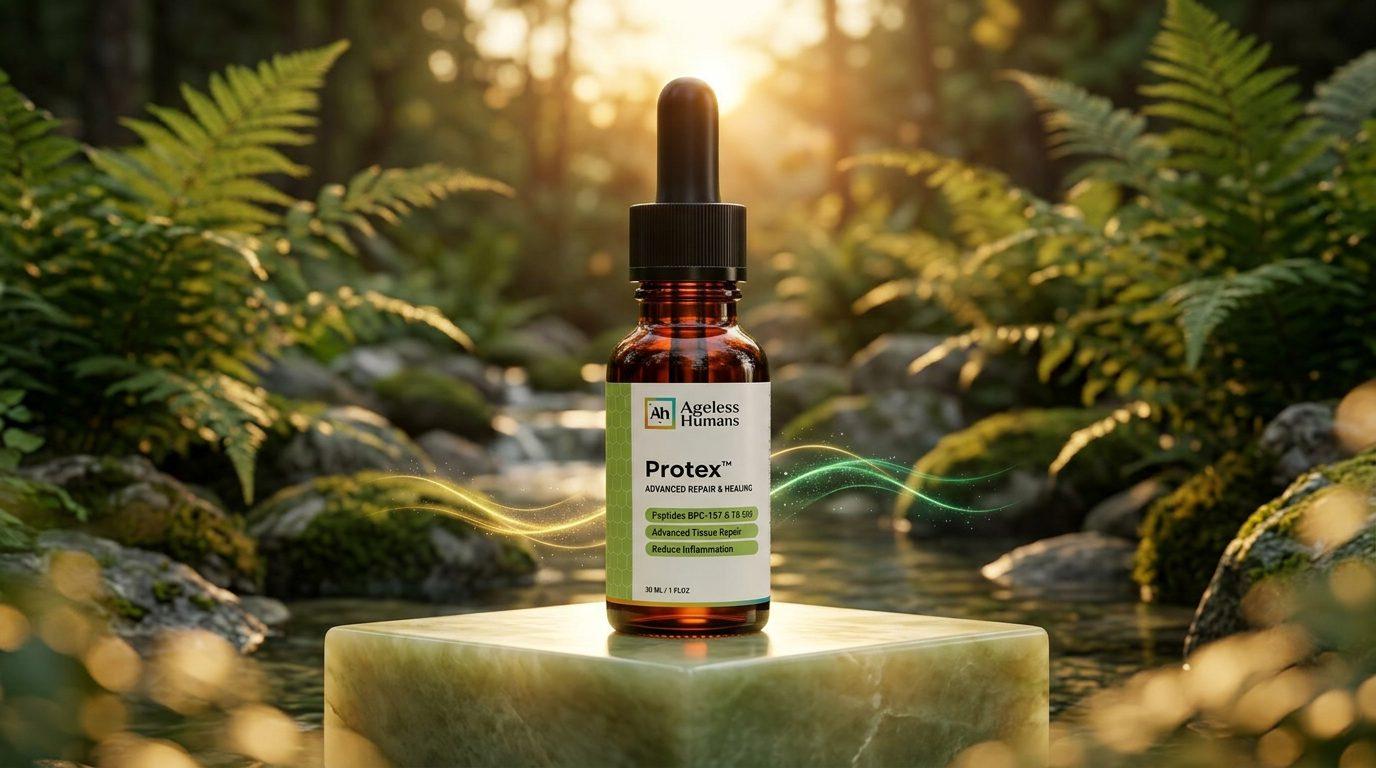
If oral peptide formulas interest you, Protex BPC-157 & TB-500 oral peptides is designed to support recovery as part of an active lifestyle. It is a different formula with a different purpose than B7-33, and it is not a substitute for it. For a broader routine, the Metamorphic Anti-Aging Protocol brings together a structured system for supporting daily energy and healthy aging. Use either one as directed on the label.
Frequently asked questions
What is B7-33?+
B7-33 is a synthetic single-chain peptide derived from the B-chain of human relaxin-2, a natural hormone. Researchers designed it to activate relaxin's receptor, RXFP1, while being much easier to manufacture than the full two-chain hormone. It is a research compound and is not approved for human use.
What are the benefits of B7-33?+
B7-33 has been studied mainly for anti-fibrotic effects, meaning reduced collagen buildup and tissue scarring, in rodent models of heart, lung, and kidney injury. Those preclinical results are promising, but they have not been confirmed in humans. No benefits for people have been established.
How does B7-33 work?+
B7-33 binds the RXFP1 receptor and preferentially activates the ERK signaling pathway over the cAMP pathway, a pattern called biased agonism. In lab studies, this signaling is linked to effects on collagen-producing cells and on enzymes that break down excess collagen. These mechanisms come from cell and animal research, not human trials.
Has B7-33 been tested in humans?+
To our knowledge, no completed human clinical trials of B7-33 have been published. The available research consists of cell studies and rodent models. Human safety, effectiveness, and dosing remain unknown.
Is B7-33 the same as BPC-157 or TB-500?+
No. B7-33 is a relaxin-derived peptide that acts on the RXFP1 receptor. BPC-157 and TB-500 come from different parent proteins and work through different proposed pathways. They are often grouped together online, but they are not interchangeable.
Is B7-33 legal to buy?+
B7-33 is not FDA-approved for any human use. It is usually sold as a research chemical labeled not for human consumption. Products in that market are not held to supplement or drug manufacturing standards, so purity and safety can vary widely.