
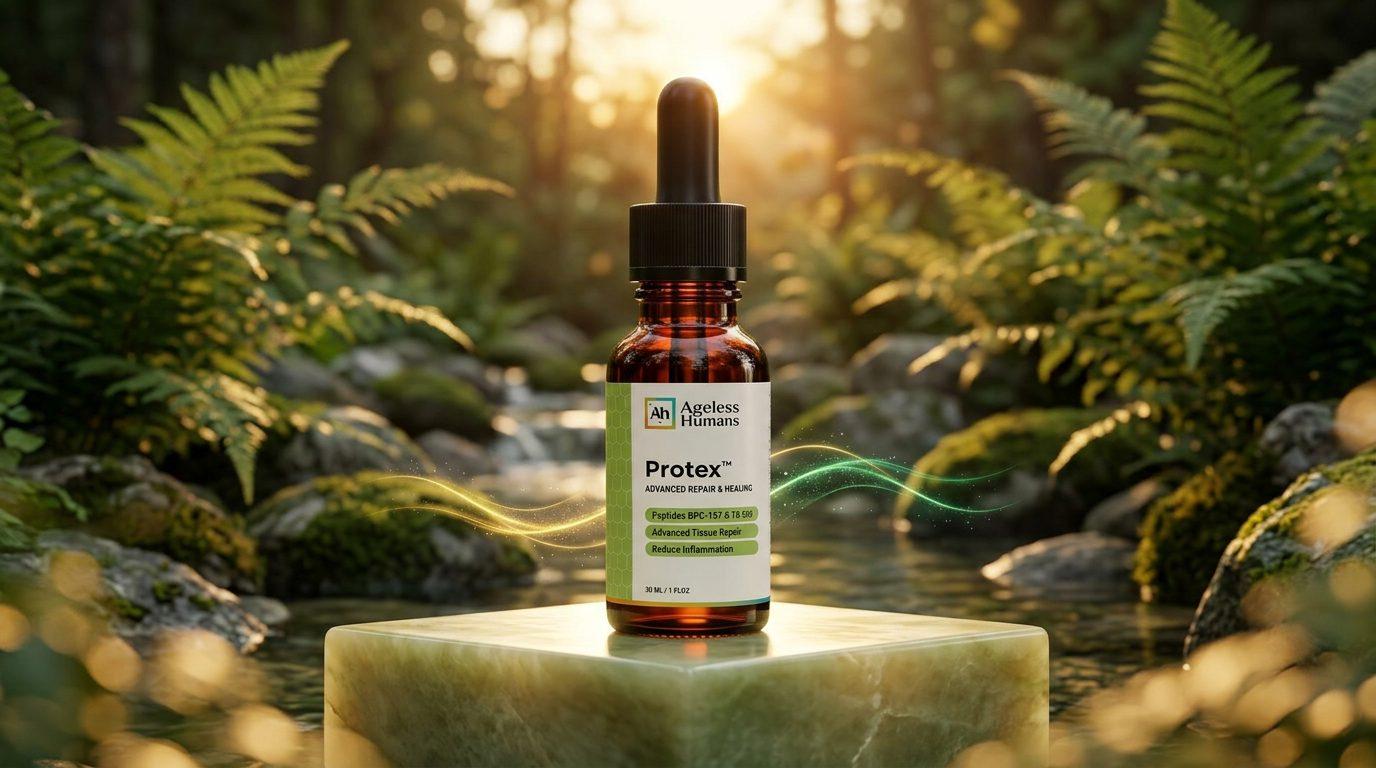
BPC-157 and TB-500 are stacked because they are studied for different, complementary steps in the body's natural repair process. BPC-157 is researched mainly for local signaling, including blood-vessel and growth-factor activity, while TB-500, a fragment of thymosin beta-4, is researched for helping cells move into an area by regulating actin. Most of the evidence comes from cell and animal studies, so the stack rests on mechanistic logic rather than proven human outcomes.
What Is the BPC-157 and TB-500 Stack?
The stack is the two peptides taken during the same period, usually to support recovery from hard training or physical strain. People combine them because each one is studied for a different part of the repair process, not because they do the same thing.
BPC-157 (Body Protection Compound-157) is a 15-amino-acid peptide derived from a protein found in human gastric juice. For a full primer, see our guide on what BPC-157 is and how it works.
TB-500 is a synthetic peptide modeled on the active region of thymosin beta-4, a 43-amino-acid protein found in nearly every cell in the body. Note the naming: most published research studies thymosin beta-4 itself or its fragments. TB-500 is the label the supplement and research-peptide market uses for the synthetic version.
BPC-157: The Local Signaling Side
BPC-157 is studied mostly for how it influences signaling at the site of tissue stress, especially blood supply and the activity of connective-tissue cells. Researchers often call it a cytoprotective peptide, meaning it is studied for helping cells maintain their integrity under stress.
In cell and animal research, BPC-157 has been linked to several pathways:
- Nitric oxide signaling, which helps regulate blood flow
- VEGF receptor activity, a pathway involved in forming new small blood vessels (angiogenesis)
- Tendon fibroblast behavior, including outgrowth and migration in lab studies
- Growth hormone receptor expression in tendon cells, studied as a way cells may become more responsive to repair signals
BPC-157 has been studied in animal models of tendon, ligament, muscle, and gut-lining stress. The common thread: it appears to shape the local environment so repair signals and nutrients can reach the tissue. Think of it as the supply-line peptide.
TB-500: The Cell Movement Side
TB-500 is studied mainly for supporting cell migration, the process that moves repair cells to where they are needed. That role comes from thymosin beta-4's best-understood job: binding G-actin, the building block of the cell's internal skeleton.
Cells crawl by building and breaking down actin filaments. By managing the pool of available actin, thymosin beta-4 influences how readily cells such as skin cells and the cells lining blood vessels can move and reorganize. It is found in high amounts in blood platelets, which gather at sites of tissue damage.
Research on thymosin beta-4 spans skin, eye surface, and heart tissue models, along with work on inflammatory signaling and new blood-vessel formation. Where BPC-157 is the supply-line peptide, TB-500 is the crew-mobilization peptide: it is studied for helping the right cells show up and get to work.
Why They're Studied Together: Complementary Mechanisms
The two are paired because their mechanisms appear to cover different stages of repair with only partial overlap. In theory, combining them addresses more of the process than either one alone.
Picture rebuilding a damaged road. You need supply routes to bring in materials, and you need crews to arrive and do the work. Research suggests:
- BPC-157 leans toward local signaling, blood flow, and connective-tissue cell activity, which is the supply side.
- TB-500 leans toward actin regulation and cell migration, which is the crew side.
- Both have been studied for blood-vessel formation and inflammatory balance, which is where they overlap.
There is also a practical difference people point to. BPC-157 research often focuses on effects near the tissue being studied, while thymosin beta-4 is a naturally circulating protein involved in processes throughout the body. Stackers often describe the pair as one targeted peptide and one systemic peptide.
The honest caveat: no published human trial has tested BPC-157 and TB-500 together. The case for stacking comes from reasoning about how each works on its own, not from data showing the combination performs better.
What the Research Does and Does Not Show
The research is promising at the mechanism level but thin in humans. Anyone considering the stack should know where the evidence actually stands.
What research suggests:
- BPC-157 shows consistent activity in rodent and cell studies of connective tissue and gut lining.
- BPC-157 has shown stability in gastric juice in lab research, which is unusual for a peptide.
- Thymosin beta-4 has a well-characterized role in actin regulation and cell migration.
- Thymosin beta-4 itself has been explored in early human research for narrow applications. Those findings do not automatically apply to TB-500 supplements.
What research has not established:
- Long-term safety of either peptide in healthy adults
- Whether the combination adds benefit over either alone
- How well TB-500 is absorbed when taken by mouth
- How animal results translate to human recovery
Regulatory context: neither peptide is an FDA-approved drug, and both appear on the World Anti-Doping Agency prohibited list. That matters for anyone in tested sport.
Who Stacks BPC-157 and TB-500 (and Who Should Skip It)
The stack is most popular with active adults who train hard and want to support their body's natural recovery. Common users include:
- Lifters and endurance athletes in demanding training blocks who are not subject to drug testing
- Adults over 40 who notice recovery between sessions takes longer than it used to
- Weekend athletes balancing physical hobbies with desk jobs
- People in a rebuild phase who are returning to training and working with a coach or clinician
Who should skip it or talk to a clinician first:
- Drug-tested athletes. Both peptides are prohibited under WADA rules.
- Anyone pregnant, nursing, or under 18
- People with a personal history of cancer or abnormal growths. Both peptides are studied for blood-vessel formation and cell migration, which raises theoretical questions no one has resolved.
- Anyone taking prescription medications or managing a health condition
One more point: a peptide stack is not a substitute for getting a real injury evaluated. Pain that is sharp, persistent, or getting worse needs a professional assessment.
Oral vs. Injectable Stacks
Oral stacks trade some research precedent for convenience, consistency, and no needles. Much of the animal research used injection, but BPC-157 stands out among peptides for its stability in gastric acid in lab studies, and some animal research has used oral routes. Our breakdown of oral BPC-157 vs. injection covers the tradeoffs in detail.
TB-500 is less clear. Oral absorption data for it is limited, and we would rather say so plainly than overstate it.
What oral formats offer is practical:
- No reconstitution, syringes, or sterile prep
- A consistent, manufactured amount per serving instead of hand-measured doses
- Easier daily consistency, which is often what separates a routine people stick with from one they quit
For people who want both peptides in one simple format, Protex BPC-157 and TB-500 oral peptides combine the stack into a single daily product.
How to Build a Smarter Recovery Routine Around the Stack
Peptides work best as one layer of a recovery routine, not the whole thing. The fundamentals still decide most of how you feel after hard training.
- Follow label directions exactly. More is not better, and nothing here replaces the label.
- Prioritize sleep and protein. Tissue repair runs on both.
- Load progressively. Connective tissue adapts to gradual increases in demand, not sudden jumps.
- Track something concrete, such as morning stiffness, readiness to train, or session quality, so you can judge honestly whether your routine is helping.
- Demand proof of quality. Peptides are easy to underdose or contaminate. Look for third-party testing with a certificate of analysis (COA) for every lot.
Every Ageless Humans product is made in our FDA-registered facility in Carlsbad, California, and every lot is third-party lab tested with a COA. If you want a broader foundation, The Recovery Starter Pack brings several recovery-focused products together. Everything is backed by a 60-day money-back guarantee.
Frequently asked questions
Why are BPC-157 and TB-500 taken together?+
BPC-157 and TB-500 are taken together because they are studied for different steps in the body's repair process. BPC-157 is researched for local signaling such as blood flow and connective-tissue cell activity. TB-500 is researched for supporting cell migration through actin regulation. No human trial has tested the combination, so the reasoning comes from how each works on its own.
What is the difference between BPC-157 and TB-500?+
BPC-157 is a 15-amino-acid peptide derived from a protein in human gastric juice and is studied mainly for local tissue signaling and blood-vessel activity. TB-500 is a synthetic peptide based on thymosin beta-4, a protein found in nearly all cells, and is studied mainly for its role in cell movement. Many people describe BPC-157 as the targeted peptide and TB-500 as the systemic one.
Is TB-500 the same as thymosin beta-4?+
No. TB-500 is a synthetic peptide modeled on the active region of thymosin beta-4, which is a naturally occurring 43-amino-acid protein. Most published research studies thymosin beta-4 itself or its fragments. Findings on the natural protein do not automatically apply to TB-500 products.
Is it safe to stack BPC-157 and TB-500?+
Long-term safety of BPC-157 and TB-500, alone or together, has not been established in human studies. Most research is in cells and animals. People who are pregnant, nursing, under 18, taking medications, or have a personal history of cancer should talk with a clinician before using either peptide. Anyone else should follow label directions exactly.
Can you take BPC-157 and TB-500 orally?+
Yes, oral BPC-157 and TB-500 products exist. BPC-157 has shown unusual stability in gastric juice in lab research, and some animal studies have used oral routes. Oral absorption data for TB-500 is more limited. Oral formats appeal to people who want a consistent daily serving without needles or reconstitution.
Are BPC-157 and TB-500 banned in sports?+
Yes. Both BPC-157 and TB-500 appear on the World Anti-Doping Agency prohibited list. Athletes subject to drug testing under WADA-aligned rules should not use either peptide. Neither is an FDA-approved drug.