
Cortagen is a synthetic tetrapeptide (Ala-Glu-Asp-Pro) developed by Russian gerontology researchers as a short-chain 'bioregulator' modeled on brain-cortex peptide extracts. It has been studied mainly in cell and animal models for nerve tissue regeneration, cortical cell function, antioxidant activity, and gene expression. Large, independent human trials are lacking, so its benefits remain unproven in people.
What Is Cortagen?
Cortagen is a short synthetic peptide made of four amino acids: alanine, glutamic acid, aspartic acid, and proline (often written AEDP). It belongs to a class of compounds called peptide bioregulators, which are short chains of amino acids proposed to support the normal function of specific tissues.
Cortagen came out of the St. Petersburg Institute of Bioregulation and Gerontology in Russia, the lab group led by Professor Vladimir Khavinson. That group spent decades studying peptide extracts taken from animal organs, then designing small synthetic peptides meant to copy the activity of those extracts. Cortagen was designed with reference to Cortexin, a polypeptide complex extracted from animal cerebral cortex. That origin explains why Cortagen is usually discussed as a 'brain' or 'nervous system' bioregulator.
If you want a quick reference card on the compound itself, see our Cortagen peptide overview. This article goes deeper into the research and its limits.
Where Cortagen Fits: The Bioregulator Idea
Cortagen is one of a family of Khavinson peptides, each tied to a target tissue. The theory behind the family is that very short peptides, usually two to four amino acids long, can act as signals that help tissues maintain their normal patterns of protein production. Other well-known members include peptides associated with the pineal gland, thymus, and blood vessels.
This is different from how most people first learn about peptides. Many popular peptides are longer chains that bind to cell-surface receptors, like a key fitting a lock. Bioregulators are proposed to work further upstream, at the level of gene expression. If you're new to the basics, start with what peptides are and how they work, then read our primer on what bioregulators are.
The key point for understanding Cortagen: nearly everything known about it comes from the same research tradition that created it. That isn't a reason to dismiss it. It is a reason to read the claims carefully.
What Has Research Studied Cortagen For?
Published Cortagen research falls into a handful of areas, almost all in lab or animal settings. Here's what investigators have looked at:
- Nerve tissue regeneration. Some of the most cited Cortagen work examined peripheral nerve recovery in rat injury models. Researchers reported signs of supported nerve fiber regrowth and function, which is where much of the 'neuro-repair' reputation comes from.
- Cortical and brain cell function. Given its link to cortex extracts, Cortagen has been studied for effects on neural cells in culture and on brain tissue activity in animals.
- Gene expression in other tissues. Interestingly, some studies looked at how Cortagen influenced gene activity in heart tissue of mice. This work is often used to support the broader idea that short peptides can shift gene expression patterns.
- Antioxidant activity. Research has explored whether Cortagen influences free-radical processes and the body's own antioxidant enzymes in animal models.
- Aging models. As with other Khavinson peptides, Cortagen has been included in research on tissue function in aging animals.
What's missing from this list matters as much as what's on it. There are no large, independent, placebo-controlled human trials establishing what Cortagen does in people.
How Is Cortagen Thought to Work?
The leading hypothesis is that Cortagen interacts with DNA or chromatin to help regulate which genes are switched on in a cell. Because it is only four amino acids long, researchers in this field propose it is small enough to reach the cell nucleus, something larger proteins generally cannot do on their own.
The proposed chain of events looks like this:
1. The peptide enters the cell. 2. It binds to specific regions of DNA or associated proteins. 3. That binding influences the expression of genes involved in normal tissue maintenance, such as those tied to cell growth, repair, or stress responses.
Some studies report changes in the expression of many genes after Cortagen exposure, which supporters point to as evidence of this mechanism. Here's the honest caveat: showing that gene expression shifts in a lab is not the same as showing a meaningful benefit in a living person. The mechanism is plausible and interesting, but it has not been confirmed by broad independent research. Treat it as a working hypothesis, not settled biology.
The Honest Evidence State: What Research Does and Doesn't Show
Cortagen research is early-stage: suggestive in animals and cells, unproven in humans. Here's a clear breakdown.
What research suggests:
- Cortagen has measurable biological activity in cell and animal models.
- It has been associated with supported nerve fiber recovery in rodent injury studies.
- It appears to influence gene expression patterns in several tissues.
What research does not show:
- That Cortagen supports memory, focus, or brain health in healthy adults.
- That results in rodents carry over to people at any amount.
- That the findings hold up when tested by labs outside the originating research group.
- That it's safe for long-term use, since long-term human safety data is thin.
Two factors shape how you should weigh this. First, much of the literature comes from one research network, and some of it was published in Russian-language journals that are harder to evaluate. Second, small animal studies routinely fail to translate to humans across all of biology, not just peptides. Neither fact proves Cortagen doesn't work. Together, they mean nobody can honestly promise you a specific benefit.
Safety, Quality, and Legal Reality
Cortagen is not an FDA-approved drug, and in the U.S. it is generally sold through gray-market 'research chemical' channels. That has real consequences for anyone considering it.
Research-chemical products are typically labeled 'not for human consumption.' That label often means there's no guarantee of what's in the vial. Purity, identity, sterility, and actual peptide content can vary from seller to seller, and independent verification is often missing or hard to confirm. A peptide that's genuinely interesting in research can still be a risky purchase if you can't verify what you're getting.
If you're curious about Cortagen, the responsible move is to talk with a qualified healthcare professional who knows your history, especially if you take medications, are pregnant or nursing, or have an ongoing health condition. Don't rely on forum dosing protocols or vendor claims.
How to Read Cortagen Claims Online
Be skeptical of any source that promises specific results from Cortagen. Because human evidence is limited, confident claims usually outrun the science. Watch for these red flags:
- Disease language. Any seller claiming Cortagen treats, cures, or reverses a medical condition is making claims the research doesn't support.
- Precise numbers with no source. Percentages and 'proven' outcomes without a traceable study should be ignored.
- Human-sounding results from animal data. 'Regenerates nerves' often means 'supported nerve recovery in rats.' Those aren't the same claim.
- Dosing charts. There's no established, regulator-reviewed human dose. Protocols you see online are guesswork.
- No testing documentation. If a vendor can't show third-party lab results for the specific lot, you can't know what's inside.
A good rule: the more certain the claim, the less you should trust it. Honest sources about Cortagen sound cautious, because the evidence is cautious.
Ageless Humans Does Not Sell Cortagen. Here's What We Do Offer
To be clear: Ageless Humans does not make or sell Cortagen. This article is education only, written because people ask about it and deserve a straight answer.
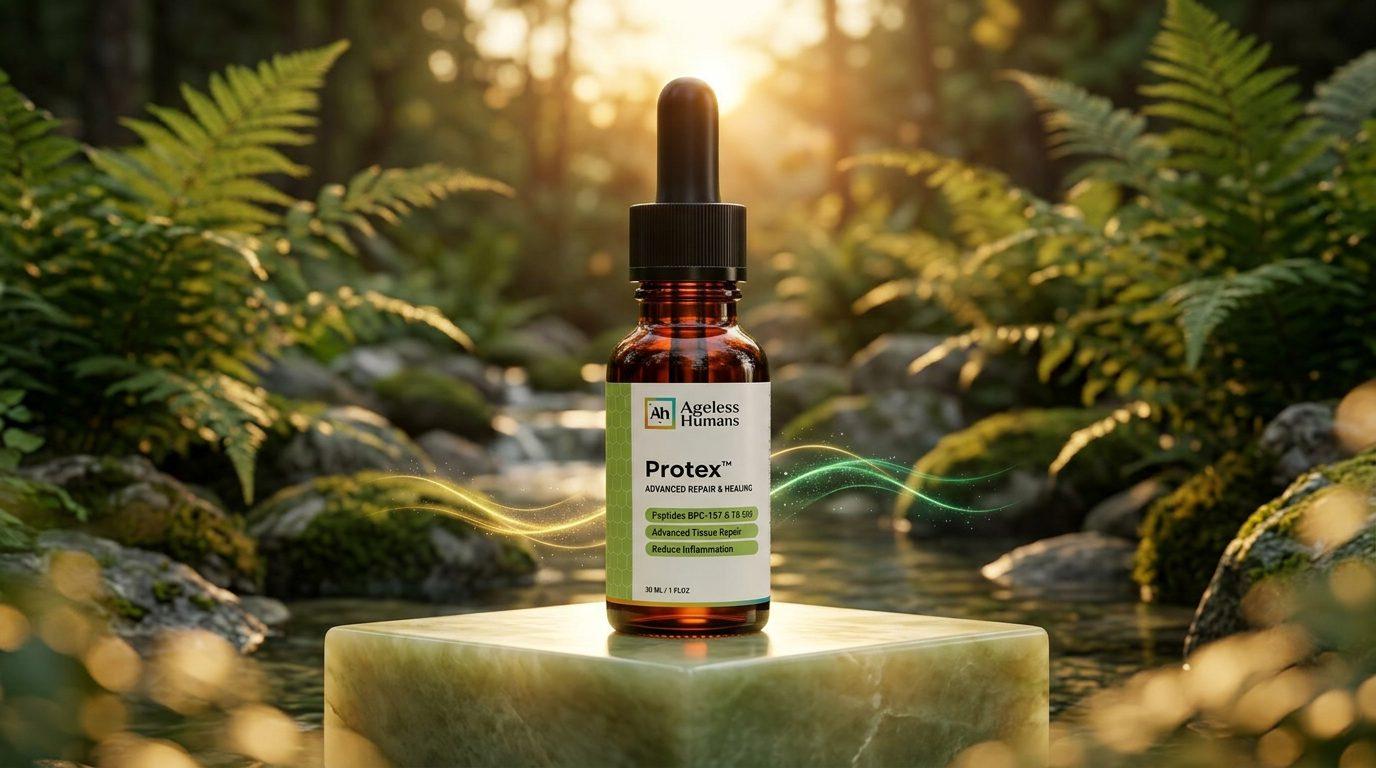
If what draws you to Cortagen is an interest in peptides and supporting your body's natural repair and recovery processes, we make products in that broader space. They are different compounds with different ingredients, and they are not substitutes for or equivalents of Cortagen. For example, Protex BPC-157 and TB-500 Oral is our oral peptide formula designed to support recovery, and the Metamorphic Anti-Aging Protocol is a structured routine for people who want a system-level approach to healthy aging.
What we can promise is how they're made. Every product is manufactured in our FDA-registered facility in Carlsbad, California, every lot is third-party lab tested with a Certificate of Analysis, and everything is backed by a 60-day money-back guarantee. That's the opposite of the unverified vial problem described above.
Frequently asked questions
What is Cortagen?+
Cortagen is a synthetic tetrapeptide made of four amino acids: alanine, glutamic acid, aspartic acid, and proline (AEDP). It was developed by Vladimir Khavinson's research group in St. Petersburg, Russia, as a peptide bioregulator modeled on brain-cortex peptide extracts. It is mainly discussed in connection with nervous system tissue.
What are the benefits of Cortagen?+
Cortagen's potential benefits are not established in humans. In cell and animal studies, it has been studied for supporting nerve tissue recovery, cortical cell function, antioxidant activity, and gene expression. Large, independent human trials are lacking, so no specific benefit in people has been confirmed.
How does Cortagen work?+
The leading hypothesis is that Cortagen, being very small, can enter cells and interact with DNA or chromatin to influence which genes are expressed. Supporters suggest this helps tissues maintain normal function. This mechanism is plausible but has not been confirmed by broad independent research.
Is Cortagen FDA approved?+
No. Cortagen is not an FDA-approved drug. In the U.S. it is generally sold as a 'research chemical,' often labeled not for human consumption, which means purity and content may not be verified.
What is the difference between Cortagen and Cortexin?+
Cortexin is a complex mixture of peptides extracted from animal cerebral cortex. Cortagen is a single, short synthetic peptide designed with reference to that extract. Cortagen is chemically defined and lab-made, while Cortexin is a natural extract with many components.
Does Ageless Humans sell Cortagen?+
No. Ageless Humans does not make or sell Cortagen, and its articles on Cortagen are for education only. The brand makes other peptide and healthy-aging products, such as an oral BPC-157 and TB-500 formula, which are different compounds and not equivalents of Cortagen.