
NMN and niacinamide are both NAD+ precursors that feed the same recycling route, the salvage pathway, but they enter at different points. Niacinamide (nicotinamide) has to pass through NAMPT, the pathway's rate-limiting enzyme, while NMN enters one step after that bottleneck. Niacinamide is also the molecule sirtuins release when they work, and it can slow them in lab settings. If your goal is NAD+ support for healthy aging and cellular energy, NMN is the more direct choice. Niacinamide remains a cheap, well-established form of vitamin B3 for basic nutritional needs.
The Short Answer: Two Cousins, One Pathway
NMN and niacinamide are not competitors in kind. They are two stops on the same assembly line. Your cells make most of their NAD+ by recycling, not by building it from scratch. That recycling loop is called the salvage pathway. Niacinamide sits at the start of the loop. NMN sits one step closer to the finished product.
That single step matters for three reasons:
- The bottleneck. Niacinamide must be converted by NAMPT, the slowest, most tightly regulated enzyme in the loop. NMN has already cleared it.
- The feedback signal. Niacinamide is the byproduct sirtuins release when they consume NAD+, and it can act as a brake on them, at least in lab studies.
- Cost and history. Niacinamide is inexpensive and has been a standard vitamin B3 form in multivitamins and fortified foods for decades. NMN is a newer, more targeted ingredient.
People confuse the two because both are "vitamin B3 relatives" and both appear in NAD+ conversations. The rest of this article explains what each one actually does once you swallow it, and where the research is solid or still open.
What Niacinamide Is, and What It Isn't
Niacinamide is the amide form of vitamin B3, also sold as nicotinamide (NAM). These are two names for one molecule. It is different from niacin (nicotinic acid), the B3 form known for causing skin flushing. Niacinamide does not typically cause that flush, which is a big reason it became the default B3 in many multivitamins.
The naming causes real confusion, so here is the family at a glance:
- Niacin (nicotinic acid): a B3 form that enters NAD+ production through a separate route, the Preiss-Handler pathway. It is known for flushing.
- Niacinamide / nicotinamide (NAM): a B3 form that enters the salvage pathway at its very first step.
- Nicotinamide riboside (NR): a B3-related compound that is converted to NMN by NRK enzymes, which lets it bypass NAMPT.
- Nicotinamide mononucleotide (NMN): the direct precursor that becomes NAD+ in one enzymatic step.
You may also know niacinamide from skincare. Topical niacinamide is a popular cosmetic ingredient, but what a serum does on your skin tells you nothing about how oral niacinamide behaves inside your cells. Keep those two conversations separate.
If you're weighing NMN against its closer cousin, see our full breakdown of NMN vs NR. That comparison is about two bypass routes. This one is about the bottleneck itself.
The Salvage Pathway: Exactly Where Each One Enters
Niacinamide enters before the NAMPT bottleneck. NMN enters after it. Here is the simplified route:
1. Niacinamide (NAM) is converted by NAMPT into NMN. 2. NMN is converted by NMNAT enzymes into NAD+. 3. Cells spend NAD+ on enzymes such as sirtuins, PARPs, and CD38, which releases niacinamide. 4. That niacinamide loops back to step 1.
NAMPT is widely described as the rate-limiting step of this loop. It sets the pace for how fast the cell can turn niacinamide back into usable NAD+. Research suggests NAMPT activity and overall NAD+ levels tend to decline with age in many tissues. If that is the slow gate, adding more niacinamide at the front of the line may not move things as efficiently as you would expect.
NMN skips that gate. That is the core mechanistic argument for NMN: it supplies the molecule NAMPT would have produced, so the body needs only one more step to make NAD+.
One honest caveat applies. Scientists still debate how NMN gets into cells. Some mouse research points to a dedicated transporter that may take NMN in intact. Other work suggests NMN is partly converted to NR outside the cell, enters, and is converted back to NMN inside. Either way, NMN still lands downstream of NAMPT, so the bypass logic holds even while the transport details are being worked out.
The Sirtuin-Inhibition Debate Around High-Dose Niacinamide
Niacinamide is a known sirtuin inhibitor in lab settings, but whether ordinary oral intake meaningfully dampens sirtuins in the human body is unresolved. This is the most cited reason longevity-focused people lean toward NMN, so it is worth getting the nuance right.
What is well established: Sirtuins are NAD+-dependent enzymes studied for their role in cellular maintenance, metabolism, and stress responses. When a sirtuin does its job, it splits NAD+ and releases niacinamide. In test tubes and cell studies, rising niacinamide concentrations slow sirtuin activity. This is classic product inhibition, a built-in feedback brake.
What is debated: Inside a living cell, niacinamide does not just sit there. It is steadily recycled back into NAD+, which sirtuins need. So two forces pull in opposite directions. More niacinamide can mean more brake, and it can also mean more fuel after it is recycled. Some researchers argue the recycling effect dominates at normal intakes. Others caution that very high intakes could raise niacinamide concentrations enough to matter, especially if NAMPT is already the slow step.
What it means for you: The concern is mostly about high-dose niacinamide, meaning amounts far beyond what a multivitamin supplies. At typical nutritional levels, niacinamide is a well-established B3 source. If your specific goal is supporting NAD+ and sirtuin activity, though, it is reasonable to prefer a precursor that is not also the sirtuin feedback signal. That is the case for NMN.
Other High-Dose Considerations: Methylation and Clearance
The body clears excess niacinamide partly by methylating it, and some researchers question what that means at large intakes. An enzyme called NNMT attaches a methyl group to niacinamide to form methylnicotinamide, which is then excreted. That methyl group comes from SAM, the body's main methyl donor, which is also used for many other processes.
The open question is whether routinely pushing large amounts of niacinamide through this disposal route places meaningful demand on methyl-donor supply. This is discussed in the research literature as a theoretical consideration. It is not a settled finding, so treat it as a reason for caution about megadosing, not as a verdict.
NMN can also be broken down into niacinamide during normal NAD+ turnover, so neither molecule escapes this biology entirely. The difference is one of starting point. Taking niacinamide loads the front of the line directly. Taking NMN provides material that is already past the gate.
The practical takeaway is simple. Whichever precursor you choose, follow the label directions. More is not automatically better with NAD+ precursors, and the research does not support guessing at higher amounts.
NMN vs Niacinamide: Side-by-Side
Quick comparison of the two:
- Pathway entry: Niacinamide enters before NAMPT. NMN enters after NAMPT, one step from NAD+.
- Steps to NAD+: Niacinamide takes two enzymatic steps. NMN takes one.
- Relationship to sirtuins: Niacinamide is the sirtuin byproduct and a lab-observed inhibitor. NMN is not a sirtuin byproduct.
- Flushing: Neither typically causes the flush associated with niacin.
- Research maturity: Niacinamide has a long history as a nutritional B3 form. NMN is newer, with growing human research, and much of its foundational work comes from animal studies.
- Cost: Niacinamide is very inexpensive. NMN costs more to produce at high purity.
- Best fit: Niacinamide suits basic B3 nutrition. NMN suits targeted NAD+ support for healthy aging and cellular energy.
What the research does not show: No one has established a head-to-head human ranking that settles which precursor raises NAD+ "best" across all tissues. The case for NMN rests on pathway position and the sirtuin-feedback logic. That case is strong, but it is not the same as a finished verdict, and anyone claiming one is overselling.
The Practical Pick: Which One Should You Choose?
Choose NMN if your goal is NAD+ support for healthy aging, cellular energy, and sirtuin function. Choose niacinamide if you simply want an inexpensive way to cover vitamin B3.
NMN makes more sense if:
- You are specifically interested in supporting NAD+ levels as you age.
- You want a precursor that bypasses the NAMPT bottleneck.
- You would rather not rely on the molecule that also acts as a sirtuin brake.
Niacinamide makes sense if:
- You want baseline B3 nutrition, the kind already in most multivitamins.
- Budget is your top priority and NAD+ optimization is not your goal.
You do not need to eliminate niacinamide. The modest amount in a standard multivitamin is ordinary nutrition, not the high-dose scenario researchers debate. Many people take a multivitamin and a dedicated NMN product. If you're on medication, pregnant, or managing a health condition, talk with your healthcare provider before starting any new supplement.
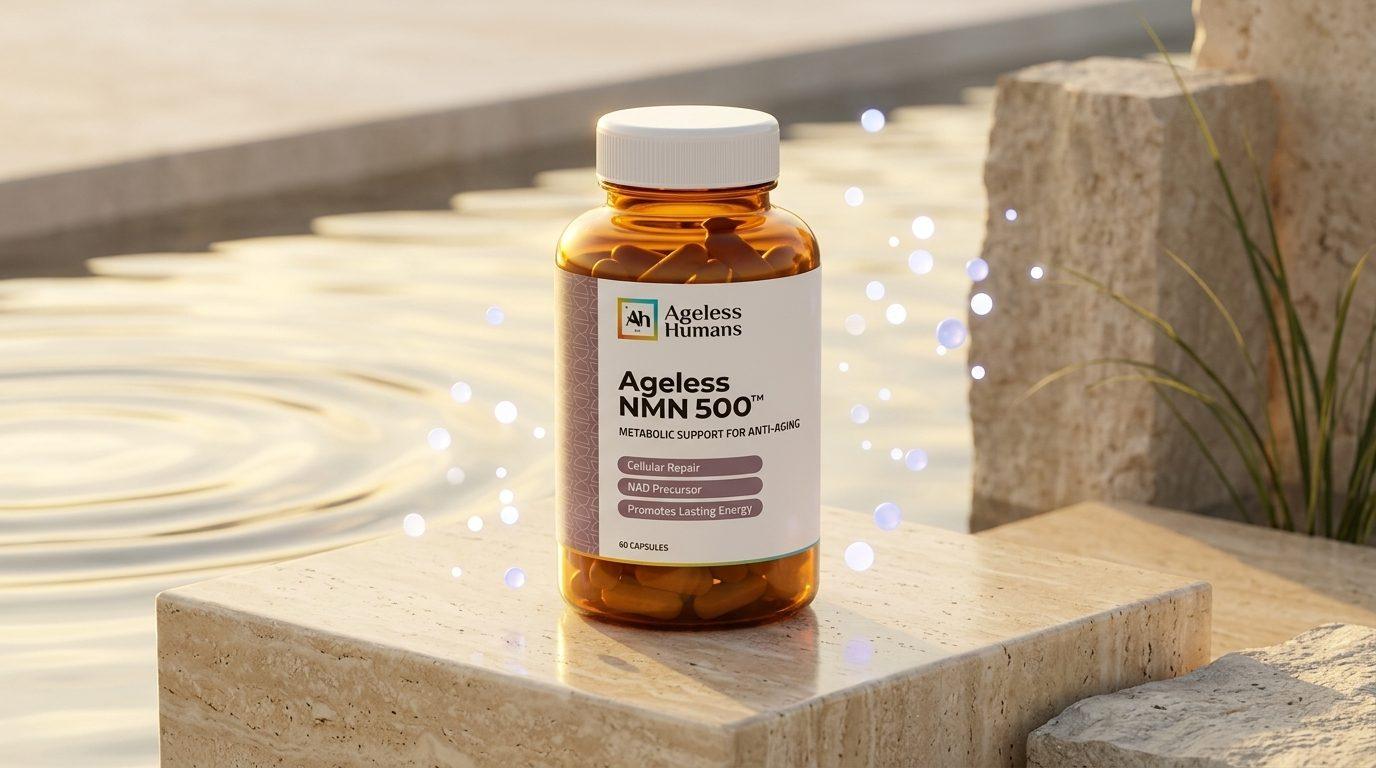
Quality matters more than the label on the front. NMN purity varies widely across the market. Look for a manufacturer that tests every lot and publishes the results. Ageless Humans makes its products in its own FDA-registered facility in Carlsbad, California. Every lot is third-party lab tested with a COA, and each product carries a 60-day money-back guarantee. If you want the straightforward version, our NMN 500 capsules deliver NMN in a simple daily format. You can also browse the full range of NAD+ and NMN supplements to compare options.
Frequently asked questions
Is niacinamide the same as NMN?+
No. Niacinamide (nicotinamide) is a form of vitamin B3, and NMN (nicotinamide mononucleotide) is a downstream molecule your body makes from it. Niacinamide has to be converted by the enzyme NAMPT to become NMN, and NMN is then converted into NAD+ in one step. They are related, but NMN sits one step closer to NAD+.
Does niacinamide inhibit sirtuins?+
In lab and cell studies, niacinamide slows sirtuin activity, because it is the byproduct sirtuins release when they use NAD+. Inside the body, niacinamide is also recycled back into NAD+, which sirtuins need, so the net effect at normal intakes is debated. The concern centers on high-dose niacinamide, not the modest amounts found in a typical multivitamin.
Why choose NMN over niacinamide for NAD+?+
NMN enters the NAD+ salvage pathway after NAMPT, the pathway's rate-limiting enzyme, so it needs only one more step to become NAD+. It is also not the sirtuin feedback molecule the way niacinamide is. For people specifically focused on supporting NAD+ levels as they age, those two features make NMN the more direct option.
Can I take NMN and niacinamide together?+
Many people take NMN alongside a multivitamin that contains niacinamide, and that small amount of niacinamide is ordinary vitamin B3 nutrition. Research does not support stacking large amounts of both. Follow each product's label directions, and check with your healthcare provider if you take medication or have a health condition.
Does niacinamide cause flushing like niacin?+
Niacinamide does not typically cause the skin flushing associated with niacin (nicotinic acid), and neither does NMN. That lack of flushing is one reason niacinamide became a common B3 form in multivitamins. Niacin and niacinamide are both vitamin B3, but they behave differently in the body.
Is NMN or NR closer to niacinamide?+
Both NMN and NR bypass NAMPT, the bottleneck enzyme that niacinamide has to pass through. NR is converted into NMN, and NMN is converted directly into NAD+. Niacinamide is the furthest upstream of the three, so NMN and NR are each more direct routes to NAD+ than niacinamide.