
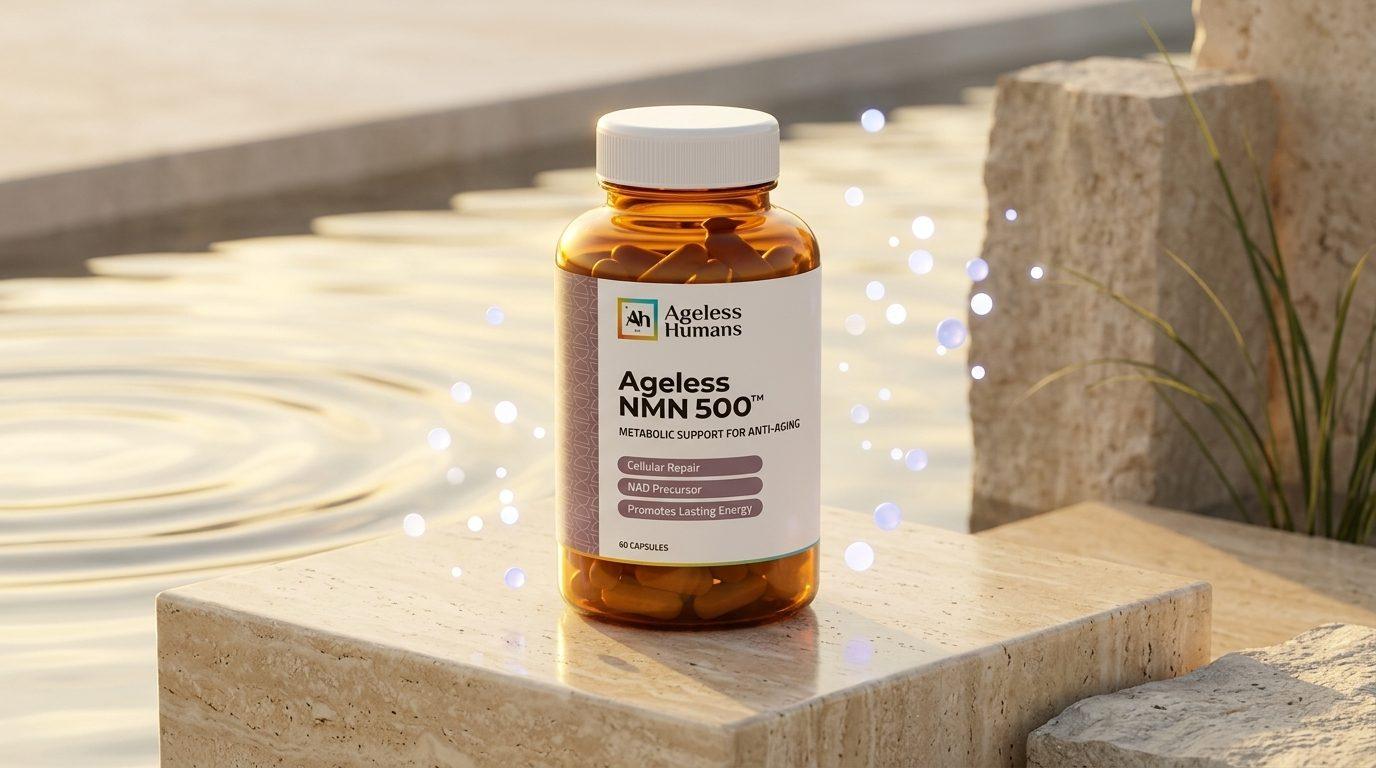
NMN and resveratrol do different jobs in the same pathway. NMN is a precursor your cells convert into NAD+, the molecule sirtuin enzymes need to function. Resveratrol is a plant compound studied for its potential to activate sirtuins more directly. If your main goal is cellular energy and NAD+ support, NMN is the more direct choice. Resveratrol is an optional add-on with weaker absorption and more debated evidence.
The Short Answer: Two Different Jobs in One Pathway
NMN is the fuel and resveratrol is the accelerator. That is the simplest accurate way to compare them. Sirtuins are a family of enzymes involved in cellular maintenance, metabolism, and stress responses. They cannot work without NAD+. NMN (nicotinamide mononucleotide) helps supply NAD+. Resveratrol has been studied as a compound that may nudge sirtuin activity upward.
The pairing became popular because Harvard researcher David Sinclair has said publicly that he takes both. His reasoning is that an accelerator does little if the tank is low, so raising NAD+ and activating sirtuins could work together. That logic makes sense, but it is a hypothesis. No large human trial has tested the combination and shown it outperforms either compound alone.
So the honest framing is this:
- NMN has a clear biochemical role: it is one step from NAD+.
- Resveratrol has a plausible but debated role: how much it directly activates sirtuins in the human body is still argued over.
- The stack follows a sound theory but has not been proven as a pair.
How NMN Works: Supplying the Raw Material for NAD+
NMN supports cellular energy by giving your cells a direct building block for NAD+. Inside the cell, an enzyme converts NMN into NAD+ in a single step. NAD+ then serves as a coenzyme in hundreds of reactions, including those that turn food into usable energy in the mitochondria. Sirtuins and PARPs, enzymes involved in DNA maintenance, also consume NAD+.
NAD+ levels have been observed to decline with age in many tissues. That observation drives interest in precursors like NMN. The goal is not to add something foreign to the body but to support a molecule your cells already make and use constantly.
NMN is one of several NAD+ precursors, along with nicotinamide riboside (NR), niacin, and nicotinamide. If you want the full picture of what NMN is studied for, see our guide to NMN benefits. If you are weighing NMN against taking NAD+ itself, our breakdown of NAD vs NMN explains why the precursor route is often preferred: whole NAD+ is a larger molecule that is generally broken down before it enters cells.
How Resveratrol Works: The Sirtuin Activator Idea and Its Controversy
Resveratrol is a polyphenol studied for its potential to activate sirtuins, especially SIRT1, but the mechanism remains debated. It occurs naturally in grape skins, red wine, Japanese knotweed, and some berries. The active form used in supplements is usually trans-resveratrol.
Resveratrol drew wide attention in the early 2000s when lab research suggested it could boost SIRT1 activity. Later work questioned that finding. Some researchers argued the effect depended partly on the synthetic test substrates used in the original assays. Follow-up research proposed that resveratrol may activate SIRT1 under certain conditions, and that it may also act through other pathways, such as AMPK signaling and general antioxidant activity.
What this means in practice:
- Resveratrol is biologically active. That is not in dispute.
- Whether it directly activates sirtuins in humans at supplement levels is not settled.
- Its effects may come from several mechanisms at once, which makes clean conclusions harder.
None of this makes resveratrol worthless. It means resveratrol's evidence should be read with more caution than NMN's basic biochemistry.
Bioavailability Caveats: The Weak Point for Both
Both compounds face absorption questions, but resveratrol's are bigger. Taking a supplement does not guarantee it reaches your tissues in active form.
Resveratrol: It is absorbed reasonably well from the gut, but the liver and intestinal wall process it quickly into conjugated forms (glucuronides and sulfates). As a result, very little free resveratrol circulates in the blood. Researchers are still studying whether those conjugated forms are inactive waste or a reservoir the body can convert back. Resveratrol is also poorly soluble in water. For that reason, some people take it with a meal that contains fat, though you should follow the directions on your product label.
NMN: NMN is water-soluble and stable when stored properly. The open question is how it gets into cells. Some research proposed a dedicated NMN transporter. Other researchers suggest NMN may be converted to NR outside the cell, enter, and then be turned back into NMN. Either route can still raise NAD+, and human studies have generally looked at whether NMN supplementation changes NAD+-related markers in the blood.
Practical takeaway: Bioavailability is where many supplements fall short. With resveratrol, form, purity, and how you take it matter more than with most ingredients.
Evidence Labels: What Research Does and Does Not Show
Here is an honest scorecard. We use four labels: Established (well-understood biology), Emerging (promising human data, still limited), Preliminary (mostly cell or animal research), and Debated (researchers actively disagree).
NMN
- Converts to NAD+ in cells: Established
- Supports NAD+ levels in humans: Emerging. Small human studies suggest supplementation can raise NAD+-related markers.
- Supports energy metabolism, muscle function, and healthy aging markers in humans: Emerging to Preliminary. Animal results are strong, while human studies are smaller and shorter.
- Generally well tolerated in studies to date: Emerging
Resveratrol
- Biologically active polyphenol with antioxidant properties: Established
- Directly activates SIRT1 in humans: Debated
- Supports cardiovascular and metabolic health markers: Emerging, with mixed results. Some human trials report modest effects and others report none.
- Supports healthy lifespan: Preliminary. Results in yeast, worms, and some animal models have not consistently translated.
The combination - NMN plus resveratrol works better than either alone: Preliminary. The theory is coherent, but head-to-head human data are lacking.
Any brand that tells you the pair is proven to slow aging is overselling. The fair claim is narrower: NMN has stronger mechanistic footing, and resveratrol is a reasonable but less certain addition.
Stack or Choose? A Simple Decision Guide
If you choose one, choose based on your goal. For NAD+ and cellular energy support, NMN is the more direct option. Here is how to think about it:
Choose NMN alone if:
- Your priority is supporting NAD+ levels, mitochondrial energy, and cellular repair processes.
- You want the ingredient with the clearest mechanism.
- You prefer a simple routine with one well-defined ingredient.
Choose resveratrol alone if:
- You are mainly interested in polyphenol and antioxidant support.
- You already get NAD+ precursors elsewhere, such as niacin from your diet or a B-complex.
Stack both if:
- You understand the logic of fuel plus accelerator and want to follow that approach.
- You accept that the combined benefit is theoretical, not proven.
- You are willing to manage resveratrol's absorption quirks and check product quality carefully.
Before you start: Talk with your healthcare provider, especially if you take prescription medications. Resveratrol has been studied for possible interactions with blood-thinning medications and with drugs processed by certain liver enzymes. The same applies if you are pregnant, nursing, or managing a medical condition. Use only the amount listed on the product label.
How to Judge Quality Before You Buy
With both ingredients, purity and verification matter more than marketing. Because the evidence is still developing, a clean, accurately dosed product is the one thing you can control.
Check for these:
- Third-party testing with a Certificate of Analysis (COA) for every lot. This confirms identity, purity, and the absence of contaminants. Every Ageless Humans lot is third-party lab tested, and a COA is available.
- Clear labeling of the active form. For resveratrol, look for trans-resveratrol and its source. For NMN, look for the NMN content per serving, not a vague proprietary blend.
- Manufacturing transparency. Know where the product is made. Ageless Humans products are made in our own FDA-registered facility in Carlsbad, California.
- Proper storage. NMN is sensitive to heat and moisture, and resveratrol degrades with light. Keep both sealed, cool, and dry.
- A fair guarantee. You should be able to try a product without risk. Ageless Humans offers a 60-day money-back guarantee.
Good sourcing will not turn preliminary evidence into proof. It does make sure you are getting the ingredient the research actually studied.
Frequently asked questions
What is the difference between NMN and resveratrol?+
NMN is a precursor that cells convert directly into NAD+, a coenzyme involved in energy production and the activity of sirtuin enzymes. Resveratrol is a plant polyphenol studied for its potential to activate sirtuins, though its exact mechanism in humans is debated. In short, NMN supplies the fuel and resveratrol is studied as a possible accelerator.
Should I take NMN and resveratrol together?+
Some people stack them because sirtuins need NAD+ to work, so raising NAD+ while activating sirtuins could, in theory, be complementary. This combination has been popularized by researcher David Sinclair, but large human trials have not confirmed it works better than either compound alone. Speak with your healthcare provider before combining supplements, and follow label directions.
Is NMN or resveratrol better?+
Neither is universally better, because they serve different roles. NMN has the clearer mechanism for supporting NAD+ levels and cellular energy. Resveratrol has more debated evidence and lower bioavailability, but it offers antioxidant and polyphenol support. Your goal should guide the choice.
Why is resveratrol's bioavailability considered poor?+
Resveratrol is absorbed from the gut, but the intestine and liver quickly convert it into conjugated forms, so little free resveratrol reaches the bloodstream. It is also poorly soluble in water. Researchers are still studying whether those converted forms contribute to its effects, which is one reason human results have been mixed.
Does resveratrol actually activate sirtuins?+
Early lab research suggested resveratrol activates SIRT1, but later studies questioned whether that effect partly depended on the test methods used. Follow-up work suggests it may activate SIRT1 under certain conditions and may also act through other pathways, such as AMPK. Whether it directly activates sirtuins in humans at supplement levels is still debated.
Do I need resveratrol for NMN to work?+
No. NMN is converted into NAD+ on its own, and NAD+ supports many cellular processes beyond sirtuin activity, including energy metabolism. Resveratrol is an optional addition based on a theory of complementary action, not a requirement for NMN to function.