
NMN and taurine are not competitors. They act on different parts of aging biology. NMN is a precursor your cells use to make NAD+, a coenzyme central to energy metabolism that research suggests declines with age. Taurine is an amino sulfonic acid that a widely covered 2023 mouse study linked to longer, healthier lives, though later human research has questioned whether taurine levels reliably fall with age. The short verdict: NMN has the clearer mechanism and more human supplementation data on its core target. Taurine has a striking animal headline and an unsettled human story.
The Short Answer: Different Molecules, Different Jobs
NMN supports cellular energy by feeding NAD+ production. Taurine supports a wide range of cell-maintenance functions and is mainly famous for one high-profile animal study. They are often paired in headlines because both have been studied in aging research. They do not do the same thing, and one cannot stand in for the other.
Here is the core difference:
- NMN (nicotinamide mononucleotide) is a direct building block of NAD+. NAD+ is required for hundreds of enzymatic reactions, including the ones that turn food into usable cellular energy and the ones that support DNA maintenance.
- Taurine is an amino sulfonic acid. It is not used to build proteins. It works in bile acid processing, fluid and mineral balance inside cells, and mitochondrial function. Your body makes some taurine, and you also get it from foods like seafood and meat.
If you remember one thing, remember this: NMN is a precursor with a specific downstream target. Taurine is a multi-role nutrient whose anti-aging reputation rests mostly on animal data.
What the Taurine Aging Studies Actually Showed
*The headline study, published in Science* in 2023, found that taurine supplementation in middle-aged mice modestly extended lifespan and improved several markers of healthspan.** The same research team reported benefits in worms, and reported healthspan-related improvements in a smaller group of middle-aged monkeys. That is a serious, well-designed body of animal work, and it earned its attention.
The human piece of that paper was different in kind. It was observational. The researchers looked at blood taurine levels in people and found associations between lower taurine and less favorable health markers. They also reported that exercise was linked to a rise in circulating taurine. Associations like these can point to a pattern, but they cannot show that taking taurine changes how people age.
Then the story got more complicated. Later research from other groups, which used longitudinal data that tracked the same people over time, questioned whether blood taurine reliably declines with age in humans at all. In some datasets, levels were stable or varied widely between individuals rather than falling in a clean line. That does not erase the animal findings. It does weaken the simple story of "taurine drops with age, so replace it."
The honest summary: taurine has compelling animal results and an open question about whether its basic premise holds in people. As of now, no large human trial has shown that taurine supplementation extends healthspan.
How NAD+ Decline Is a Different Kind of Story
The case for NMN rests on a mechanism that has been studied for years: NAD+ levels appear to decline in many tissues as we age, and NMN is one step away from becoming NAD+. Taurine's premise is now being debated. NAD+ decline with age has been reported across multiple research groups and tissue types, though the size of the decline varies by tissue and by person.
Why this matters: NAD+ is a required coenzyme for mitochondrial energy production. It is also consumed by enzymes involved in DNA repair and cellular stress responses, including the sirtuins and PARPs. When demand for NAD+ rises and supply falls, researchers hypothesize that cells have a harder time keeping up with routine maintenance.
The NMN pathway is straightforward:
1. You take in NMN. 2. Cells convert it to NAD+ in a single enzymatic step. 3. NAD+ supports energy metabolism and NAD+-dependent enzymes.
Small human studies have generally found that NMN supplementation raises NAD+ levels in the blood. Whether that rise translates into meaningful, long-term healthspan outcomes in people is still being studied. For a deeper look at the specific areas researchers have explored, see our guide to NMN benefits.
NMN vs Taurine: Side-by-Side Comparison
On the question most people care about, "does it do what it claims in humans?", NMN has more direct human data on its core target. Taurine has the more dramatic animal headline. Here is how they stack up:
- What it is: NMN is a NAD+ precursor. Taurine is an amino sulfonic acid.
- Primary role: NMN supports cellular energy and NAD+-dependent enzymes. Taurine supports bile acid processing, cell volume and mineral balance, and mitochondrial function.
- Age-related decline: NAD+ decline with age is widely reported in research. Whether taurine declines with age in humans is now debated.
- Strongest evidence: For NMN, animal studies plus small human trials showing that NAD+ levels rise. For taurine, multi-species animal lifespan and healthspan data.
- Human outcome data: Limited for both. Long-term healthspan trials in people are lacking for each.
- Dietary sources: NMN occurs in trace amounts in some vegetables. Taurine is found in meaningful amounts in seafood and meat, and is largely absent from plant foods.
Neither compound has proof that it slows human aging. Anyone telling you otherwise is ahead of the science.
Honest Verdicts: When Each One Makes Sense
Choose NMN if your main goal is supporting cellular energy and NAD+ levels. Taurine is most worth a closer look if your diet is low in it or you want to experiment with an earlier-stage longevity compound.
NMN verdict: NMN offers the more coherent rationale for aging-focused supplementation. It has a clear mechanism, a target that research links to age-related change, and human data showing it moves that target. Its limitation is the gap between raising NAD+ and proving long-term outcomes. That gap is real, and it is narrower than the one taurine faces.
Taurine verdict: The 2023 animal work is genuinely interesting. Taurine is also a common, well-tolerated nutrient found in everyday foods. But the human premise is in flux. If you eat little or no animal food, your dietary taurine intake is likely lower, which is a practical reason some people consider it. As a longevity intervention specifically, it is a promising hypothesis, not an established one.
Can you take both? They act through different pathways, and there is no known reason they would cancel each other out. If you are considering both, follow each product's label directions and talk with your healthcare provider, especially if you take medications or have a health condition.
Why the Headlines Keep Pairing Them
NMN and taurine get grouped together because both had major aging-research moments and both are sold as supplements, not because they work alike. Media coverage tends to flatten nuance. A mouse lifespan result becomes "the anti-aging molecule," and two unrelated compounds end up in the same listicle.
A few patterns to watch for when you read longevity news:
- Species jumps. Results in worms or mice are often reported as if they apply to people. They are a starting point, not a conclusion.
- Association vs. causation. "People with higher levels were healthier" does not mean "taking it makes you healthier."
- Biomarker vs. outcome. Raising a blood level, like NAD+ from NMN, is meaningful, but it is not the same as showing a long-term health result.
- Single-study hype. One strong paper deserves attention. It does not settle a question until other groups replicate it, and the taurine story shows why.
For a broader, evidence-graded view of where both compounds fit among other options, see our roundup of the best longevity supplements.
What to Look For If You Choose NMN
Quality is the variable you can control, so prioritize purity verification, transparent manufacturing, and a clear label. NMN is a newer ingredient, and quality varies across the market. A clean mechanism means little if the capsule does not contain what the label says.
Use this checklist:
- Third-party testing with a Certificate of Analysis (COA) for every lot, confirming identity and purity.
- Known manufacturing location in a registered facility, not an anonymous supply chain.
- Simple formulation that lists NMN clearly, so you know exactly what you are taking.
- A real guarantee that shows the company stands behind the product.
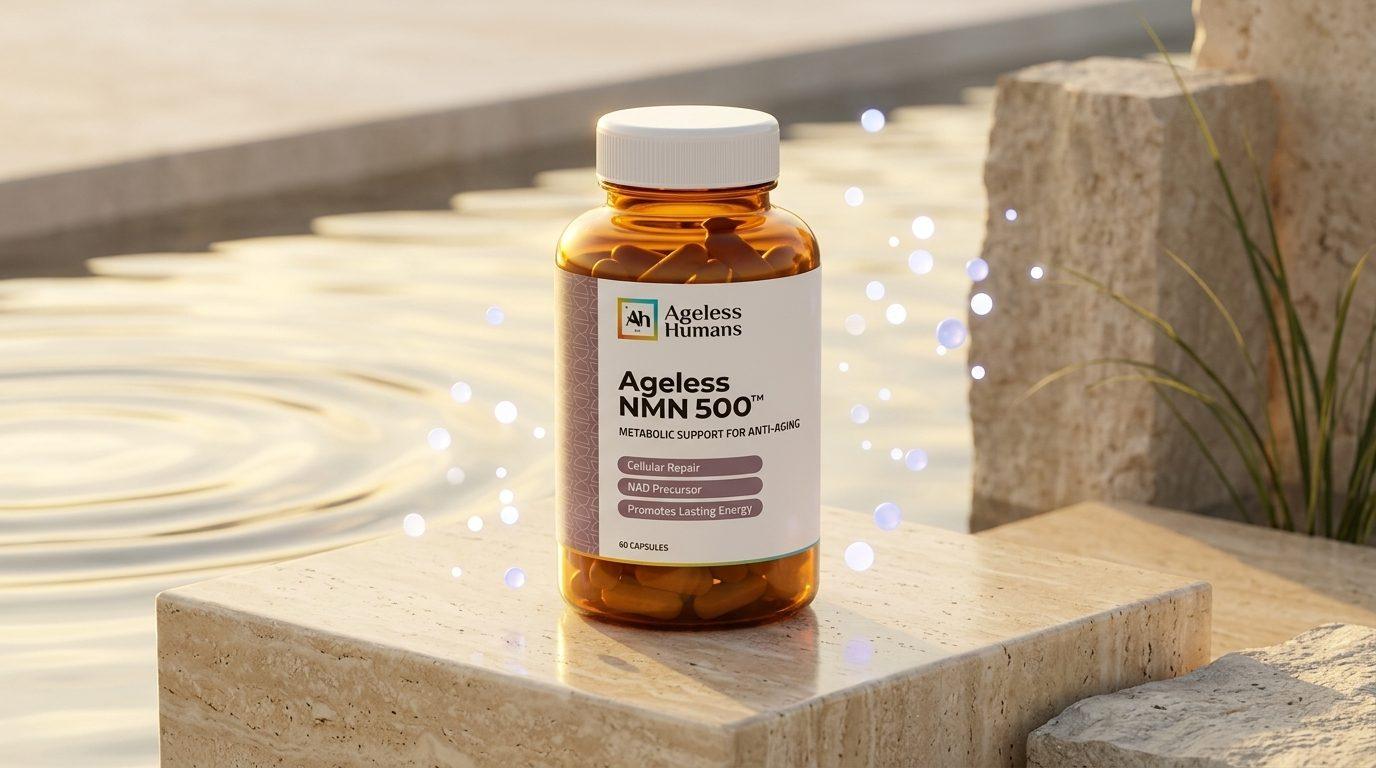
At Ageless Humans, our products are made and manufactured in our own FDA-registered facility in Carlsbad, California. Every lot is third-party lab tested with a COA, and every order is backed by a 60-day money-back guarantee. If you want a straightforward place to start, our NMN 500 capsules are built around exactly that standard.
Frequently asked questions
Is NMN or taurine better for longevity?+
Neither has been proven to extend human lifespan. NMN has the clearer rationale: it is a direct precursor to NAD+, research suggests NAD+ declines with age, and small human studies show NMN raises NAD+ levels. Taurine has striking animal lifespan data, but whether taurine declines with age in humans is now debated.
What did the 2023 taurine study actually find?+
A 2023 study in the journal Science found that taurine supplementation modestly extended lifespan in middle-aged mice and improved healthspan markers in several animal species, including a small group of monkeys. Its human findings were observational, linking lower blood taurine to less favorable health markers. It did not test whether taurine supplements change how people age.
Does taurine really decline with age?+
This is unsettled. The 2023 research suggested taurine levels fall with age, but later studies that tracked people over time questioned that pattern and found taurine levels were often stable or varied widely between individuals. Because of this, the idea that taurine needs to be replaced as we age is not established in humans.
Can you take NMN and taurine together?+
NMN and taurine work through different pathways, and there is no known reason they would counteract each other. If you choose to take both, follow each product's label directions. Check with your healthcare provider first, especially if you take medications or have a health condition.
How is NAD+ decline different from taurine decline?+
NAD+ decline with age has been reported by many research groups across multiple tissues. NAD+ is a required coenzyme for cellular energy production and DNA-maintenance enzymes. Taurine decline is a newer and more contested idea, and recent human data has challenged it. NMN targets NAD+ directly, while taurine's role in aging is still being worked out.
Do I get taurine or NMN from food?+
Taurine is found in meaningful amounts in seafood and meat and is largely absent from plant foods, so people who eat few animal products tend to take in less. NMN occurs naturally only in trace amounts in some foods, such as certain vegetables. That is why people interested in supporting NAD+ levels often turn to supplements.