
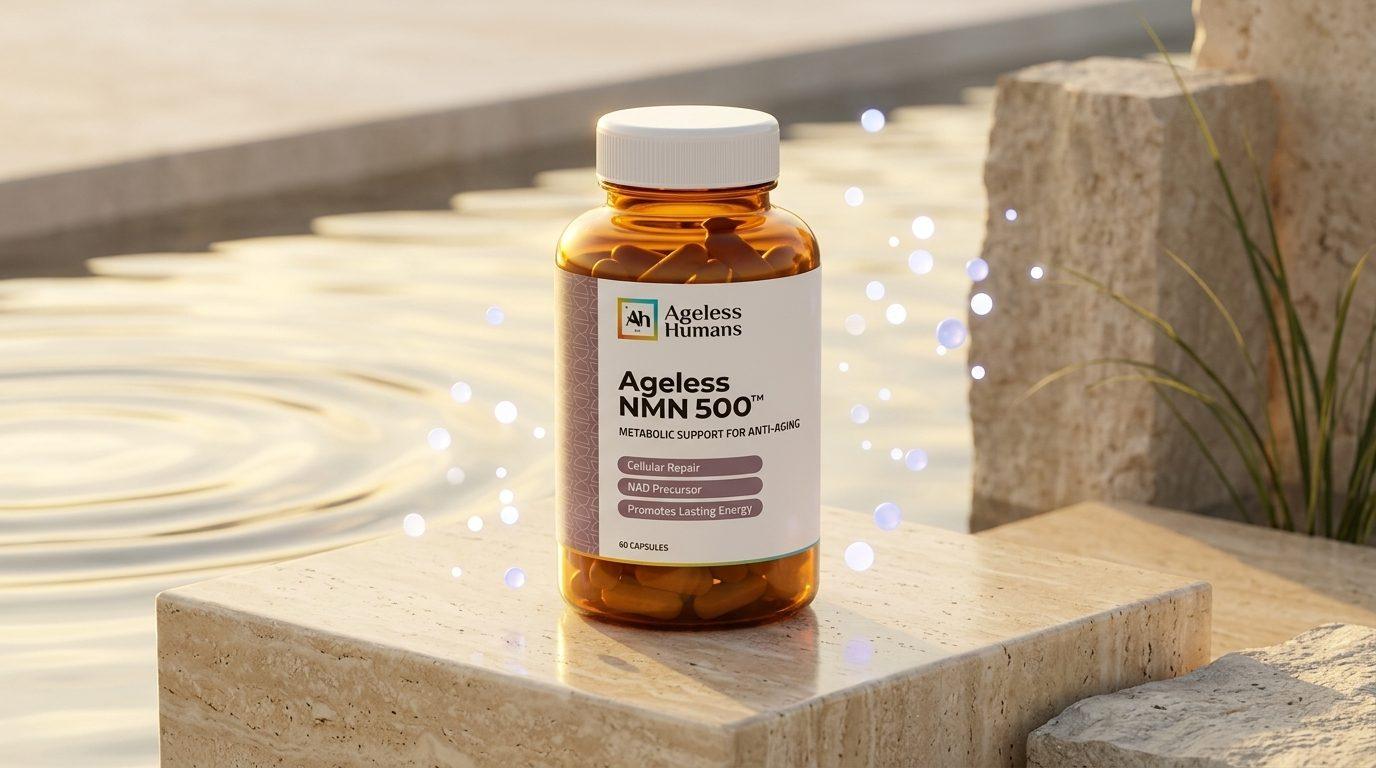
Creatine and NMN support energy in different ways. Creatine helps your muscles quickly recharge ATP during short, intense efforts, and it has one of the deepest research records of any sports supplement. NMN is a precursor to NAD+, the coenzyme your cells use to make energy in the first place; its human research is promising but much earlier, and it fits better with longevity goals than with chasing a new personal record.
The Short Answer: They Do Different Jobs
Choose creatine if your goal is gym performance. Consider NMN if your goal is supporting cellular energy as you age. They are not competitors for the same job, and many people use both.
Think of your cells' energy system as a phone. Creatine is the fast charger. It refills your usable energy in seconds during a heavy set or a sprint. NMN supports the power plant. It provides raw material for NAD+, which your mitochondria need to produce energy all day, during training and at rest.
The evidence for each is very different, too. Creatine's performance research spans decades and many controlled human trials. NMN's human research is newer and smaller, and much of what we know still comes from cell and animal studies. That gap should shape how you choose.
How Creatine Works: Rapid ATP Recharge
Creatine increases your muscles' phosphocreatine stores. Phosphocreatine rebuilds ATP almost instantly when demand spikes. ATP is the molecule that powers every muscle contraction, but your muscles keep only a small amount on hand. During a hard set, that supply runs low within seconds.
After ATP gives up its energy, it becomes ADP. Phosphocreatine donates a phosphate group back to ADP and turns it into ATP again. This system is fast but short-lived. It matters most for brief, maximal efforts:
- Heavy compound lifts and low-rep sets
- Sprints, jumps, and explosive movements
- Repeated short bursts with brief rest between them
When your muscle creatine stores are fuller, you can often sustain high output a little longer and recover a little faster between sets. Over weeks, that can add up to more total training volume, which is the reason creatine is linked with strength and lean-mass gains in research. Creatine is not a stimulant and does not "give you energy" the way caffeine does. Its effects build gradually as muscle stores fill.
How NMN Works: The NAD+ Supply Line
NMN (nicotinamide mononucleotide) is a direct precursor your body converts into NAD+, a coenzyme found in every cell. NAD+ shuttles electrons in the metabolic reactions that turn food into usable energy inside your mitochondria. That is the slower, aerobic ATP production that powers you through long sessions, recovery, and everyday life.
NAD+ also does more than help produce energy. It is used by enzymes involved in cellular maintenance, including sirtuins and DNA-repair enzymes. Research suggests NAD+ levels tend to decline with age, which is why NMN shows up in longevity conversations far more often than in bodybuilding ones.
In short, creatine helps you spend energy quickly, and NAD+ helps you make it. For a deeper look at how ATP, mitochondria, and NAD+ fit together, see our complete guide to cellular energy.
Evidence Depth: An Honest Side-by-Side
Creatine has strong, consistent human evidence for performance. NMN has early human evidence for raising NAD+ levels, with mixed and limited results for performance. Here is how they compare when you are honest about both:
Creatine monohydrate
- Studied for decades in many controlled human trials
- Research consistently supports its role in high-intensity strength and power output and in training adaptations
- Widely studied for safety in healthy adults at label-directed use
- Emerging research is exploring cognitive and healthy-aging roles, but this area is less settled than the performance data
NMN
- Human trials so far are relatively small and short
- Research suggests oral NMN can raise NAD+ levels in the blood
- Studies of muscle function, endurance, and metabolic markers in adults show mixed results, with some promising signals and some null findings
- Much of the most striking data, including lifespan and healthspan findings, comes from animal models and has not been confirmed in humans
This does not make NMN a bad choice. It means you should match your expectations to the evidence. If someone promises NMN will add plates to your bench press, they are getting ahead of the science. Our NMN benefits breakdown covers what the research does and does not show in more detail.
Performance vs Longevity: Which One Fits Your Goal?
Pick based on what you are training for and on your time horizon. Use this quick chooser:
Creatine is likely the better first pick if you:
- Want measurable improvements in strength, power, or training volume
- Lift heavy, sprint, play team sports, or do high-intensity intervals
- Want the supplement with the deepest evidence behind it
- Do not eat much meat or fish, the main dietary sources of creatine
NMN may be worth considering if you:
- Are focused on long-term cellular health as much as on gym numbers
- Are in midlife or beyond, when research suggests NAD+ tends to decline
- Already train consistently and want to support your body's energy production from the inside
- Are comfortable with evidence that is promising but still developing
A 25-year-old chasing a powerlifting total and a 50-year-old who wants to keep training hard for the next 30 years are asking different questions. The first person almost certainly wants creatine. The second may reasonably want both.
Can You Take NMN and Creatine Together?
Yes. NMN and creatine work on different parts of the energy system, and there is no known reason they compete. Creatine supports the fast phosphocreatine buffer in muscle. NMN supports the NAD+ pool that your mitochondria use for steady energy production. Using both covers rapid output and cellular energy at the same time.
A few practical points:
- Follow each product's label directions. More is not better, and neither supplement needs to be "megadosed."
- Be consistent. Creatine works by filling muscle stores over time. NMN is usually taken daily as part of a routine. Neither works as a one-off pre-workout hit.
- Track what matters to you. Log your lifts, recovery, and how you feel over several weeks instead of judging after a few days.
- Talk to your healthcare provider before starting either one if you have a medical condition, take medications, or are pregnant or nursing.
Some people notice a small increase in scale weight when they start creatine, which is generally attributed to water held inside muscle cells. That is expected and is not fat gain.
What to Look for in Quality
For either supplement, purity and transparency matter more than marketing. Creatine monohydrate is the most studied form, so fancy blends rarely add much. For NMN, the key questions are whether the product contains what the label says and whether it has been tested.
Look for:
- Third-party lab testing with a Certificate of Analysis (COA) you can actually see
- Clear sourcing and manufacturing information, not just a brand name on a private-label bottle
- Simple, honest labels with no proprietary blends hiding the amounts
- Structure/function language. Be wary of any product claiming to cure, reverse, or treat anything.
At Ageless Humans, every product is made in our FDA-registered facility in Carlsbad, California, and every lot is third-party lab tested with a COA. That is the standard you should expect from any supplement you take daily.
The Bottom Line
Creatine is the proven choice for gym performance. NMN is a longevity-focused choice that supports NAD+ and cellular energy production, backed by earlier-stage human research. If you can only pick one and your priority is getting stronger, start with creatine. If your priority is supporting how your cells produce energy as you age, NMN deserves a look, and you can still pair it with creatine.
The honest framing is simple. Creatine helps you perform today. NMN supports the energy machinery you will rely on for decades. Neither replaces the fundamentals: progressive training, enough protein, quality sleep, and recovery.
Frequently asked questions
Is NMN or creatine better for building muscle?+
Creatine has much stronger evidence for supporting strength, power, and muscle gains from resistance training. It helps muscles regenerate ATP during intense sets, which can support more total training volume over time. NMN's human research on muscle outcomes is limited and mixed, so it is better viewed as cellular energy and longevity support than as a muscle-building supplement.
Can I take NMN and creatine at the same time?+
Yes. NMN and creatine support different parts of the energy system, and there is no known reason they compete. Creatine supports rapid ATP recharge in muscle, while NMN is a precursor to NAD+, which cells use to produce energy. Follow each product's label directions, and check with your healthcare provider if you have a medical condition or take medications.
Does NMN improve workout performance?+
Human research on NMN and exercise performance is early and mixed. Some small studies have reported encouraging signals in adults, while others found little difference. Research suggests NMN can raise NAD+ levels, which supports cellular energy production, but it should not be expected to deliver the kind of performance effects associated with creatine.
What is the difference between ATP and NAD+?+
ATP is the molecule cells spend directly for energy, including every muscle contraction. NAD+ is a coenzyme that helps cells produce ATP by moving electrons through metabolic reactions in the mitochondria. Creatine helps recycle ATP quickly during intense effort, while NMN supports NAD+ levels and the ongoing production of ATP.
Is NMN worth it for younger gym-goers?+
For younger lifters focused on strength and power, creatine is usually the more evidence-backed first choice. Research suggests NAD+ levels tend to decline with age, so NMN is more often considered by people in midlife and beyond who are focused on long-term cellular health. Younger people can still choose NMN, but they should keep their expectations in line with the early-stage research.
How long does it take for creatine or NMN to work?+
Creatine works by gradually filling muscle stores, so its effects build over consistent daily use rather than showing up right away. NMN is also taken as a daily routine, and any changes tend to be subtle and gradual. For either supplement, follow the label directions and judge the results over several weeks, not a few days.