
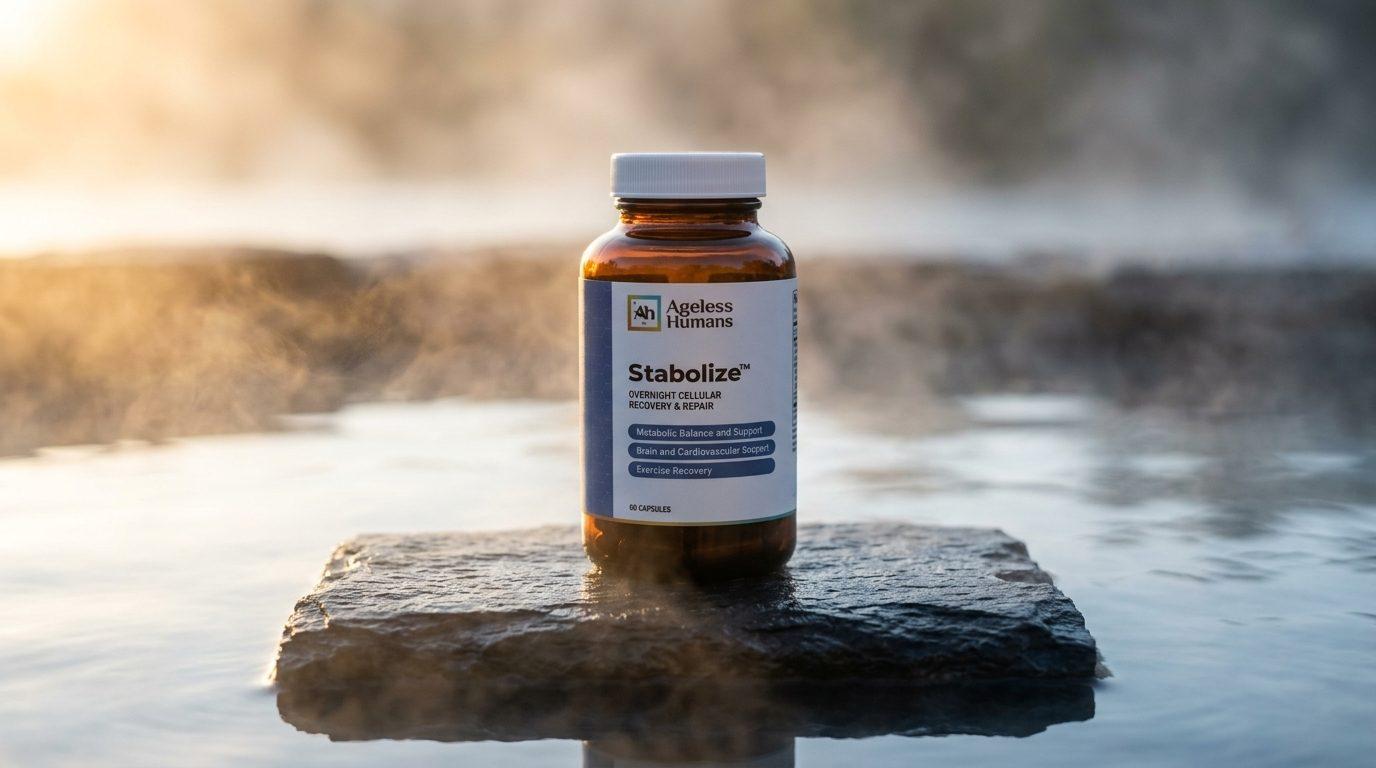
The best overnight recovery supplements support work your body already does while you sleep: deep sleep, tissue repair, and the metabolic reset of the overnight fast. Magnesium, glycine, L-theanine, and tart cherry are among the most-studied bedtime ingredients. They work best on top of consistent sleep habits, not as a replacement for them.
Why Night Is Your Body's Repair Window
Sleep is when your body stops spending resources and starts rebuilding. Several repair processes are tied to sleep and the overnight fast, so what you do in the hours before bed shapes how well they run.
Here is what happens after lights out:
- Growth hormone peaks. For most adults, the biggest growth hormone release of the day comes during early deep (slow-wave) sleep. Growth hormone supports muscle, connective tissue, and other tissue maintenance.
- The brain clears out. Research, mostly in animals so far, suggests the brain's glymphatic system becomes more active during sleep and helps flush metabolic byproducts that build up during waking hours.
- Metabolism changes gears. Once your last meal is digested, insulin falls and your body draws more on stored energy. Cellular cleanup processes such as autophagy are studied in this fasted state.
- Your clock resets. Circadian rhythms in nearly every tissue use the sleep-wake cycle to time hormone release, appetite signals, and energy use for the next day.
Short, broken, or poorly timed sleep cuts every one of these windows. That is why overnight recovery is less about one magic ingredient and more about protecting and supporting a process that is already built in.
The Three Jobs of an Overnight Recovery Stack
A complete overnight recovery approach does three jobs: it supports sleep quality, physical repair, and metabolic balance. Most bedtime products only do the first.
1. Sleep quality. Falling asleep, staying asleep, and getting enough deep sleep. Every other recovery process depends on this one. 2. Physical repair. Supplying raw materials and a calm nervous system so muscles and tissues can rebuild after daily stress and training. 3. Metabolic support. Helping your body make good use of the overnight fast, including healthy blood sugar levels already within the normal range and normal energy metabolism.
Thinking in these three categories keeps you from stacking five sleep aids that all do the same thing while ignoring the other two. It also makes it easier to judge a product: ask which of the three jobs each ingredient is actually there to do.
The Most-Studied Ingredients to Take Before Bed
The bedtime ingredients with the most research behind them are magnesium, glycine, L-theanine, tart cherry, and, for occasional use, melatonin. Here is what each is studied for and how strong the evidence is.
- Magnesium. This mineral is involved in hundreds of enzyme reactions, including muscle relaxation and nervous system signaling. Many adults fall short of it in their diet. Research on magnesium and sleep quality is promising but mixed, and the benefit may be largest in people who are low to begin with. Glycinate and similar forms are popular at night because they are generally gentle on digestion.
- Glycine. An amino acid studied for its role in lowering core body temperature, one of the signals that starts sleep. Small human studies suggest it may support sleep quality and how rested people feel the next day.
- L-theanine. An amino acid from tea that is studied for supporting a calm, relaxed state without sedation. It is often paired with magnesium.
- Tart cherry. A natural source of melatonin and polyphenols. It is studied both for sleep and for supporting normal muscle recovery after exercise.
- Melatonin. A hormone that signals darkness to your body. It is best understood as a timing signal, not a sedative. It is most studied for shifting sleep timing, such as with jet lag. Follow label directions, because more is not better.
- Apigenin (from chamomile). A plant compound studied for relaxation. Human research is still early.
Notice the pattern: these support the conditions for sleep. None of them should knock you out.
Overnight Metabolic Support: What It Means and What Helps
Overnight metabolic support means helping your body make the most of the 8 to 12 hours you go without food. Food timing matters as much as any capsule. Eating a large meal close to bed keeps insulin high and digestion busy during the window your body would otherwise spend on repair.
The simplest metabolic lever is to finish eating two to three hours before bed and keep late snacks light. If you train hard, research on slow-digesting protein before sleep (such as casein) suggests it may support overnight muscle protein synthesis. It is one of the few cases where a pre-bed calorie earns its place.
On the supplement side, ingredients such as myo-inositol, chromium, and berberine are studied for supporting healthy glucose metabolism and blood sugar levels already within the normal range. Results vary, and most studies are short. Formulas built for this purpose, like Overnight Metabolic Recovery & Support, are designed to pair evening metabolic support with recovery support, so you can cover both jobs in one routine instead of piecing together separate bottles.
If you take any medication that affects blood sugar, talk with your healthcare provider before adding a metabolic supplement.
What the Research Does and Doesn't Show
Research supports modest, real benefits from several bedtime ingredients, but no supplement can replace sleep itself. Being honest about that is the difference between a smart routine and an expensive placebo.
What the evidence generally shows:
- Many sleep supplement studies are small, short, and done in specific groups, such as older adults, athletes, or people with low baseline intake. Results may not carry over to everyone.
- Effects tend to be subtle: falling asleep a bit faster, feeling a bit more rested, or better sleep quality scores. They are not dramatic changes.
- Individual response varies widely. Magnesium may help someone who is low and do little for someone who is not.
- Animal and cell studies, such as much of the autophagy and glymphatic research, explain why night matters but do not prove that a given supplement improves those processes in people.
What it does not show: that any supplement can make up for six hours of sleep, a late heavy meal, or a phone in bed at midnight. Treat supplements as the last 10 to 20 percent, not the foundation.
How to Build a Bedtime Stack That Makes Sense
Start with one goal, add one product at a time, and give each change two to four weeks before judging it. This is how you learn what actually works for your body.
1. Pick your weakest job. Trouble winding down? Start with calming support such as magnesium or L-theanine. Waking up stiff and sore? Look at recovery support. Late-night eating or energy dips? Look at metabolic support. 2. Check for overlap. Many blends repeat the same ingredients. Add up your totals across products and stay within each label's directions. 3. Watch for hidden stimulants. Green tea extract, guarana, and some "energy" blends contain caffeine. Keep them out of your evening routine. 4. Time it consistently. Take your products at the time the label directs, at roughly the same time each night. Consistency supports your circadian rhythm. 5. Track simply. Note how long it takes you to fall asleep, how often you wake, and how you feel in the morning. A simple 1 to 5 rating is enough. 6. Loop in your provider if you are pregnant or nursing, take prescription medication, or have an ongoing health condition.
The Habits That Do the Heavy Lifting
Consistent timing, darkness, a cool room, and an early caffeine cutoff do more for overnight recovery than any supplement. Supplements work best when these are already in place.
- Same wake time daily, including weekends. It anchors your circadian clock better than a fixed bedtime does.
- Morning light, dim evenings. Get outdoor light early in the day and lower the lights in the last hour before bed.
- Cool, dark, quiet room. A slightly cool bedroom supports the drop in core temperature that starts sleep.
- Caffeine cutoff by early afternoon. Caffeine can stay active in your body for many hours.
- Go easy on alcohol at night. It may make you drowsy, but research links it to lighter, more fragmented sleep in the second half of the night.
- Wind-down routine. Fifteen to thirty minutes of the same calm activity tells your brain that the day is over.
For a full breakdown of sleep stages, routines, and room setup, see our complete sleep and overnight recovery guide. If you snore heavily or regularly wake up unrefreshed despite good habits, talk with a doctor before trying more supplements.
How to Choose an Overnight Recovery Supplement You Can Trust
Choose supplements with full ingredient amounts on the label, third-party testing, and a clear source of manufacture. The supplement market varies widely in quality, and bedtime products are no exception.
Use this checklist:
- Transparent labels. Avoid "proprietary blends" that hide how much of each ingredient you are getting.
- Third-party testing with a COA. A Certificate of Analysis confirms what is in the product and screens for contaminants.
- Known manufacturing. Know where and how the product is made.
- A real guarantee. It shows the brand stands behind the product.
Every Ageless Humans product is made in our own FDA-registered facility in Carlsbad, California. Every lot is third-party lab tested with a COA, and every purchase is backed by a 60-day money-back guarantee. If overnight recovery is one part of a broader longevity routine, the Metamorphic Anti-Aging Protocol brings daytime and nighttime support together in one structured plan.
Frequently asked questions
What is the best supplement to take before bed for recovery?+
Magnesium, glycine, L-theanine, and tart cherry are among the most-studied bedtime ingredients for supporting sleep quality and recovery. Magnesium is a common starting point because it plays a role in muscle relaxation and nervous system function, and many adults get too little of it. The best choice depends on whether your main goal is falling asleep, physical recovery, or metabolic support.
Why does the body repair itself at night?+
During deep sleep, the body releases its largest daily pulse of growth hormone, which supports tissue maintenance. Research suggests the brain clears metabolic byproducts more actively during sleep. The overnight fast also lets insulin fall and shifts the body toward using stored energy, which together make night the body's main repair window.
Is it better to take magnesium in the morning or at night?+
Many people take magnesium in the evening because it is studied for supporting relaxation and sleep quality. Forms like magnesium glycinate are popular at night because they are generally gentle on digestion. Always follow the timing and amount on your product's label.
Should I eat before bed for muscle recovery?+
For most people, finishing meals two to three hours before bed better supports overnight metabolic function. One exception studied in research is a slow-digesting protein, such as casein, before sleep for people who train hard, which may support overnight muscle protein synthesis. Large, high-sugar meals close to bedtime are best avoided.
Can I take melatonin every night?+
Melatonin is a hormone that signals darkness to your body, and it is most studied for shifting sleep timing, such as during jet lag. It works as a timing signal rather than a sedative, so higher amounts are not necessarily better. Follow label directions and talk with your healthcare provider about long-term nightly use.
How long does it take for sleep and recovery supplements to work?+
Some ingredients, like L-theanine, may be noticeable within a night or two. Others, like magnesium, may take two to four weeks of consistent use, especially if you start out low. Track how quickly you fall asleep and how you feel in the morning so you can judge results honestly.