
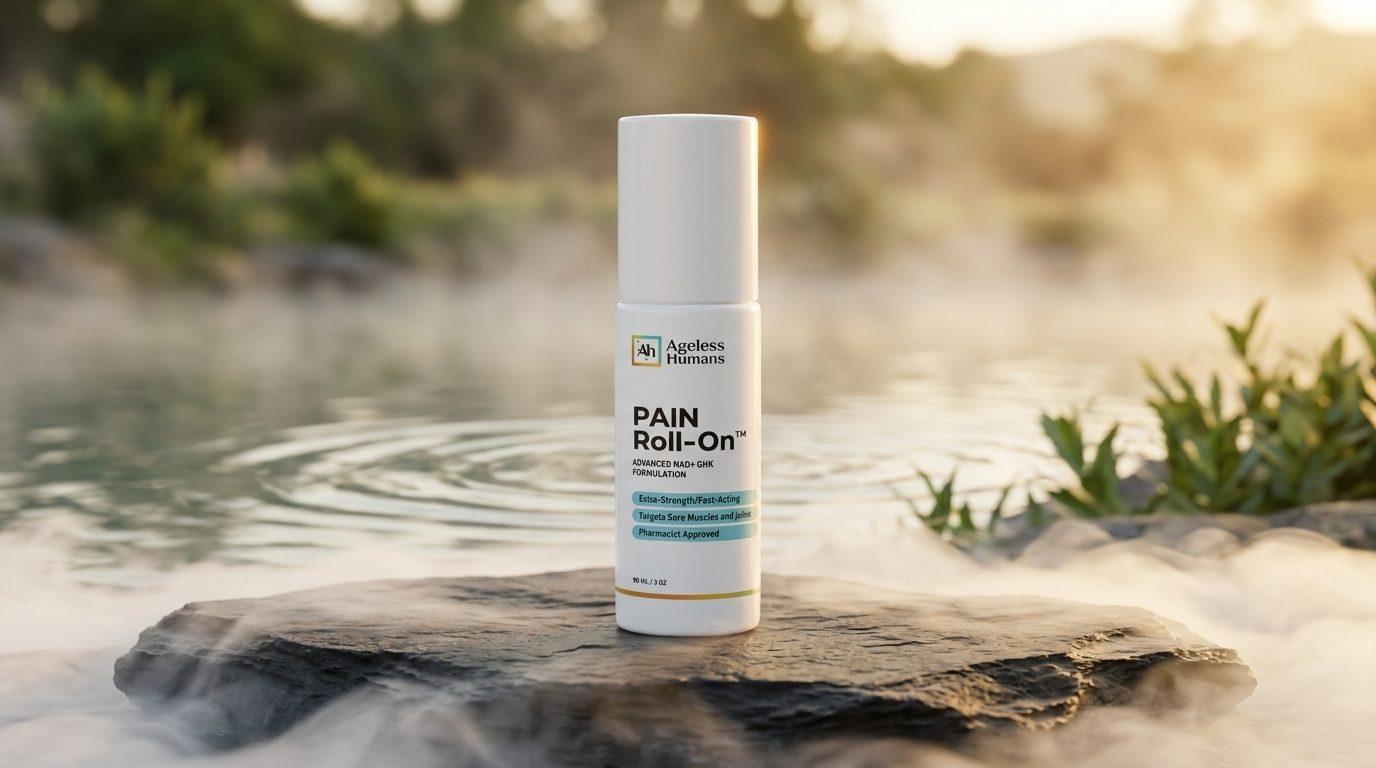
Use a topical roll-on or cream when your recovery need is localized: one shoulder, one knee, one tight calf you can point to. Use an oral supplement when the need is systemic: whole-body training load, several areas at once, or ongoing support you want working in the background. Many active people use both, because the two routes do different jobs and don't compete.
The Short Answer: Match the Route to the Size of the Problem
The right delivery route depends on where you want support to go. A topical is applied to the skin over a specific area, so it acts mostly where you put it. An oral supplement is absorbed through the gut and enters circulation, so it reaches the whole body.
A simple test: can you put one finger on it? If the area you want to support is a single, defined spot, start with a topical. If the feeling is diffuse (general stiffness after a heavy training block, slower bounce-back across the board, several areas that feel worn), oral support makes more sense.
Neither route is better in general. They solve different problems. Most of the confusion comes from expecting a cream to do a capsule's job, or a capsule to do a cream's job.
How Topicals Work, and Their Honest Limits
Topicals work by delivering ingredients through or onto the skin at the point of application. That gives them three real advantages: speed of sensation, precision, and a low systemic footprint. You feel a cooling or warming product within minutes, you put it exactly where you want it, and much less of it circulates through the rest of your body than an oral dose would.
The limit is the skin itself. Its outer layer, the stratum corneum, is built to keep things out. A widely cited rule of thumb in dermatology holds that smaller, fat-soluble molecules pass through more easily than large or charged ones. In practice, how deep an ingredient goes depends on molecule size, the formula's base, and how it's applied. Some ingredients mainly act at the skin surface. Others are studied for their ability to reach underlying tissue.
What that means for you:
- Topicals are strongest for surface and near-surface support and for comfort you can feel in that spot.
- The act of applying them counts. Massaging a product into tight tissue increases local circulation and gives you a reason to slow down and pay attention to that area.
- Be skeptical of any topical marketed as a whole-body solution. That's not what the format is built for.
How Oral Supplements Work: Whole-Body by Design
Oral supplements work systemically. After digestion and absorption, ingredients enter the bloodstream and become available to tissues throughout the body. Recovery after hard training is a whole-body process involving muscle, connective tissue, the nervous system, and energy metabolism, so a systemic approach fits that kind of demand.
The trade-offs are timing and absorption. Oral support is usually a consistency play. It's meant to be taken daily as part of a routine, not reached for in the moment. Ingredients also have to survive digestion, and some, peptides especially, face real questions about how much arrives intact. Formulation choices matter here, and so does honest reporting on what research has and hasn't shown.
Oral supplements make the most sense when you want broad, background support: your training volume is high, you're recovering from cumulative load rather than one sore spot, or you want to support the foundations of tissue maintenance over weeks rather than hours. For a full breakdown of the ingredient categories involved, see our complete guide to recovery supplements.
When a Roll-On or Cream Makes Sense
Reach for a topical when the need is specific, local, and you want to feel something now. Common scenarios:
- One area takes the brunt of your activity. A runner's calves, a lifter's elbow, a golfer's lower back, a desk worker's neck and traps.
- You want a pre- or post-session ritual. Applying a roll-on before warming up or after cooling down builds a habit of attending to a problem area.
- You want targeted support without adding to a daily pill routine. Topicals keep the effect where you apply it.
- You care about the skin and tissue in that area. Some topical ingredients are studied specifically for skin and connective-tissue support, which is a natural fit for direct application.
Our Advanced Muscle Roll-On is built for this use case. It pairs NAD+ with GHK, a small copper-binding peptide that has been studied in skin research, in a roll-on format for precise, mess-free application. For a richer massage-in texture with an immediate soothing feel, a cream like Pain Cream Max suits people who like the hands-on routine of working a product into tight muscles.
A note on expectations: a topical supports the area you apply it to. If you're applying it to five different places every day, that's a sign you may want systemic support as well.
When Oral Supplementation Makes More Sense
Choose oral support when the recovery demand is spread across your body or ongoing. Signs you're in systemic territory:
- You can't point to one spot. You feel generally beaten up after training, not sore in one place.
- Your training load is high and sustained. Multiple sessions per week, endurance blocks, or a sport that taxes the whole body.
- You're thinking long-term. You want to support connective tissue, muscle maintenance, and recovery capacity over months, not just get through tomorrow.
- Age is part of the picture. Many people find recovery takes longer as they get older, and a whole-body approach matches a whole-body change.
Peptides are one of the most discussed categories here. BPC-157 is a peptide fragment originally derived from a protein found in gastric juice, which is one reason researchers have explored oral use. TB-500 is a synthetic fragment related to thymosin beta-4, a naturally occurring protein involved in cell movement. Be clear-eyed about the evidence: most published research on both is preclinical, meaning animal and cell studies, and well-controlled human data is limited. Anyone telling you otherwise is overselling. That's why we position Protex as an oral option for people who have looked into this research and want daily, whole-body support, not as a guaranteed outcome.
Using Both: A Layered Approach
Topical and oral products don't compete, and they stack well. Think of oral support as the foundation and topicals as targeted reinforcement.
A practical layering model:
1. Foundation (daily, whole-body): sleep, adequate protein, hydration, sensible progression in training load, and an oral supplement if you choose one. 2. Targeted (as needed, local): a roll-on or cream on the one or two areas that take the most stress, applied around training or at the end of the day. 3. Feedback loop: pay attention to which areas still need topical attention after a few weeks of consistent foundational habits. That tells you where the real stress points in your training are.
This also helps you diagnose your own needs. If topicals handle everything, you may not need systemic support. If you're applying cream everywhere, the issue is probably whole-body, and the foundation needs attention.
What to Look For in Either Format
Quality signals matter more than format. Whether you choose a cream, a roll-on, or a capsule, check for:
- Clear ingredient disclosure. You should know exactly what's in it and in what form.
- Third-party testing with a Certificate of Analysis (COA). This confirms identity and purity. It matters especially for peptides, where quality varies widely across the market.
- Known manufacturing. Where and how a product is made matters.
- Honest claims. Good brands say "supports" and "studied for." Brands that promise to fix, heal, or cure anything are telling you something about how much you can trust them.
- A real guarantee. Confidence in a product shows in the return policy.
Every Ageless Humans product is made in our FDA-registered facility in Carlsbad, California, every lot is third-party lab tested with a COA, and every order is backed by a 60-day money-back guarantee.
Neither Format Replaces the Fundamentals
No cream or capsule outperforms sleep, nutrition, and smart training. Supplements, topical or oral, are multipliers. They support a recovery process your body already runs. They can't build that process from nothing.
If you're under-sleeping, under-eating protein, or adding training volume faster than your body can adapt, start there. Then use topicals for the spots that need extra attention and oral support for the whole-body load. That order keeps your money and your expectations working for you.
Frequently asked questions
Is a topical or oral recovery product better?+
Neither is better overall. They do different jobs. Topicals act mainly where you apply them, so they suit one specific area like a knee, shoulder, or calf. Oral supplements are absorbed into circulation and support the whole body, so they suit general training load and long-term recovery.
Do recovery creams and roll-ons actually absorb through the skin?+
It depends on the ingredient and the formula. The skin's outer layer is a strong barrier, and smaller, fat-soluble molecules generally pass through more easily than large or charged ones. Some topical ingredients act mainly at the skin surface, while others are studied for reaching underlying tissue. Massaging the product in also increases local circulation in that area.
Can I use a topical recovery product and an oral supplement together?+
Yes. Many active people layer them: a daily oral supplement for whole-body support and a topical for the one or two areas that take the most stress. The two routes don't compete. Check the label directions for each product, and talk with a healthcare professional if you have medical questions.
Are oral BPC-157 and TB-500 supported by research?+
BPC-157 and TB-500 have been studied mostly in preclinical research, meaning animal and cell studies, and well-controlled human data is limited. BPC-157 comes from a protein found in gastric juice, which is one reason researchers have explored oral use. Treat them as emerging research areas, not proven outcomes, and choose third-party tested products.
How do I know whether I need localized or whole-body recovery support?+
Ask whether you can point to one spot. If the need is in a single defined area, a topical roll-on or cream is a logical starting point. If you feel generally worn down, have several areas that need attention, or carry a high ongoing training load, oral whole-body support fits better.
What should I look for in a quality recovery product?+
Look for full ingredient disclosure, third-party lab testing with a Certificate of Analysis, a known manufacturing facility, and honest structure/function language like "supports" rather than promises to heal or cure. A real money-back guarantee is another good sign that the brand stands behind the product.