
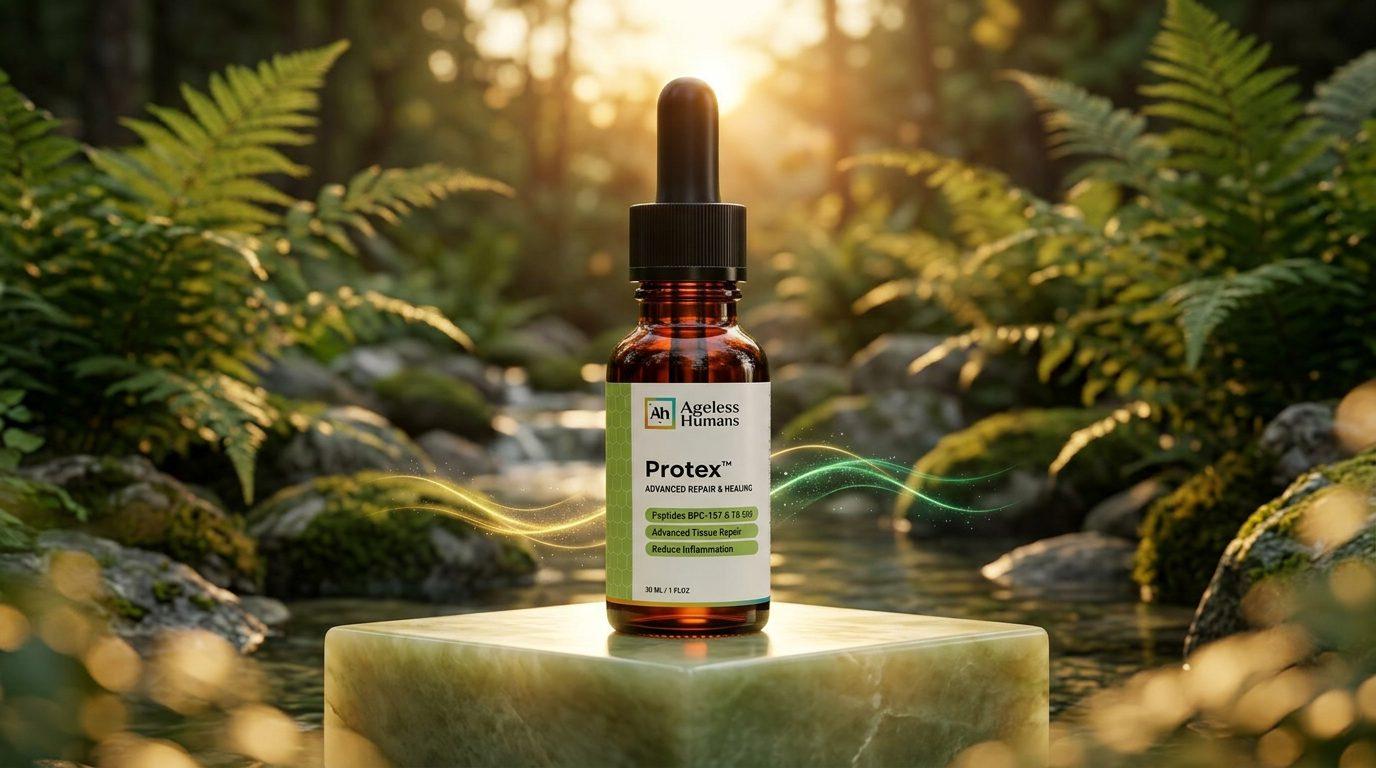
TB-500 is a synthetic peptide modeled on the active region of thymosin beta-4, a protein your body makes naturally to help cells move, organize, and respond to tissue stress. It is studied mainly for its role in cell migration, tissue repair, flexibility, and recovery. Most of that research is in cell cultures and animals, with limited human data, so the honest answer is that it is promising, actively researched, and not yet settled science.
What Is TB-500?
TB-500 is a lab-made peptide based on thymosin beta-4 (Tβ4), a 43-amino-acid protein found in nearly every cell in the human body. Thymosin beta-4 is especially concentrated in blood platelets, wound fluid, and white blood cells. These are the places where the body coordinates its response to tissue stress.
The name TB-500 is used loosely. Some sources use it for a synthetic copy of full-length thymosin beta-4. Others use it for a short fragment built around the protein's actin-binding region, the part researchers believe drives much of its activity. When you read about TB-500, check which version is being discussed. Research on the full natural protein does not automatically apply to every fragment sold under the name.
Thymosin beta-4's main job inside cells is managing actin, the protein that forms the cell's internal scaffolding. Actin filaments let cells change shape, crawl, and divide. By binding and releasing actin, Tβ4 helps control when and where a cell builds that scaffolding. That makes it a central player in cell movement, and cell movement is the first step in almost every repair process the body runs.
How TB-500 Works: Actin, Cell Migration, and Repair Signaling
TB-500 is studied because thymosin beta-4 helps cells migrate to where they are needed. When tissue is stressed, repair depends on new cells arriving: fibroblasts that lay down structural protein, endothelial cells that form new blood vessels, and immune cells that clear debris. None of that happens unless cells can move.
Researchers have looked at thymosin beta-4 through several overlapping mechanisms:
- Actin regulation: It holds a reserve of actin building blocks, letting cells reshape themselves quickly.
- Cell migration: In lab studies it has been shown to promote movement of cells involved in tissue maintenance.
- Blood vessel formation: It has been studied for its role in angiogenesis, the growth of new small vessels that deliver oxygen and nutrients.
- Inflammatory signaling: Some research suggests it helps modulate the body's signaling response to tissue stress.
- Tissue remodeling: It has been examined for its influence on how connective tissue organizes during repair.
Unlike a peptide that targets a single receptor, thymosin beta-4 seems to act more like a coordinator. That broad role is why it shows up in research on skin, muscle, eye, and heart tissue in animal models. It is also why researchers stay cautious: a molecule that touches many processes needs careful study before anyone draws firm conclusions.
TB-500 Benefits: What It Is Studied For
The main areas of TB-500 and thymosin beta-4 research are tissue repair, recovery, flexibility, and cell protection. Here is what each area means and where the evidence actually comes from.
1. Tissue repair and wound response. This is the most-studied area. Animal and cell research suggests thymosin beta-4 supports the migration of skin and connective tissue cells and the formation of new blood vessels at sites of tissue stress. Some early-stage human research has explored topical forms.
2. Muscle, tendon, and ligament recovery. Athletes are drawn to TB-500 because of research on how Tβ4 influences cell movement and remodeling in soft tissue. Most of this evidence comes from animal models and lab work, not controlled human trials on athletes.
3. Flexibility and mobility. Users often describe TB-500 as supporting flexibility. This connects to its studied role in connective tissue organization. Direct human evidence on flexibility outcomes is limited, so treat these reports as anecdotal.
4. Hair and skin. Thymosin beta-4 has been studied in animal models for its role in hair follicle cell activity and skin cell migration.
5. Cell protection under stress. Researchers have examined Tβ4 in models of heart, eye, and nervous system tissue, looking at how it may help cells survive stress. This is research context, not an established human benefit.
Research Honesty: What the Evidence Does and Does Not Show
The honest summary is that the research is strong on mechanism, early on human outcomes. Thymosin beta-4 is a well-characterized natural protein with decades of published lab and animal research. That foundation is real. What is missing is a large body of controlled human trials showing specific benefits for healthy, active adults.
Keep these distinctions in mind when you read claims online:
- Natural protein vs. synthetic fragment. Much of the research uses full-length thymosin beta-4. Results do not automatically transfer to every TB-500 product.
- Animal vs. human. Promising results in rodents often shrink or disappear in people. That is normal in biology, and it is the reason human trials exist.
- Delivery route matters. Most research uses injected or topical forms. Oral forms face digestion, and the evidence for them is thinner still.
- Anecdote vs. data. Forum reports and testimonials are not evidence, even when they are sincere.
Anyone who tells you TB-500 is proven to rebuild tissue in humans is overselling. Anyone who dismisses it as having no science behind it is also wrong. The accurate position sits in between: a biologically plausible, actively researched peptide whose real-world effects in people are still being mapped.
Who Uses TB-500 and Why
TB-500 is mainly used by athletes, active adults, and longevity-focused people who want to support recovery and keep moving well as they age. The common thread is a demand on soft tissue that outpaces how fast the body seems to bounce back.
Typical users include:
- Strength and endurance athletes looking to support recovery between hard training blocks.
- Active adults over 40 who notice that tendons, joints, and muscles take longer to feel ready again.
- Weekend warriors who train hard in bursts and want to support how their body handles it.
- Biohackers and longevity enthusiasts interested in peptides that support the body's own repair signaling.
TB-500 first gained attention in performance-animal circles before spreading to human fitness communities. That history matters for one practical reason: thymosin beta-4 and its derivatives, including TB-500, appear on the World Anti-Doping Agency's prohibited list. If you compete in a tested sport, do not use it. Regulators have also scrutinized injectable peptide products, so where you source any peptide matters a great deal.
TB-500 vs. BPC-157: How They Differ
TB-500 and BPC-157 are both studied for recovery, but they come from different biology and appear to work through different pathways. TB-500 is based on thymosin beta-4, a structural protein tied to actin and cell migration. BPC-157 is a short peptide derived from a protein found in gastric juice, studied for its role in gut lining, blood vessel signaling, and tendon and ligament tissue.
A simple way to think about it: research frames thymosin beta-4 as helping cells get to where repair is needed. BPC-157 is studied more for supporting the local environment where repair happens. That rough split is why many people are curious about combining them. For a full breakdown of BPC-157 on its own, read our guide on what BPC-157 is and what it is studied for.
Combining two peptides with overlapping but distinct research profiles is a popular idea. It has also been studied even less than either peptide alone. If you want the reasoning, the tradeoffs, and how people think about pairing them, our BPC-157 and TB-500 stack guide covers it in detail.
Safety, Sourcing, and Smart Use
The biggest practical risk with TB-500 is not the peptide itself but where it comes from. The peptide market is crowded with research-chemical sellers, unclear labeling, and products that may not contain what the label says. Purity and identity testing are the minimum standard you should expect.
Before you choose any TB-500 product, check for:
- Third-party testing with a certificate of analysis (COA) for each lot, not one generic report.
- A known manufacturer with a registered facility, not an anonymous reseller.
- Clear labeling of what is in the product and how much.
- Plain-language marketing that uses structure/function language rather than promising to fix medical problems.
Long-term human safety data for TB-500 is limited. Because thymosin beta-4 is involved in cell growth and blood vessel formation, researchers have raised questions about its use in people with certain existing health concerns. Talk with a qualified healthcare provider before starting any peptide, especially if you are pregnant, nursing, taking medication, or managing a health condition. Follow label directions and do not exceed them.
The Bottom Line on TB-500 Benefits
TB-500 is a well-studied peptide concept with limited human proof. Thymosin beta-4 plays a real, documented role in how cells move and organize during repair. That is why TB-500 is studied for tissue recovery, flexibility, and resilience. The gap is in controlled human research, particularly for oral forms and for healthy active adults.
If you are considering it, set expectations based on what the science actually shows. Choose a transparently made and tested product. Treat it as one part of a recovery foundation that still depends on sleep, protein, training load, and time. A peptide can support the process. It does not replace the basics.
Frequently asked questions
What is TB-500 used for?+
TB-500 is used mainly to support recovery, flexibility, and soft-tissue resilience, especially by athletes and active adults. It is based on thymosin beta-4, a natural protein studied for its role in cell migration and tissue repair. Most supporting research comes from cell and animal studies rather than large human trials.
Is TB-500 the same as thymosin beta-4?+
Not exactly. Thymosin beta-4 is a 43-amino-acid protein the body makes naturally. TB-500 is a synthetic peptide modeled on it, and the name is used for both a full-length synthetic version and a shorter fragment built around its active actin-binding region. Research on the natural protein does not automatically apply to every product labeled TB-500.
Is there human research on TB-500?+
Human research on TB-500 is limited. Most published work on thymosin beta-4 involves cell cultures and animal models, with some early-stage human research on specific forms such as topical applications. The mechanism is well studied, but controlled human trials on recovery or flexibility in healthy adults are lacking.
What is the difference between TB-500 and BPC-157?+
TB-500 is based on thymosin beta-4 and is studied mainly for its role in actin regulation and cell migration. BPC-157 is a peptide derived from a gastric protein and is studied for its role in gut lining, blood vessel signaling, and tendon tissue. Both are researched for recovery support, but they come from different biology and appear to act through different pathways.
Is TB-500 banned in sports?+
Yes. Thymosin beta-4 and its derivatives, including TB-500, appear on the World Anti-Doping Agency prohibited list. Athletes in tested sports should not use TB-500 in any form.
Does oral TB-500 work?+
Most TB-500 and thymosin beta-4 research uses injected or topical forms, so evidence for oral use is limited. Peptides taken by mouth face digestion, which is why formulation and transparent testing matter for oral products. Set expectations around supporting recovery rather than replicating results from injection-based studies.