
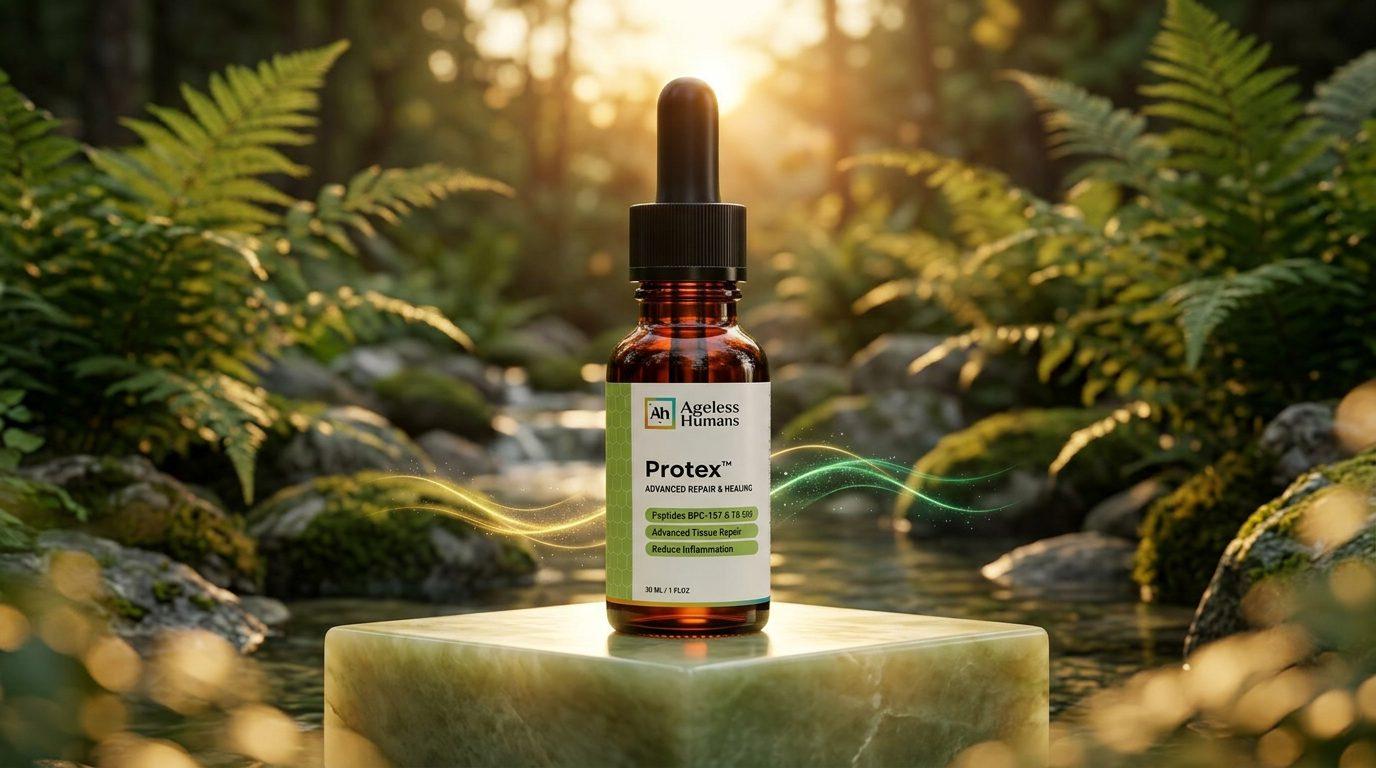
GHK-Cu is a naturally occurring copper-binding tripeptide studied mainly for its role in skin and connective tissue. Research suggests it may support collagen production, skin firmness and the body's normal tissue-renewal processes. Its most practical, best-studied use is topical skincare, and early lab work has also explored it for hair. Most of the evidence comes from cell and animal studies plus a modest number of small cosmetic trials, so expectations should match that evidence.
What Is GHK-Cu?
GHK-Cu is a three-amino-acid peptide (glycine, histidine, lysine) bound to a copper ion. Your body already makes it. It circulates in plasma, saliva and urine, and researchers first identified it in human plasma in the early 1970s while studying why tissue from younger donors behaved differently from older tissue.
The "GHK" part is the peptide. The "Cu" is copper, which GHK grabs onto with high affinity. That pairing matters. Copper is a required cofactor for enzymes involved in building connective tissue and in antioxidant defense. GHK appears to help deliver copper to where it's used and to buffer it so it stays in a usable, non-reactive form.
GHK levels are reported to decline with age. That observation is a big reason the peptide became a focus of longevity and skin research. If you're new to the category, our guide to what peptides are and how they work covers the basics.
How GHK-Cu Works: The Mechanisms Researchers Study
GHK-Cu acts more like a signaling molecule than a building block. It doesn't become collagen itself. It appears to tell cells, especially fibroblasts, to shift into a more active maintenance mode.
The main mechanisms studied include:
- Collagen and matrix signaling: Lab studies show GHK-Cu can stimulate fibroblasts to produce collagen, elastin and glycosaminoglycans, the components that give skin structure and bounce.
- Balanced remodeling: It also appears to influence the enzymes that break down old matrix and the inhibitors that restrain them. Healthy tissue depends on both building and clearing, not one or the other.
- Copper delivery: Copper is needed by lysyl oxidase, the enzyme that cross-links collagen and elastin, and by superoxide dismutase, a key antioxidant enzyme.
- Gene expression: Computational analyses of gene-expression databases suggest GHK may influence a large number of genes tied to tissue repair, antioxidant activity and cellular housekeeping. This work is interesting but still hypothesis-generating, not proof of effects in people.
The honest summary: the mechanism story is well developed in the lab. How much of it carries over to a cream on human skin depends heavily on formulation and dose, which is why results in people are more modest and variable.
GHK-Cu Benefits for Skin: The Strongest Evidence
Skin is where GHK-Cu has the most human data, and it's the most realistic use case. Small cosmetic studies of topical GHK-Cu formulations have reported improvements in skin's look and feel, including firmness, elasticity, smoothness and the appearance of fine lines. Research suggests it may also support skin density and the look of an even tone.
A few points keep this in perspective:
- The trials are small and often cosmetic-industry run. They're useful, but they aren't large, independent, long-term studies.
- Formulas differ. Concentration, vehicle and companion ingredients vary widely between studies, so one result doesn't guarantee another product will match it.
- Change is gradual. Collagen turnover is slow. Studies typically ran for weeks to months, not days.
Compared with retinoids, GHK-Cu has a reputation for being gentle, which is a big reason people layer it into routines where stronger actives cause irritation. It isn't a replacement for daily sunscreen, which remains the foundation of any skin-aging routine.
GHK-Cu and Tissue Research: Recovery, Barrier and Repair Processes
Beyond facial skin, GHK-Cu is studied for how it supports the body's normal tissue-renewal processes. Much of the early research looked at skin repair in animal models and cell cultures, where GHK-Cu appeared to support new tissue formation, blood vessel growth signals and an orderly remodeling phase.
Researchers have also examined its antioxidant and calming signaling activity in lab settings, which may help explain why it's explored for skin that's stressed by environment, friction or exercise. These are early-stage findings. They describe biological plausibility, not a proven outcome in people.
This is the reasoning behind topical GHK-Cu formulas aimed at skin over working muscles and joints: supporting the skin and superficial tissue as part of a post-activity routine. For the wider picture of which compounds are studied in this area, see our breakdown of the best peptides for recovery.
GHK-Cu for Hair: Promising but Early
Hair is the most hyped and least proven GHK-Cu benefit. Most of the support comes from cell studies and animal research suggesting copper peptides may support hair follicle size and the growth phase of the hair cycle. Human evidence is limited.
The theory is reasonable. Follicles sit in skin, depend on a healthy surrounding matrix and blood supply, and are influenced by the same fibroblast signaling GHK-Cu affects. Copper peptides show up in many scalp serums for that reason.
What's missing is solid, independent human data. If you try a GHK-Cu scalp product, treat it as a supportive part of a scalp-care routine, give it several months, and be skeptical of before-and-after claims that promise dramatic regrowth. Shedding or thinning that's sudden or patchy is worth discussing with a dermatologist rather than self-managing.
How to Use GHK-Cu Topically for the Best Results
Apply GHK-Cu to clean skin, use it consistently, and keep it away from ingredients that can deactivate copper. Formulation and routine matter as much as the peptide itself.
Practical guidelines:
1. Follow the label. Use the amount and frequency on the product directions. 2. Apply to clean, slightly damp skin, then follow with moisturizer if the formula isn't already one. 3. Separate it from direct acids and pure vitamin C (L-ascorbic acid). Low pH and strong reducing agents can interact with the copper complex. Many people use GHK-Cu at night and vitamin C in the morning. 4. Be thoughtful with retinoids and exfoliating acids. Alternating nights is the common approach and reduces irritation risk. 5. Wear sunscreen daily. No topical peptide offsets unprotected sun exposure. 6. Give it time. Assess after at least 8 to 12 weeks of consistent use.
Penetration is the real challenge. GHK-Cu is small for a peptide, but it's water-loving and charged, so it doesn't pass the skin barrier easily. Well-designed vehicles, sensible concentrations and pairing with barrier-friendly ingredients matter. A blue or blue-green tint is normal for copper peptide products.
Safety, Quality and What to Watch For
Topical GHK-Cu is generally considered well tolerated, but quality varies widely. Patch-test any new product on a small area for a few days. Stop if you notice persistent redness, itching or irritation.
A few cautions:
- More is not better. Very high copper peptide concentrations aren't shown to work better and may irritate some skin.
- Injectable GHK-Cu is a different thing. It's sold as a "research peptide" outside regulated supplement and cosmetic channels. Purity, sterility and dosing are uncertain, and we don't recommend it. Topical use is the best-supported, lowest-risk route.
- Check for testing. Peptides degrade, and copper complexes can be inconsistent. Look for brands that publish third-party lab results.
If you're pregnant, nursing, have a copper-metabolism condition, or are under a dermatologist's care, check with your clinician before adding copper peptides.
The Bottom Line on GHK-Cu Benefits
GHK-Cu is one of the better-researched cosmetic peptides, with the strongest case for supporting skin firmness, elasticity and texture. Its tissue-support research is biologically compelling but mostly preclinical, and its hair benefits are still early.
Use it topically, pair it with sunscreen and a simple routine, avoid mixing it with strong acids, and judge results over months, not days. Choose products that are transparent about formulation and testing. That's how you get what the research actually supports without paying for what it doesn't.
Frequently asked questions
What does GHK-Cu do for skin?+
GHK-Cu is a copper-binding peptide that research suggests may support collagen and elastin production by signaling skin cells called fibroblasts. Small cosmetic studies of topical formulas have reported improvements in the look of firmness, elasticity, smoothness and fine lines. Results build gradually over weeks to months of consistent use.
Does GHK-Cu help hair growth?+
GHK-Cu has been studied for hair mainly in cell and animal research, where it appeared to support hair follicle size and the growth phase of the hair cycle. Human evidence is limited, so it's best viewed as a supportive scalp-care ingredient rather than a proven hair-growth solution. Give any scalp product several months before judging it.
Can I use GHK-Cu with vitamin C or retinol?+
It's best to separate GHK-Cu from pure vitamin C (L-ascorbic acid) and strong exfoliating acids, because low pH and reducing agents can interact with the copper complex. A common approach is vitamin C in the morning and GHK-Cu at night. With retinoids, many people alternate nights to lower the chance of irritation.
How long does GHK-Cu take to work?+
Most people should expect to wait at least 8 to 12 weeks of consistent use before evaluating results. Collagen and skin structure renew slowly, and the cosmetic studies on GHK-Cu generally ran for weeks to months. Early changes are often in texture and feel before firmness.
Is topical GHK-Cu safe?+
Topical GHK-Cu is generally considered well tolerated when used as directed. Patch-test a new product first and stop if persistent redness or irritation develops. People who are pregnant, nursing or have a copper-metabolism condition should check with a clinician first.
Is topical GHK-Cu better than injectable GHK-Cu?+
Topical GHK-Cu is the best-studied and lowest-risk way to use the peptide, with human cosmetic research behind it. Injectable GHK-Cu is sold as an unregulated research peptide with uncertain purity, sterility and dosing. For skin and surface tissue support, a well-formulated, third-party-tested topical is the sensible choice.