
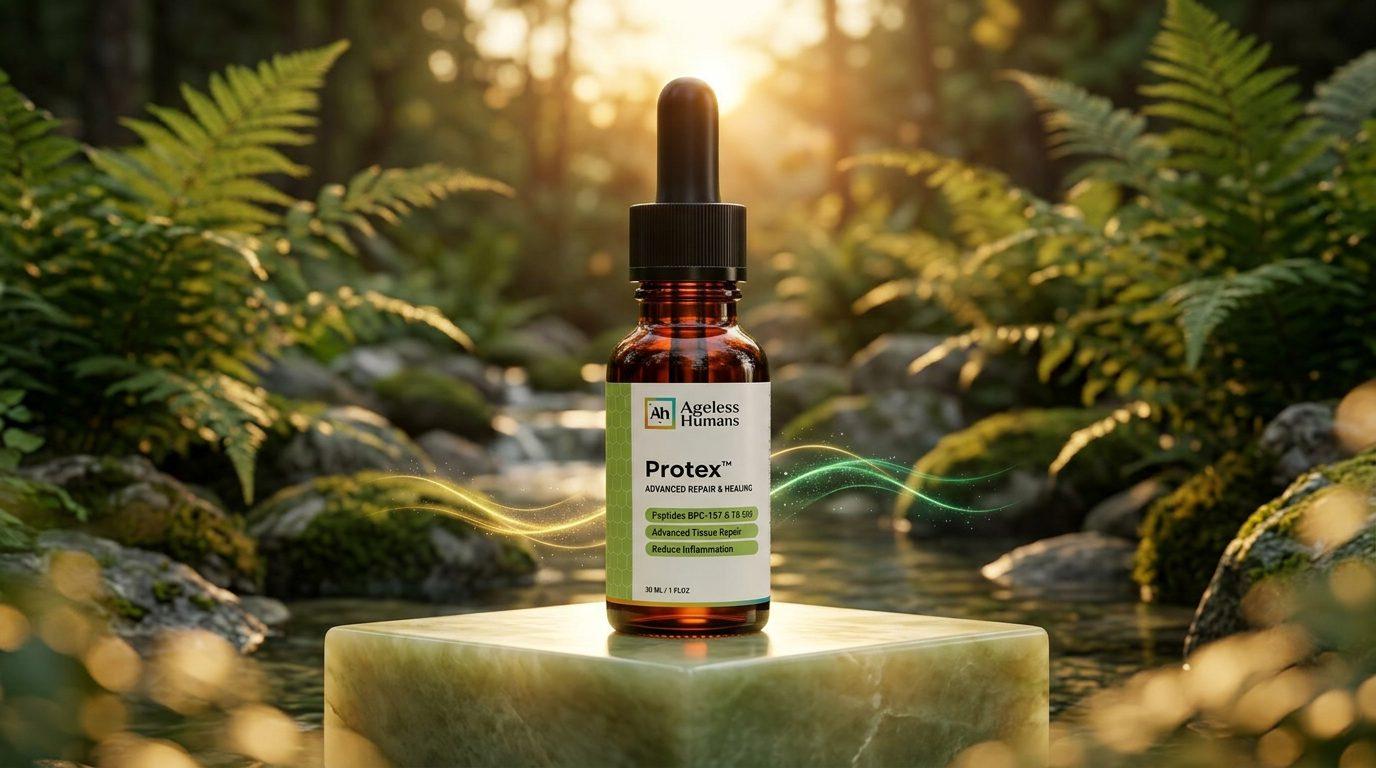
The three peptides most studied for recovery are BPC-157, TB-500, and GHK-Cu, and each fits a different job. BPC-157 has the broadest early research on connective tissue and gut lining, TB-500 is studied for tissue repair and flexibility support, and GHK-Cu is best known for skin and collagen support, mostly in topical form. Most of the evidence comes from animal and lab studies, so the best choice depends on your goal, how you want to take it, and whether you compete in tested sport.
The Short Answer: Match the Peptide to the Recovery Goal
Pick the peptide by the tissue you care about, not by the hype. Each of the big three has a different research focus:
- BPC-157: tendons, ligaments, muscle, and the gut lining. It is the most researched recovery peptide and the one with the strongest case for oral use.
- TB-500: whole-body tissue repair signaling, cell migration, and flexibility. It is often paired with BPC-157 because the two are studied through different pathways.
- GHK-Cu: skin, collagen, and the outer tissue layers. It is the best-supported option for topical use.
If you train hard and want broad support for connective tissue, BPC-157 is the usual starting point. If you want a two-pathway approach, a BPC-157 and TB-500 stack is the most common combination. If your focus is skin quality and the tissue you can actually reach with your hands, GHK-Cu belongs in the conversation. New to the category? Our primer on what peptides are and how they work covers the basics in five minutes.
BPC-157: The Most Researched Recovery Peptide
BPC-157 is a 15-amino-acid peptide derived from a protein found in gastric juice, and it has the deepest body of recovery research of any peptide on this list. Most of that research is preclinical, meaning animal and cell studies. Researchers have studied it in models of tendon, ligament, muscle, and gut tissue, and the findings suggest it may support blood vessel formation, normal tissue repair signaling, and a healthy inflammatory response.
Here is the honest part. Large, controlled human trials are limited. Promising animal data does not automatically carry over to people, and anyone who tells you BPC-157 is proven in humans is overselling it. What you can fairly say is that it is one of the most actively studied peptides for connective tissue support, and interest from athletes has outpaced the clinical literature.
Why athletes like it: researchers describe BPC-157 as unusually stable in stomach acid for a peptide. That matters because most peptides break down in the digestive tract. That stability is the main reason oral BPC-157 is a realistic option rather than a gimmick.
TB-500: Tissue Repair Signaling and Flexibility
TB-500 is a synthetic fragment of thymosin beta-4, a protein your body makes naturally and that plays a role in cell movement and tissue repair. Thymosin beta-4 helps regulate actin, a structural protein cells use to move and rebuild. Research on thymosin beta-4 suggests it may support cell migration to areas that need repair, new blood vessel formation, and normal tissue flexibility.
Like BPC-157, most of the evidence is preclinical. Much of the research was done on the full thymosin beta-4 protein, and TB-500 is a shorter fragment, so be careful about assuming every finding applies to the fragment.
Where TB-500 fits: people tend to use it for broad, whole-body recovery support rather than one specific spot. It is rarely discussed on its own today. Most active people encounter it as half of a BPC-157 stack, because the two are studied through different mechanisms that may complement each other.
GHK-Cu: The Copper Peptide for Skin and Collagen
GHK-Cu is a naturally occurring copper-binding peptide found in human plasma, and it is the best-studied of the three for skin and collagen support. Its levels in the body are reported to decline with age, which is part of why it shows up in both longevity and skincare research. Lab research suggests GHK-Cu may support collagen and elastin production, skin firmness, and the body's normal tissue remodeling processes.
GHK-Cu is different from BPC-157 and TB-500 in one practical way: it has a long track record in topical use. You can apply it directly to the skin over the area you are working on, which makes it a natural fit for post-training routines where you are already using a roll-on or massage.
For athletes, GHK-Cu is not a replacement for BPC-157 or TB-500. Think of it as the outside layer of a recovery routine: skin and surface tissue support, paired with whatever you take internally.
Side-by-Side: How the Three Compare
Here is the quick comparison, based on what the research actually covers:
BPC-157
- Research focus: tendons, ligaments, muscle, gut lining
- Evidence stage: extensive preclinical, limited human data
- Oral practicality: strongest of the three, thanks to its stability in gastric conditions
- Best for: targeted connective tissue and gut support
TB-500
- Research focus: cell migration, tissue repair signaling, flexibility
- Evidence stage: mostly preclinical, much of it on full thymosin beta-4
- Oral practicality: less established on its own; most often used alongside BPC-157
- Best for: broad, whole-body recovery support
GHK-Cu
- Research focus: collagen, elastin, skin structure
- Evidence stage: lab and topical research, longest cosmetic track record
- Oral practicality: mainly used topically
- Best for: skin and surface tissue support
The takeaway: none of these is a magic fix, and none replaces sleep, protein, load management, and smart programming. They are tools that may support the processes your body already runs.
Oral vs. Injectable: The Practical Tradeoffs
For most active people, oral or topical peptides are the more practical choice, and injectables carry real tradeoffs that are easy to underestimate. Injectable peptides are often sold online as research chemicals labeled not for human consumption. That label means no one is standing behind purity, sterility, or dosing accuracy. You are also handling needles, reconstitution, and storage, which adds room for error.
Oral formats trade some theoretical absorption for a large gain in convenience and consistency. BPC-157 is the peptide where oral use makes the most sense, because researchers have specifically noted its stability in stomach acid. You take a capsule, you follow the label, and you know what is in it if the maker publishes lab results.
The honest tradeoff: injection delivers a peptide directly, while oral absorption varies by peptide and formulation. Neither route has large human trials showing one is clearly superior for recovery outcomes. We break down the details in oral BPC-157 vs. injection. Our view: start with a tested oral product and a consistent routine before chasing anything more complicated.
Should You Stack BPC-157 and TB-500?
Stacking BPC-157 and TB-500 is the most popular recovery peptide combination because the two are studied through different pathways. BPC-157 research centers on local tissue and blood vessel support, while TB-500 research centers on cell migration and the actin system. In theory, that makes them complementary rather than redundant.
To be clear, there is very little research testing the two together. The case for stacking is built on their separate mechanisms, not on head-to-head combination trials. That is a reasonable basis for a stack, but it is not proof.
If you want a single product rather than two bottles, Protex oral BPC-157 and TB-500 combines both in capsule form. For timing, how long people typically run a stack, and what to realistically expect, read our full BPC-157 and TB-500 stack guide.
How to Choose a Recovery Peptide You Can Trust
Quality matters more than the peptide you pick, because the peptide market is full of underdosed and mislabeled products. Use this checklist before you buy:
1. Third-party testing with a COA for every lot. If a brand will not show you a certificate of analysis, walk away. 2. A real manufacturing facility. Look for products made in an FDA-registered facility, not repackaged research chemicals. 3. Human-use labeling. Skip anything marked for research use only. 4. Clear label directions. Follow them, and talk to your doctor before starting, especially if you take medications. 5. A guarantee. A brand confident in its product will let you return it.
If you compete in tested sport, check the current WADA Prohibited List first. BPC-157 and thymosin beta-4 related compounds appear on it, and supplement labels will not protect you from a positive test.
Every Ageless Humans product is made in our FDA-registered facility in Carlsbad, California, every lot is third-party lab tested with a COA, and every order is backed by a 60-day money-back guarantee.
Frequently asked questions
What is the best peptide for recovery?+
BPC-157 is the most researched recovery peptide, with preclinical studies on tendons, ligaments, muscle, and gut lining. TB-500 is often paired with it for broader tissue repair support, and GHK-Cu is best suited to topical skin and collagen support. Most of the evidence is from animal and lab studies, so the best choice depends on your goal and preferred format.
Does oral BPC-157 work, or do you need injections?+
Oral BPC-157 is a practical option because researchers describe it as unusually stable in stomach acid, which is rare for a peptide. Injection delivers the peptide directly, but no large human trials show one route is clearly better for recovery outcomes. Oral capsules from a third-party tested brand avoid the sterility, dosing, and sourcing risks of research-chemical injectables.
Can you take BPC-157 and TB-500 together?+
Yes, BPC-157 and TB-500 are commonly stacked because they are studied through different pathways: BPC-157 for local tissue and blood vessel support, TB-500 for cell migration and repair signaling. Very little research tests the two together, so the rationale rests on their separate mechanisms. Follow label directions and check with your doctor before starting.
Is GHK-Cu good for muscle recovery?+
GHK-Cu is best studied for skin and collagen support, not muscle tissue directly. Lab research suggests it may support collagen and elastin production and normal tissue remodeling. For active people, it works best as a topical layer in a recovery routine alongside internal support.
Are BPC-157 and TB-500 banned in sports?+
Yes, BPC-157 and thymosin beta-4 related compounds such as TB-500 appear on the World Anti-Doping Agency Prohibited List. Athletes in tested sport should check the current list before using any peptide product. A supplement label does not protect you from a positive test.
Are recovery peptides proven in humans?+
Not yet in any definitive way. BPC-157, TB-500, and GHK-Cu have promising preclinical research, but large controlled human trials on recovery outcomes are limited. Treat them as tools that may support your body's normal processes, not as replacements for sleep, nutrition, and smart training.