
Glucosamine and collagen support joints in different ways. Glucosamine supplies a building block for the cushioning molecules in cartilage. Collagen supplies the protein framework that cartilage, tendons, and ligaments are built on. Research on both is mixed but real, so the better choice depends on your goal: glucosamine for long-term cartilage comfort, hydrolyzed collagen if you are active and want connective-tissue support, or both together.
The Short Answer: Different Jobs, Same Joint
Pick glucosamine if your main goal is cartilage comfort and mobility as you age. Pick collagen if you want broader connective-tissue support, especially if you train hard. Many people take both because the two don't compete. They work on different parts of the same structure.
Think of cartilage like reinforced concrete. Collagen is the rebar, a woven protein mesh that gives the tissue tensile strength. Glucosamine feeds the concrete, the water-holding gel of proteoglycans that lets cartilage absorb shock. A healthy joint needs both.
Neither supplement works like a fast-acting product. Both are slow, structural plays. Most research runs for weeks to months, and that's the timeframe you should expect too. If you want something you can feel today, you need a different tool, which we cover below.
How Glucosamine Is Thought to Support Cartilage
Glucosamine is an amino sugar your body already makes. It's a raw material for glycosaminoglycans, the molecules that help cartilage hold water and resist compression. The theory behind supplementing is simple. Production of these building blocks may not keep pace with demand as you age, so you give your body more substrate.
What to know about the forms:
- Glucosamine sulfate is the form used in most of the positive European research. The sulfate itself may contribute, since sulfur is part of cartilage chemistry.
- Glucosamine hydrochloride (HCl) is more concentrated per milligram but has a thinner research record on its own.
- Source matters for some people. Most glucosamine comes from shellfish shells. Vegetarian versions made by fermentation exist.
Glucosamine is often paired with chondroitin, another cartilage component. The pairing makes sense on paper, but adding chondroitin hasn't consistently outperformed glucosamine alone in research.
How Collagen Is Thought to Support Joints
Collagen is the most abundant protein in your body and the main structural protein in cartilage, tendons, and ligaments. Supplements come in two very different forms, and they work by different proposed mechanisms.
Hydrolyzed collagen (collagen peptides) is collagen broken into small fragments. Research suggests some of these peptides, especially ones rich in proline and hydroxyproline, survive digestion and reach connective tissue. There they may act as signals that encourage cells to maintain their matrix, not just as raw protein. This form is taken in gram amounts, usually as a powder.
Undenatured type II collagen keeps its original 3D structure. It's taken in very small amounts. Instead of acting as a building block, it's thought to work through the gut's immune tissue, helping the body maintain a balanced response to its own cartilage. It's a different mechanism entirely, so don't judge one form by the other's research.
Collagen also has a broader footprint than glucosamine. The same peptides are studied for tendons, ligaments, skin, and bone. That makes collagen a natural fit if your joint goal is really a connective-tissue goal.
What the Research Actually Shows
Honest summary: both have supportive studies and both have studies showing little effect over placebo. Neither is a sure thing, and anyone who tells you otherwise is overselling.
Glucosamine has the longer research history, with decades of trials, many in older adults with joint discomfort. Results split. Some trials, especially with crystalline glucosamine sulfate, reported benefits for comfort and function. Several large, independently funded trials found results close to placebo. Study design, product form, and who funded the work all seem to matter. Professional guidelines reflect this uncertainty and range from cautious support to skepticism.
Collagen research is newer and smaller but growing fast. Studies of hydrolyzed collagen in active adults and athletes have reported support for joint comfort during activity. Undenatured type II collagen has its own small set of trials with encouraging results. The limitation is that many collagen studies are short, use small groups, and are funded by ingredient makers.
What no one can honestly claim: that either supplement rebuilds lost cartilage in people. Research measures comfort, mobility, and function far more often than tissue changes. The realistic expectation is support for comfort and function over time, not regeneration.
How to Choose: A Practical Decision Guide
Match the supplement to your situation, not to the marketing.
- You're 50+, your main concern is knee or hip stiffness, and you want the most-studied option: start with glucosamine sulfate.
- You lift, run, or play sports and want to support tendons and ligaments along with cartilage: start with hydrolyzed collagen peptides.
- You want a tiny daily capsule instead of a powder: consider undenatured type II collagen.
- You have a shellfish allergy: choose collagen or a non-shellfish glucosamine.
- You want to cover both the protein framework and the cushioning gel: combine glucosamine and collagen. There's no known conflict between them.
Give it a fair trial. Most studies run eight to twelve weeks or longer. Take one approach consistently, follow label directions, and judge it at the end of that window. Don't switch every two weeks.
Check safety first. Glucosamine may interact with blood-thinning medications and may matter for people managing blood sugar. Talk with your clinician before starting if you take any prescription medication, are pregnant, or have a medical condition.
Where Peptide Support Fits
Glucosamine and collagen supply building blocks. Signaling peptides like BPC-157 and TB-500 are studied for a different role: supporting the body's own repair and recovery processes in tendons, ligaments, and soft tissue.
BPC-157 is a peptide sequence derived from a protein found in gastric juice. In preclinical research, mostly animal studies, it has been studied for supporting tendon and ligament recovery, blood vessel formation, and tissue organization. TB-500 is a synthetic fragment of thymosin beta-4, a protein involved in cell movement, and is studied for similar recovery-related roles.
Be clear about the evidence. Most peptide research is preclinical, and human data is limited. The mechanisms are interesting, and many people include peptides in their recovery stack. But they don't have the human trial record that glucosamine and collagen have. For a deeper look at the research, read our guide to BPC-157 for joint and tendon support.
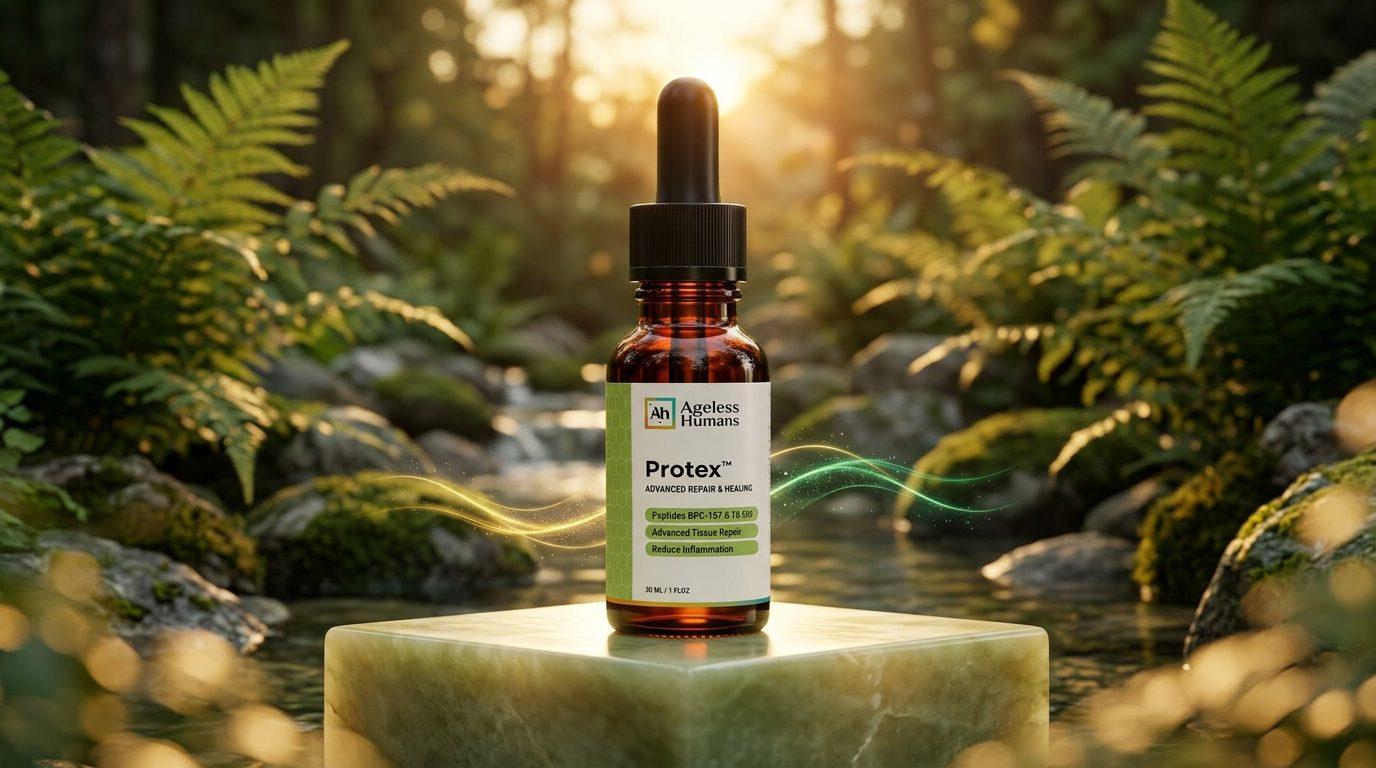
In practice, peptides make the most sense next to a substrate approach, not instead of one. Collagen or glucosamine supplies the materials. Peptides are studied for supporting the processes that put those materials to use. That's why active people often pair them with an oral blend such as Protex BPC-157 & TB-500.
Don't Forget the Fast Layer and the Fundamentals
Oral joint supplements are slow. For day-to-day comfort, many people add a topical, and none of it replaces movement, strength, and body composition.
A topical works locally, right where you feel it, and on a different timeline than anything you swallow. Keeping something like Pain Cream Max in your gym bag gives you targeted, soothing comfort after a hard session while your oral routine works in the background.
The fundamentals still matter most:
- Move daily. Cartilage has no direct blood supply. It gets nutrients from joint fluid that circulates when you move.
- Build the muscle around the joint. Strong quads, glutes, and hips take load off knees and hips.
- Eat enough protein and vitamin C. Your body needs vitamin C to make collagen.
- Manage body weight. Every extra pound adds load to weight-bearing joints with each step.
Supplements support a joint that's already being cared for. They don't replace the care.
Quality Checks Before You Buy
Joint supplements vary widely in form, dose, and purity, so check the label before you trust the claim.
Look for:
- The exact form named: glucosamine sulfate or HCl, collagen peptides or undenatured type II. A vague "joint complex" tells you nothing.
- Amounts that match the research form, not trace amounts used for label decoration.
- Third-party testing with a Certificate of Analysis (COA) for each lot.
- Transparent manufacturing. You should know where and how your supplement is made.
At Ageless Humans, every product is made in our own FDA-registered facility in Carlsbad, California. Every lot is third-party lab tested with a COA, and every order is backed by a 60-day money-back guarantee.
Frequently asked questions
Is glucosamine or collagen better for joints?+
Neither is universally better because they do different jobs. Glucosamine supplies a building block for the shock-absorbing gel in cartilage. Collagen supplies the protein framework of cartilage, tendons, and ligaments. Glucosamine has the longer research history for age-related joint comfort, and collagen is a strong fit for active people who want broader connective-tissue support.
Can you take glucosamine and collagen together?+
Yes. Many people take glucosamine and collagen together because they support different parts of the joint, and there is no known conflict between them. Follow each product's label directions. Check with your clinician first if you take blood thinners or other prescription medications.
How long does it take for glucosamine or collagen to work?+
Both are slow, structural supplements. Most research runs eight to twelve weeks or longer. Take one consistently for at least that long before judging whether it supports your joint comfort and mobility.
Does collagen rebuild cartilage?+
There is no solid evidence that oral collagen rebuilds lost cartilage in people. Research suggests collagen peptides may support joint comfort and help maintain connective tissue, possibly by signaling cells that maintain the cartilage matrix. Expect support over time, not regeneration.
Who should avoid glucosamine?+
People with shellfish allergies should avoid shellfish-derived glucosamine and choose a vegetarian version or collagen instead. Glucosamine may interact with blood-thinning medications and may be relevant for people managing blood sugar. Anyone who is pregnant, nursing, or on prescription medication should talk with a clinician before starting.
How is BPC-157 different from glucosamine and collagen?+
Glucosamine and collagen provide structural building blocks for joint tissue. BPC-157 is a signaling peptide studied, mostly in animal research, for supporting the body's own tendon, ligament, and soft-tissue recovery processes. Human evidence for BPC-157 is still limited, so it is best viewed as a complement to a substrate approach, not a replacement.