
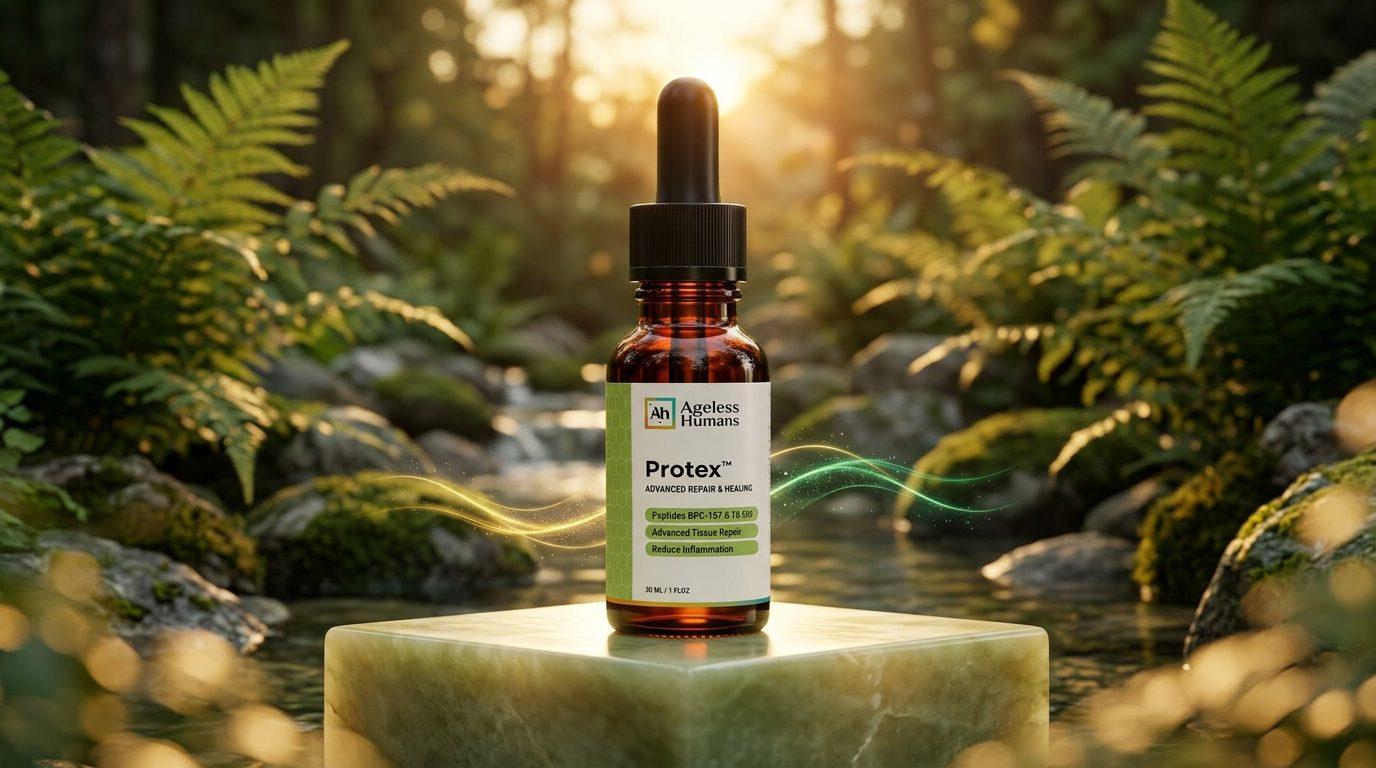
GHK-Cu and vitamin C do different jobs. Vitamin C is a daytime antioxidant that supports brightness and even-looking tone. GHK-Cu is a copper peptide that supports firmness, smoothness, and the skin's own renewal processes. You can use both, but most formulators advise against layering pure vitamin C (L-ascorbic acid) and copper peptides in the same step. The simplest fix is vitamin C in the morning and GHK-Cu at night.
The Short Answer: Use Both, Just Not in the Same Layer
Vitamin C belongs in your morning routine. GHK-Cu belongs in your evening routine. That split keeps each ingredient in the conditions where it works best and sidesteps the copper-ascorbate chemistry question entirely.
These two are not competitors. They are complementary tools that act at different points in how skin looks and holds up over time:
- Vitamin C serum is mainly an antioxidant and brightener. It helps defend skin against visible environmental stress during the day and supports a more even, radiant-looking tone.
- GHK-Cu (copper tripeptide-1) is a signaling peptide. It is studied for supporting the skin's natural production of collagen and elastin, which shows up as firmer, smoother-looking skin.
If you only have room for one, choose based on your main goal. Pick vitamin C for dullness and uneven tone. Pick GHK-Cu for firmness, texture, and skin that looks like it is losing its bounce. If you want both, the rest of this guide shows how to run them without having them work against each other.
What Vitamin C Serum Does for Skin Appearance
Vitamin C works best as a daytime antioxidant that supports brightness, even tone, and collagen structure. It is one of the most studied topical ingredients in skincare, and its strengths are clear.
Antioxidant support. Sunlight and pollution generate free radicals in skin. Vitamin C helps neutralize them. That is why it pairs well with sunscreen in the morning. It does not replace SPF, but it adds a second line of support.
Brightness and tone. Research suggests topical vitamin C helps the look of uneven pigmentation and dullness, giving skin a more radiant, uniform appearance with consistent use.
Collagen support. Vitamin C is a required cofactor for the enzymes that build and stabilize collagen. Without enough of it, the skin cannot assemble collagen properly.
The catch is stability. L-ascorbic acid, the pure and most researched form, oxidizes easily when exposed to air, light, and heat. It is also typically formulated at a low, acidic pH to penetrate skin well. A serum that has turned dark orange or brown has likely oxidized and lost much of its value. Derivatives such as sodium ascorbyl phosphate, ascorbyl glucoside, and tetrahexyldecyl ascorbate are more stable and gentler, though the evidence behind them is generally thinner than for L-ascorbic acid.
What GHK-Cu Does for Skin Appearance
GHK-Cu is a naturally occurring copper peptide studied for supporting the skin's own repair and remodeling signals, which helps skin look firmer, smoother, and more resilient. The body produces GHK on its own, and research suggests its levels decline with age. That decline is one reason it gets so much attention in longevity-focused skincare.
Rather than acting as a shield the way vitamin C does, GHK-Cu acts as a messenger. Lab and cosmetic research has studied it for:
- Supporting the skin's natural production of collagen, elastin, and glycosaminoglycans, the structural materials behind firm, plump-looking skin
- Promoting a smoother texture and softening the look of fine lines
- Supporting a comfortable, healthy-looking skin barrier
- Contributing its own antioxidant activity
GHK-Cu is happiest in a near-neutral pH and does not need sunlight protection the way L-ascorbic acid does. That makes it a natural fit for nighttime, when skin is not dealing with UV exposure. For a deeper look at the research, see our full guide to GHK-Cu benefits.
The Copper-Ascorbate Stability Debate, Explained Honestly
The concern is real chemistry, but how much it matters on your face is less clear. Here is what is well established and what is still open.
What is well established:
1. Copper speeds up vitamin C oxidation. In solution, copper ions are a classic catalyst for breaking down ascorbic acid. Vitamin C can also reduce copper from one form to another, and that reaction can generate reactive oxygen species. That is the opposite of what you want from an antioxidant. 2. pH conflict. L-ascorbic acid serums are usually strongly acidic. GHK-Cu prefers a near-neutral environment, and low pH can loosen the bond between the peptide and its copper. A loosened complex may not deliver the intended benefit. 3. Formulators avoid combining them in one product. That is a strong practical signal. Stable combination formulas are difficult to make.
What is not well established:
There is little direct published research on what happens when you apply two separate products, one after the other, on living skin. Some dermatologists consider the risk overstated. Others say it is not worth testing on your own face. Nobody can honestly tell you that layering them will ruin your results, and nobody can promise it is fine either.
The practical takeaway: you lose nothing by separating them, and you remove the uncertainty. That is why the AM/PM split is the default recommendation. It costs you nothing, and it puts each ingredient in its ideal conditions.
The AM/PM Split Routine (Step by Step)
Run vitamin C in the morning with sunscreen and GHK-Cu at night. This is the cleanest, lowest-risk way to use both.
Morning routine:
1. Gentle cleanser 2. Vitamin C serum on dry skin. Let it absorb for a minute or two. 3. Lightweight moisturizer, if you need one 4. Broad-spectrum sunscreen. This step is not optional, and it works with vitamin C, not against it.
Evening routine:
1. Cleanser. Double cleanse if you wore sunscreen or makeup. 2. Hydrating toner or essence, if you use one 3. GHK-Cu serum or cream 4. Moisturizer, if your GHK-Cu product is not already a cream
This split also helps with a few other common conflicts. Keep strong exfoliating acids (AHAs and BHAs) away from your GHK-Cu step for the same pH reasons. If you use a retinoid, many people alternate retinoid nights with GHK-Cu nights, which also makes it easier to see how your skin responds to each.
Alternatives If the AM/PM Split Doesn't Fit Your Routine
If you only do one skincare session a day, alternate days or switch to a vitamin C derivative. These options are the next best choices.
- Alternate days. Use vitamin C one morning and GHK-Cu the next evening, or simply alternate by day. You still get both ingredients, just less often.
- Use a gentler vitamin C derivative. Forms like sodium ascorbyl phosphate or tetrahexyldecyl ascorbate work at a higher pH and are less reactive than L-ascorbic acid. Many people find them easier to fit into a routine alongside peptides. Even so, applying them in separate steps or sessions is still the more conservative choice.
- If you must layer in one session: apply vitamin C first, wait until it has fully absorbed (several minutes to longer), then apply GHK-Cu. This is the least ideal option. The evidence is not settled, so treat it as a compromise rather than a best practice.
Whichever approach you choose, introduce one new product at a time and patch test first. Copper peptides and strong vitamin C serums can each cause tingling or redness in sensitive skin, and adding both at once makes it impossible to tell which one is responsible.
Which One Should You Prioritize?
Choose by your main concern: vitamin C for tone and radiance, GHK-Cu for firmness and texture. Here is a quick way to decide.
| Your main goal | Lean toward |
|---|---|
| Dull, uneven-looking tone | Vitamin C (AM) |
| Daytime antioxidant support | Vitamin C (AM) |
| Firmness and bounce | GHK-Cu (PM) |
| Smoother texture, softer-looking lines | GHK-Cu (PM) |
| Sensitive skin that reacts to acids | GHK-Cu, or a gentle vitamin C derivative |
| Comprehensive routine | Both, split AM/PM |
A few honest notes:
- Consistency beats intensity. Either ingredient needs weeks of steady use before you can fairly judge results. Switching products every few days tells you nothing.
- Sunscreen matters more than either one. Daily sun protection is the foundation every other active builds on.
- Formulation matters. A well-made product with a stable form, sensible packaging (opaque and airtight for vitamin C), and transparent testing will outperform a trendy label.
For the bigger picture on building a routine around long-term skin health, see our skin longevity guide.
How to Tell If a Product Is Worth Using
Look for a stable form, protective packaging, and proof of what is inside. Both ingredients are easy to under-dose, poorly stabilize, or mislabel.
For vitamin C serums:
- Check which form is listed and where it falls in the ingredient list
- Choose opaque, airtight, or pump packaging
- Throw it out if it turns dark orange or brown
For GHK-Cu products:
- Look for "copper tripeptide-1" on the label
- Expect a faint blue tint in many formulas, which comes from the copper complex
- Avoid products that combine copper peptides with strong acids in the same formula
For any product: ask for third-party testing. At Ageless Humans, every product is made in our FDA-registered facility in Carlsbad, California, and every lot is third-party lab tested with a Certificate of Analysis (COA). Every product is also backed by a 60-day money-back guarantee, so you can give a routine the time it needs to show results.
Frequently asked questions
Can I use GHK-Cu and vitamin C together?+
Yes, but most experts recommend not layering pure vitamin C (L-ascorbic acid) and GHK-Cu in the same step. Copper can speed up vitamin C oxidation, and the two prefer very different pH levels. The simplest approach is to use vitamin C in the morning and GHK-Cu at night.
Should I use vitamin C or GHK-Cu in the morning?+
Use vitamin C in the morning. It works as an antioxidant that supports skin against daytime environmental stress, and it pairs well with sunscreen. Save GHK-Cu for your evening routine, where it supports the skin's natural overnight renewal processes.
Do copper peptides really cancel out vitamin C?+
In a bottle or solution, copper ions are known to catalyze the breakdown of ascorbic acid, and that is well-established chemistry. There is little direct research on what happens when the two are applied as separate products on skin, so the real-world impact is uncertain. Separating them into AM and PM routines removes the risk at no cost.
Is GHK-Cu better than vitamin C for aging skin?+
Neither is better overall because they do different jobs. Vitamin C mainly supports brightness, even tone, and antioxidant defense. GHK-Cu is studied for supporting the skin's own collagen and elastin production, which helps with firmness and texture. Many people use both for a more complete routine.
Can I use a vitamin C derivative with GHK-Cu?+
Derivatives like sodium ascorbyl phosphate or tetrahexyldecyl ascorbate are more stable and work at a higher pH than L-ascorbic acid, so many people find them easier to pair with copper peptides. Applying them in separate steps or at separate times of day is still the more conservative choice. Patch test any new combination before using it on your whole face.
How long does it take to see results from GHK-Cu or vitamin C?+
Both ingredients need consistent use over several weeks before you can fairly judge results, and individual responses vary. Use them as directed, wear sunscreen every day, and introduce one product at a time so you can tell what is working.