
The right peptide depends on the one outcome you care about most. For training recovery, BPC-157 and TB-500 are the most-studied pairing. For skin firmness and texture, topical GHK-Cu is the best fit. For mental energy and focus, NAD+ (a coenzyme, not technically a peptide) is the better match. Sleep is the exception: no peptide has strong human evidence there, so sleep habits come first. Pick your top goal below, or take our quiz for a personalized answer.
The Quick Decision Tree: Match Your Goal to the Compound
Start with the problem you notice most often, then follow the match. Most people waste time and money because they buy the most popular peptide instead of the one built for their goal. Use this tree first:
- Sore, stiff, or slow to bounce back after training? → Recovery: BPC-157 + TB-500
- Skin looking less firm, less even, or less bright? → Skin: GHK-Cu, applied topically
- Afternoon fog, harder focus, energy that fades by 3 p.m.? → Cognition and energy: NAD+ support
- Trouble winding down or waking up unrefreshed? → Sleep: habits first; peptides second, if at all
If more than one applies, choose the goal that affects your day most. The sections below explain what each compound is, what it has been studied for, and where the evidence is still thin. If you'd rather skip the reading, our 2-minute quiz asks about your goals, routine, and preferences, then points you to a starting point.
Recovery: BPC-157 and TB-500
If your goal is bouncing back from training, BPC-157 paired with TB-500 is the most logical starting point. These two are the most-discussed recovery peptides, and they are studied for different parts of the same process.
BPC-157 is a 15-amino-acid sequence derived from a protein found in gastric juice. It has been studied mostly in lab and animal models for its role in tissue repair processes in tendons, ligaments, muscle, and the gut lining. Research also suggests it is relatively stable in stomach conditions. That stability is one reason oral forms exist.
TB-500 is a synthetic fragment of thymosin beta-4, a protein your body uses to regulate actin, part of the machinery cells use to move and rebuild. It has been studied for supporting cell migration and tissue repair processes.
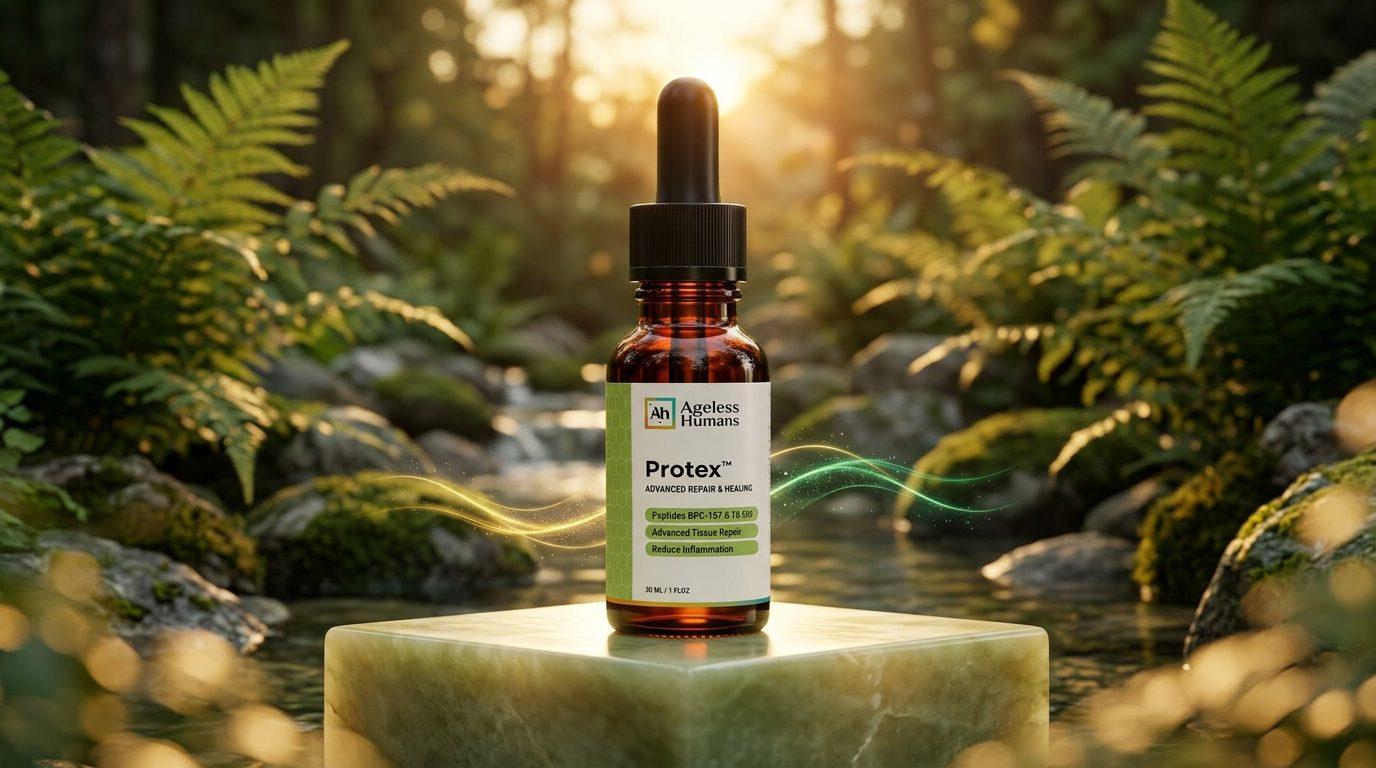
The honest part: most of this research is preclinical. Human clinical data is limited, so treat bold online claims with skepticism. This category fits people who train hard, have physically demanding jobs, or notice recovery taking longer than it used to. For a deeper breakdown of every option, read our guide to the best peptides for recovery. If you'd rather avoid needles, Protex BPC-157 & TB-500 oral peptides combine both in capsule form to support recovery after training.
Skin: GHK-Cu, and Why Topical Matters
If your goal is firmer, smoother, more even-looking skin, GHK-Cu applied to the skin is the best-matched peptide. It is one of the most researched peptides in skincare, and it works where you put it.
GHK-Cu is a tripeptide (glycine, histidine, lysine) bound to copper. It occurs naturally in human plasma, and research suggests levels decline with age. In topical studies it has been looked at for supporting collagen and elastin production, skin firmness, and the appearance of fine lines. That is why it shows up in serious skincare formulas rather than in capsules.
Why topical: skin peptides need to reach skin cells. A cream delivers GHK-Cu directly to the tissue you want to support. Pairing it with NAD+, which cells use for energy and repair processes, is a logical combination for aging skin. Radium NAD + GHK-Cu cream is built on that pairing.
Set realistic expectations. Skin turns over slowly, so changes build over weeks of consistent use, not days. Daily sunscreen, sleep, and hydration still do the heavy lifting. A peptide cream supports that foundation. It does not replace it.
Cognition and Mental Energy: Where NAD+ Fits
If your goal is sharper focus and steadier mental energy, NAD+ support is the better match than any single peptide. That is worth saying plainly, because NAD+ is not a peptide. It is a coenzyme every cell uses to turn food into usable energy.
It belongs in this guide because people searching for brain peptides usually want one outcome: to think clearly and stay energized through the day. Your brain is one of the most energy-hungry organs in your body, and research suggests NAD+ levels decline with age. Supporting NAD+ is a direct way to support the cellular energy production behind focus.
You'll also see nootropic peptides such as Semax and Selank discussed online. They have been studied, mostly outside the U.S., but the human evidence is limited and they are not part of our catalog. We would rather point you to something with a clearer purpose.
Delivery matters here too. A nasal spray is a fast, needle-free way to use NAD+, though research on intranasal NAD+ is still early. RockitFuel with Focus NAD+ nasal spray is designed for people who want to support mental energy and focus without another pill.
Sleep: The Honest Answer
If sleep is your main goal, no peptide is the right first move. Sleep habits are. The sleep peptides discussed online, such as DSIP (delta sleep-inducing peptide), have thin and inconsistent human evidence. We don't sell a sleep peptide, and we won't pretend one is proven.
What consistently supports better sleep:
- A fixed wake time, seven days a week
- Morning daylight within an hour of waking
- A cool, dark, quiet bedroom
- A caffeine cutoff about eight hours before bed
- Less alcohol, which tends to fragment sleep even when it helps you fall asleep
Sleep also connects to the other goals. Hard training without enough recovery can leave you wired and sore. Low daytime energy can push you toward late caffeine. Supporting recovery or daytime energy won't fix a poor routine, but it can remove some friction. If sleep problems persist for weeks, talk with a healthcare provider.
Multiple Goals? How to Prioritize and Layer
Start with one goal, give it a consistent run, then add the next. Starting everything at once makes it impossible to know what's working.
A simple order:
1. Pick the goal that costs you the most day to day. For an athlete, that's usually recovery. For someone at a desk, it's often focus. 2. Use one product consistently, following label directions, for several weeks. 3. Track one or two simple markers. Soreness the day after training, a mid-afternoon focus rating, or a monthly photo of your skin in the same light. 4. Then layer the next goal.
Layering works well because these products use different routes. A topical cream, an oral capsule, and a nasal spray don't compete for the same delivery path, so building a routine across goals is simple. If you take medications, are pregnant or nursing, or have a health condition, check with your healthcare provider before adding anything. Not sure where to start? The Ageless Humans quiz ranks your goals for you.
How to Vet Any Peptide Product Before You Buy
The right peptide only helps if the product contains what the label says. Peptides are a fast-growing, loosely policed category, so quality checks matter as much as goal matching.
Use this checklist on any brand, including ours:
- Where is it made? Look for a named, registered manufacturing facility, not a vague 'imported' label.
- Is every lot third-party tested? Ask for the certificate of analysis (COA). A reputable brand will share it.
- Is the label specific? You should see clear ingredient amounts, not just 'proprietary blend.'
- Is the language responsible? Any product promising to cure or treat a condition is a red flag. Supplements support normal body function. They don't replace medical care.
- Is there a real guarantee? Confidence shows up in the return policy.
At Ageless Humans, every product is made in our own FDA-registered facility in Carlsbad, California. Every lot is third-party lab tested with a COA, and every order is backed by a 60-day money-back guarantee.
Frequently asked questions
Which peptide is best for beginners?+
The best beginner peptide is the one that matches your single most important goal: BPC-157 and TB-500 for training recovery, or topical GHK-Cu for skin. Start with one product, follow the label directions, and use it consistently for several weeks before adding anything else. That way you can tell whether it's working for you.
Is NAD+ a peptide?+
No. NAD+ is a coenzyme, not a peptide. Every cell uses it to convert nutrients into energy. It often appears alongside peptides because people looking for focus, energy, or healthy-aging support tend to research both, and research suggests NAD+ levels decline with age.
Can I use a recovery peptide and a skin peptide at the same time?+
Generally yes, because they use different routes. Recovery peptides like BPC-157 and TB-500 are often taken orally, while GHK-Cu is applied to the skin. Many people still prefer to start one at a time so they can judge each product's effect. Check with your healthcare provider if you take medications or have a health condition.
Do oral peptides work, or do they need to be injected?+
It depends on the peptide. BPC-157 has been noted in research for being relatively stable in stomach conditions, which is why oral forms exist, while many other peptides break down during digestion. Most peptide research is preclinical, so human data comparing oral and injected forms is limited. Oral capsules are a needle-free option for people who want a simpler routine.
Is there a peptide that helps with sleep?+
No peptide currently has strong human evidence for supporting sleep. DSIP is often discussed online, but research on it is thin and inconsistent. A fixed wake time, morning daylight, a cool dark bedroom, and an early caffeine cutoff are better-supported first steps. Talk with a healthcare provider if sleep trouble persists.
How long does it take to notice results from peptides?+
It varies by goal and by person. Skin changes from topical GHK-Cu build gradually because skin renews slowly, so plan on weeks of consistent use. Recovery and energy support may feel more noticeable day to day. Tracking one simple marker, like next-day soreness or afternoon focus, helps you judge progress honestly.