
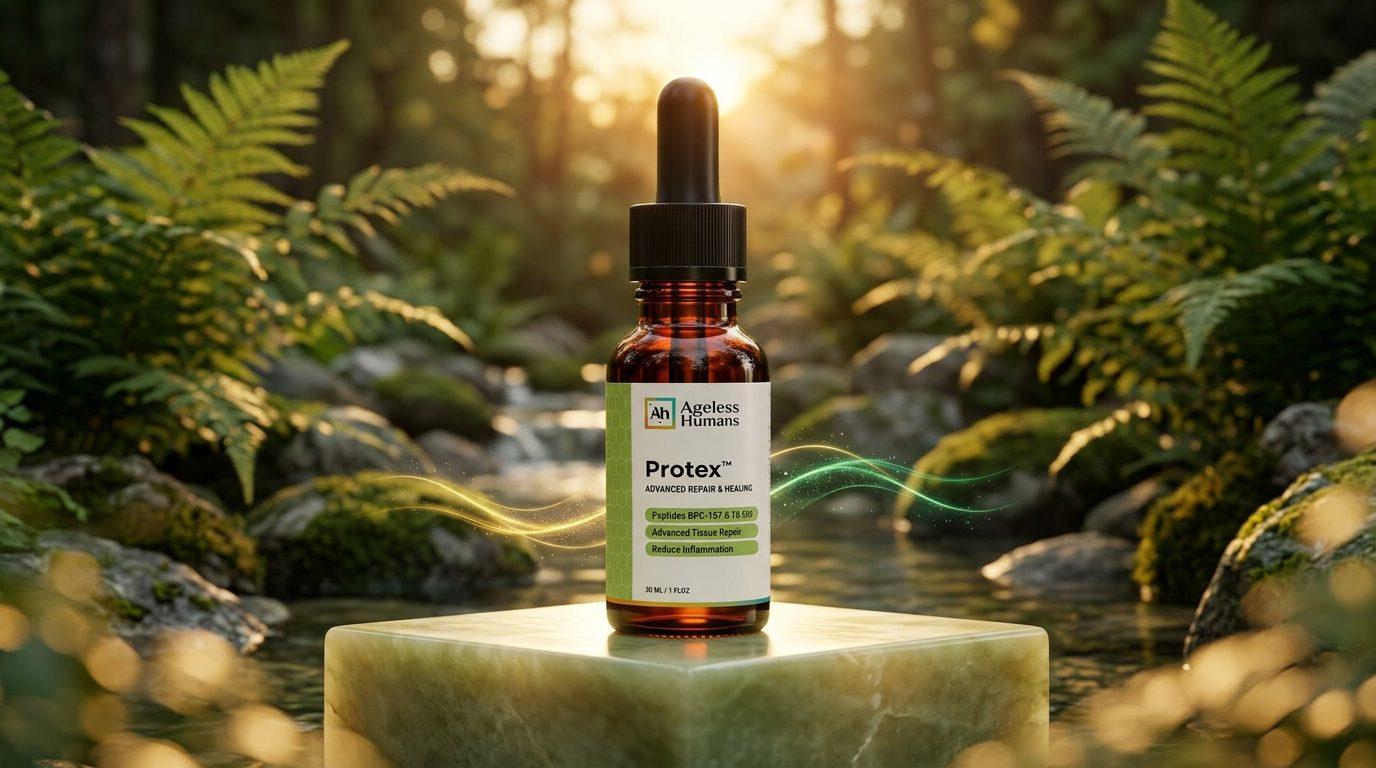
PDA (pentadeca arginate) is a modified form of BPC-157, a 15-amino-acid peptide studied for its role in tissue signaling and blood-vessel formation. TB-500 is a synthetic peptide based on the active region of thymosin beta-4, a protein that regulates actin, the cell's internal scaffolding. They come from different molecular families and act on different pathways, and neither has strong human clinical evidence. Most of what is known comes from cell and animal research.
The Short Answer: Different Origins, Different Pathways, Similar Evidence Gaps
PDA and TB-500 are not two versions of the same thing. PDA traces back to BPC-157, a sequence first isolated from a protein in gastric juice. TB-500 traces back to thymosin beta-4, a protein found in nearly every human cell. People often group them together because both come up in conversations about tissue recovery. Their molecular stories are separate.
Here is the core contrast:
- PDA: a BPC-157 analog. Researchers have mostly studied the BPC-157 lineage in relation to growth-factor signaling, nitric oxide pathways, and new blood-vessel formation (angiogenesis).
- TB-500: a thymosin beta-4 fragment. Its parent protein has mostly been studied for actin binding, which governs how cells move, migrate, and organize.
- Shared limitation: both have a preclinical evidence base, meaning cell cultures and animal models, with very little published controlled human research.
If you have already read our deep dives on PDA (pentadeca arginate) benefits and TB-500 benefits, this article puts the two side by side.
What PDA Is: A Modified BPC-157
PDA is BPC-157's 15-amino-acid sequence paired with an arginate (arginine salt) modification. The goal of the modification is stability. Standard BPC-157 is often sold as an acetate salt. The arginate form is promoted as more stable and possibly better tolerated by the body. That is the main reason PDA exists as a separate product category.
This is the most important point about PDA's evidence: almost all of the research people cite for PDA was actually done on BPC-157. Published, peer-reviewed studies on the arginate form itself are scarce. The working assumption is that PDA behaves like BPC-157 because the active peptide sequence is the same. That assumption is reasonable, but it has not been directly confirmed in head-to-head published research.
The BPC-157 literature, mostly rodent studies from a small number of research groups, has looked at the peptide's relationship to:
- Angiogenesis signaling, including VEGF receptor pathways
- Nitric oxide system interactions
- Fibroblast behavior in tendon and connective-tissue models, including cell outgrowth and migration
- Gut-lining integrity, which fits its gastric origin
When you see claims about PDA, ask one question: is this a PDA study, or a BPC-157 study being applied to PDA? Usually it is the second.
What TB-500 Is: A Thymosin Beta-4 Fragment
TB-500 is a synthetic peptide modeled on the active region of thymosin beta-4 (Tβ4), a 43-amino-acid protein that binds actin. Actin is one of the most abundant proteins in your cells. It forms filaments that let cells change shape and crawl toward where they are needed. Tβ4 holds individual actin units in reserve, which helps control that process.
TB-500 is usually described as built around Tβ4's actin-binding region, the short stretch most associated with the protein's activity. The idea is to keep the functional piece in a smaller, simpler molecule.
The research picture has a twist that mirrors PDA's. Most published work studies full-length thymosin beta-4, not TB-500 specifically. Tβ4 has been studied in animal and cell models for:
- Cell migration toward areas under repair
- Angiogenesis and blood-vessel organization
- Inflammatory signaling modulation
- Wound and tissue repair models, including skin, eye, and muscle research
Full-length Tβ4 has also appeared in some early-stage human research programs. That makes its research history somewhat broader than BPC-157's. TB-500 the fragment, however, borrows most of its reputation from its parent protein.
Mechanism Contrast: Signaling vs Scaffolding
The simplest way to remember the difference: the BPC-157/PDA line is studied mainly as a signaling modulator, and the thymosin line is studied mainly as a cytoskeleton regulator. One influences the chemical messages cells receive. The other influences the physical machinery cells use to move.
BPC-157 / PDA, studied pathways:
- Growth-factor and receptor signaling linked to blood-vessel formation
- Nitric oxide pathway interactions
- Fibroblast activity in connective-tissue models
- Often discussed as having localized effects, partly because of its gut-protein origin
TB-500 / Thymosin beta-4, studied pathways:
- Actin sequestration and cytoskeletal organization
- Cell migration and motility
- Angiogenesis, with some overlap with the BPC-157 line
- Often discussed as having broader, systemic effects because Tβ4 is present throughout the body
The "local vs. systemic" framing is common in enthusiast communities, but treat it as a rule of thumb, not settled science. Researchers have not mapped either compound's distribution in the human body well enough to make that call with confidence. Both lines do touch angiogenesis, which is one reason people discuss them as complementary rather than competing.
Research Maturity: An Honest Scorecard
Neither PDA nor TB-500 has robust human clinical evidence. Their parent compounds have more research than they do. Here is how the evidence stacks up, from most to least studied:
1. Thymosin beta-4 (full-length): the broadest body of work. It includes extensive cell and animal research and some early-stage human research programs. Its biology, including actin binding, is well characterized. 2. BPC-157: a sizable animal literature, mostly rodent models, concentrated in a limited number of research groups. Controlled human data is minimal. 3. TB-500 (the fragment): limited direct research. Much of its rationale is inferred from Tβ4. 4. PDA (the arginate form): the least direct published research. Its rationale is inferred almost entirely from BPC-157.
This ranking does not mean one is "better." It means the further you move from the parent molecule, the more you are relying on inference. Any brand that claims proven human results for PDA or TB-500 is going beyond the published evidence.
What the research does not show: established human doses, long-term safety data in humans, or head-to-head comparisons between PDA and TB-500. Nobody has run that comparison study. Articles that crown a winner are giving opinion, not evidence.
Stability, Form, and Practical Differences
The practical differences come down to molecular stability, delivery form, and regulatory status. These matter as much as mechanism when people compare products.
- Stability: PDA's arginate modification exists to improve stability over BPC-157 acetate. BPC-157 itself is often described as unusually stable for a peptide, especially in stomach acid, which is part of why oral forms exist. TB-500 is a short, simple peptide, but there is less published discussion of its oral stability.
- Delivery: Peptides are generally broken down in digestion. Oral delivery is a real question for any peptide, and you should weigh it honestly. BPC-157's gastric origin makes it the strongest candidate in this group for oral formats.
- Sport testing: Both BPC-157 and TB-500 appear on the World Anti-Doping Agency prohibited list. If you compete in a tested sport, check current WADA rules before using any product that contains them.
- Regulatory environment: Peptide regulation has shifted in recent years. Buy from manufacturers who are transparent about sourcing, testing, and what their products are.
Why People Pair Them, and How to Choose
Many people don't choose between the two. They pair the BPC-157 line with TB-500 because the two are studied through different, overlapping pathways. The logic is straightforward: one line supports signaling, the other supports cellular movement and scaffolding. No published human study has tested the pairing, so this is a rationale, not a proven synergy.
If you are deciding, here are honest questions to ask:
- What does the label actually contain? "PDA" and "BPC-157" are not interchangeable on a label, even if their sequences overlap.
- Is every lot tested? Peptide quality varies widely. Insist on a third-party Certificate of Analysis (COA) for the specific lot.
- Who makes it, and where? Domestic manufacturing in a registered facility gives you accountability.
- Does the brand overclaim? Phrases like "heals," "cures," or "clinically proven" are a red flag for this category.
- Are you in tested sport? If so, the WADA issue may settle the question for you.
Always follow label directions. Talk to a qualified healthcare provider before starting any peptide, especially if you are pregnant, nursing, take medication, or have a medical condition.
Frequently asked questions
Is PDA the same as BPC-157?+
PDA (pentadeca arginate) uses the same 15-amino-acid sequence as BPC-157 but pairs it with an arginate salt instead of the more common acetate. The modification is meant to improve stability. Nearly all the research cited for PDA was conducted on BPC-157, and direct published studies on the arginate form are scarce.
What is the main difference between PDA and TB-500?+
PDA is a BPC-157 analog studied mainly in relation to growth-factor signaling, nitric oxide pathways, and blood-vessel formation. TB-500 is a fragment of thymosin beta-4, a protein that binds actin and helps regulate how cells move and organize. They come from different molecular families and act on different, partly overlapping pathways.
Which has more research, PDA or TB-500?+
Neither has strong human clinical evidence. Their parent compounds have more research: thymosin beta-4 has the broadest research history, including some early human research programs, and BPC-157 has a sizable animal literature. TB-500 and PDA themselves have limited direct published research and rely mostly on inference from those parent molecules.
Can PDA and TB-500 be taken together?+
Many people pair the BPC-157 line with TB-500 because the two are studied through different pathways, signaling on one side and cytoskeletal regulation on the other. No published human study has tested the combination, so any synergy is a rationale, not a proven result. Follow label directions and consult a healthcare provider before combining peptides.
Are PDA and TB-500 banned in sports?+
BPC-157 and TB-500 both appear on the World Anti-Doping Agency (WADA) prohibited list. PDA is a BPC-157 analog, so athletes should assume it raises the same concern. Anyone competing in a tested sport should check current WADA rules and their governing body before using these compounds.
Do oral peptides like BPC-157 and TB-500 work?+
Most peptides are broken down during digestion, so oral delivery is a fair question. BPC-157 was originally derived from a gastric protein and is often described as unusually stable in stomach acid, which is the main rationale for oral formats. Human data on oral absorption of these peptides is limited.