
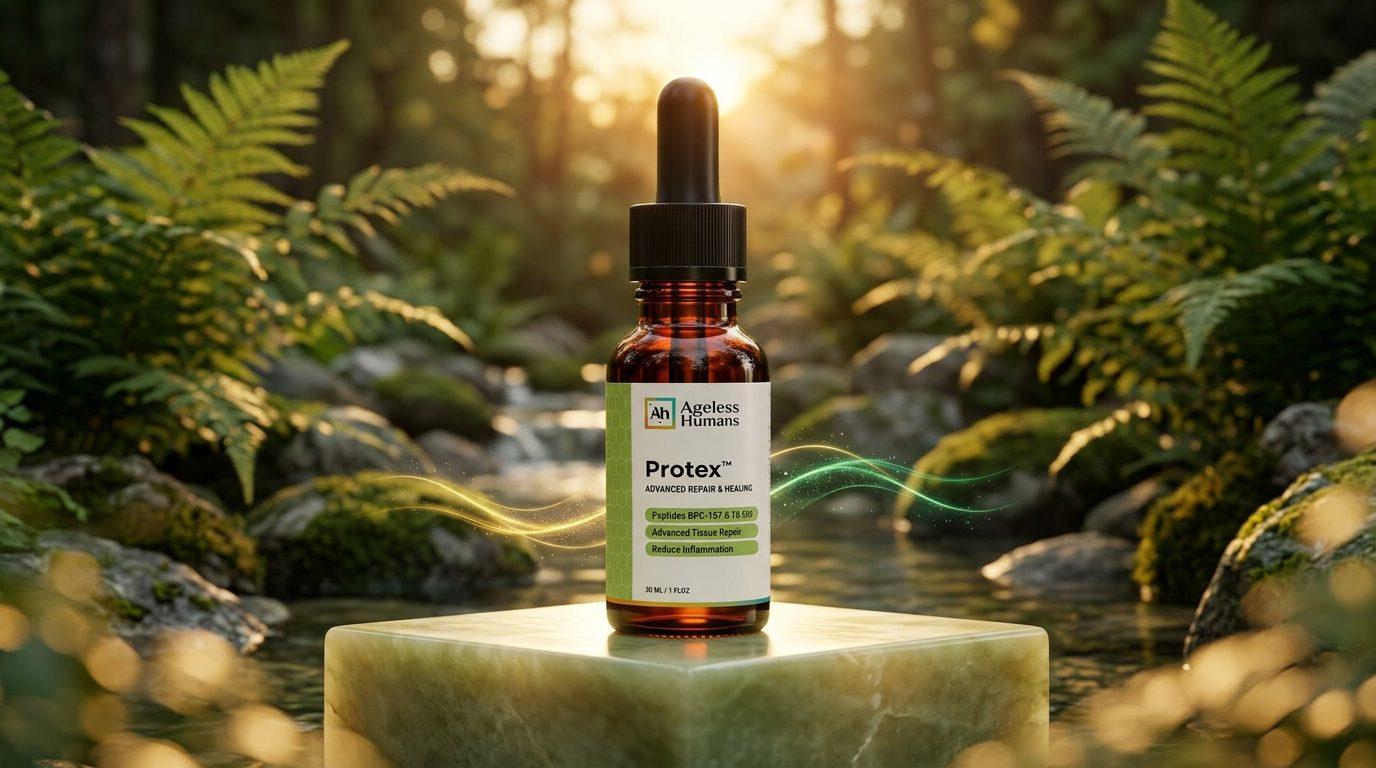
You shouldn't give your dog your own BPC-157 supplement. Human formulas are sized for adult human body weight and metabolism, and they may contain flavorings, sweeteners, or capsule ingredients that were never evaluated for dogs. If you want peptide support for your dog, use a formula made for dogs, follow its weight-based label directions, and talk with your veterinarian first.
The Short Answer: Your Bottle Isn't Your Dog's Bottle
A human BPC-157 product is designed, sized, and labeled for people. It is not a scaled-down dog product. The peptide may be the same molecule, but almost everything around it was chosen with a human in mind: the amount per serving, the capsule or tablet size, the inactive ingredients, the flavoring, and the label directions.
Pet owners often reason that a dog needs "a smaller piece" of the human serving. That logic breaks down in three places:
- Serving math. Dogs don't process compounds like small humans, so dividing by body weight is unreliable.
- Formulation. Ingredients that are harmless to people can be a problem for dogs.
- Labeling. A human label offers no weight-based directions for a 12-pound terrier or a 90-pound shepherd.
A dedicated pet formula addresses all three. Your veterinarian can confirm whether peptide support makes sense for your dog at all. For a broader look at safety, see our peptides for dogs safety guide.
Why Serving Size by Weight Isn't Simple Division
Dogs and humans differ in metabolism, digestion, and how quickly they clear compounds, so you can't just divide a human serving by body weight. A 25-pound dog does not equal one-sixth of a 150-pound adult.
Veterinary and pharmacology science uses a concept called allometric scaling. Smaller animals tend to have faster metabolic rates per pound than larger ones, which is why serving sizes across species are often based on body surface area or metabolic rate instead of straight weight. Dogs also vary widely among themselves. A Chihuahua and a Great Dane are the same species with very different needs.
Other factors matter too:
- Digestive transit. Dogs have a shorter, more acidic digestive tract than people. That can affect how an oral ingredient behaves on its way through.
- Age and life stage. Puppies, adults, and seniors process things differently.
- Breed and health status. Some breeds have known sensitivities, and existing health conditions change the picture.
- Other supplements and medications. Combining products can stack ingredients in ways you won't catch by reading a single label.
This is why a pet product should come with weight-based label directions written for dogs, and why your vet is the right person to apply them to your specific animal. We don't give serving recommendations beyond the product label, and you shouldn't improvise one from a human bottle.
Formulation: What Else Is in the Capsule
The peptide is only part of a supplement. The inactive ingredients are where human and pet products often differ most. Every capsule or tablet includes fillers, flow agents, coatings, and sometimes flavors or sweeteners. Manufacturers choose them for the intended user.
Things to watch for when people consider sharing a human product:
- Sweeteners. Some human supplements, especially chewables, gummies, and flavored powders, use sugar alcohols. Xylitol is well documented as dangerous to dogs. Always check every label, and never give a dog a human product that contains it.
- Flavorings and botanicals. Herbs, essential oils, and flavor systems made for people may not suit dogs.
- Capsule size. A capsule sized for an adult human can be hard for a small dog to swallow. Opening or splitting it changes how evenly the contents are divided and may expose ingredients meant to stay protected.
- Combination formulas. Many human products pair peptides with vitamins, minerals, or other actives sized for people. Those extras weren't chosen with dogs in mind.
A formula made for dogs starts from the other direction. It picks ingredients, format, and palatability for the animal that will actually take it.
What a Dedicated Pet Formula Changes
A pet peptide formula changes the serving structure, the format, the ingredient choices, and the label, so you aren't guessing. Here's what that looks like in practice:
1. Dog-specific label directions. Serving guidance is organized by your dog's weight range, so owners of small and large dogs both have a clear starting point to review with their vet. 2. Format built for dogs. Pet formulas are designed to be given easily, whether that means a size that works across breeds or a format you can add to food. 3. Ingredient choices for dogs. Inactive ingredients are chosen with canine tolerance in mind, without human-oriented sweeteners or flavor systems. 4. Fewer unnecessary extras. A focused pet formula avoids the add-ons common in human "stack" products.
That's the thinking behind ProteX Pets BPC-157 + TB-500 for Dogs. It pairs the same two peptides we use in our human line with dog-specific label directions. Like every Ageless Humans product, it's made in our FDA-registered facility in Carlsbad, California, and each lot is third-party lab tested with a Certificate of Analysis (COA).
What the Research Does and Doesn't Show
Most BPC-157 research is preclinical, meaning lab and animal studies. Controlled studies in companion dogs are very limited. Anyone who tells you otherwise is overselling.
What we can say honestly:
- BPC-157 is a short peptide, 15 amino acids long, derived from a protein found in gastric juice. It has been studied in lab models for its role in supporting tissue repair processes, gut lining integrity, and recovery.
- TB-500 is a synthetic fragment of thymosin beta-4, a naturally occurring protein. It has been studied for its role in cell migration and tissue recovery processes.
- Much of the published work comes from rodent models. Results in rodents don't automatically apply to people or dogs.
- Rigorous, published clinical trials in dogs are scarce. Veterinary interest is growing, but evidence-based canine serving standards haven't been established through large controlled studies.
This gap is exactly why the human-versus-pet question matters. With limited species-specific data, you want a product with conservative, dog-specific label directions, transparent lot testing, and a vet involved. Improvising from a human product adds uncertainty on top of uncertainty. For more on what's known, read our deeper look at BPC-157 for dogs.
How to Talk to Your Vet About Peptides
Bring the product label, a full list of everything your dog takes, and a clear goal. That makes the conversation fast and useful. Many vets are still forming their views on peptides, so give them complete information.
Bring:
- The full supplement facts panel and ingredient list, not just the product name
- The lot's COA, if your vet wants to see testing results
- Every medication, supplement, chew, and topical your dog currently uses
- Your dog's current weight, age, and any recent changes in appetite, energy, or mobility
Ask:
- Is there any reason this is a poor fit for my dog's health history?
- Could it interact with current medications or upcoming procedures?
- Does the label's weight-based serving make sense for my dog, or should we start more conservatively?
- What should I watch for, and when should we check in?
After you start, watch for digestive upset, changes in appetite, unusual lethargy, or behavior changes. If you notice anything concerning, stop the product and contact your vet. Supplements are not a substitute for veterinary diagnosis or care.
A Quick Checklist for Choosing a Pet Peptide Product
Choose a product made for dogs, tested by a third party, and made by a company that stands behind it. Use this checklist:
- Species-specific: Labeled for dogs, with directions by weight.
- Transparent label: Every active and inactive ingredient is listed. No xylitol or human-oriented sweeteners.
- Third-party testing: A COA is available for the lot you buy, confirming identity and purity.
- Manufacturing: Made in an FDA-registered facility with clear sourcing.
- Honest claims: The product says it "supports" or "promotes" wellness. Be wary of anything that promises to treat or cure.
- Guarantee: A real return policy. Ageless Humans offers a 60-day money-back guarantee.
If you take peptides yourself, keep your bottle separate from your dog's and store both out of paw's reach. A human product like ProteX BPC-157 & TB-500 Oral is formulated and labeled for adult humans, and that's who should be taking it.
Frequently asked questions
Can dogs take human BPC-157?+
It isn't recommended. Human BPC-157 supplements are sized and labeled for adult people and may contain inactive ingredients, flavorings, or sweeteners that aren't suitable for dogs. If you're interested in peptide support for your dog, choose a formula made for dogs and review it with your veterinarian first.
Can I just give my dog a smaller amount of my human peptide supplement?+
Dividing a human serving by body weight doesn't reliably translate to dogs, because dogs differ from people in metabolism, digestion, and how they clear compounds. Opening or splitting capsules also makes it hard to divide contents evenly. A pet formula with dog-specific, weight-based label directions removes that guesswork.
What's the difference between human and pet peptide formulas?+
The peptide itself may be the same, but pet formulas change the serving structure, format, inactive ingredients, and label directions to suit dogs. Human formulas are built around adult human body weight and may include extras chosen for people. Pet formulas give weight-based guidance and avoid ingredients that aren't appropriate for dogs.
Is there research on BPC-157 in dogs?+
Most BPC-157 research is preclinical and comes largely from rodent and lab studies, where it has been studied for its role in supporting tissue repair processes. Published controlled studies in companion dogs are limited. That's why vet involvement and conservative, label-directed use matter.
Should I talk to my vet before giving my dog peptides?+
Yes. Your vet can assess your dog's health history, current medications, and weight to judge whether a peptide supplement is a reasonable fit. Bring the full ingredient label and a list of everything your dog currently takes so they can review possible interactions.
What ingredients in human supplements are unsafe for dogs?+
Xylitol, a sugar alcohol found in some human chewables, gummies, and flavored products, is well documented as dangerous to dogs. Some flavorings, essential oils, and botanicals made for people may also be unsuitable. Always read the full label, and never give a dog a human product without checking with your vet.