
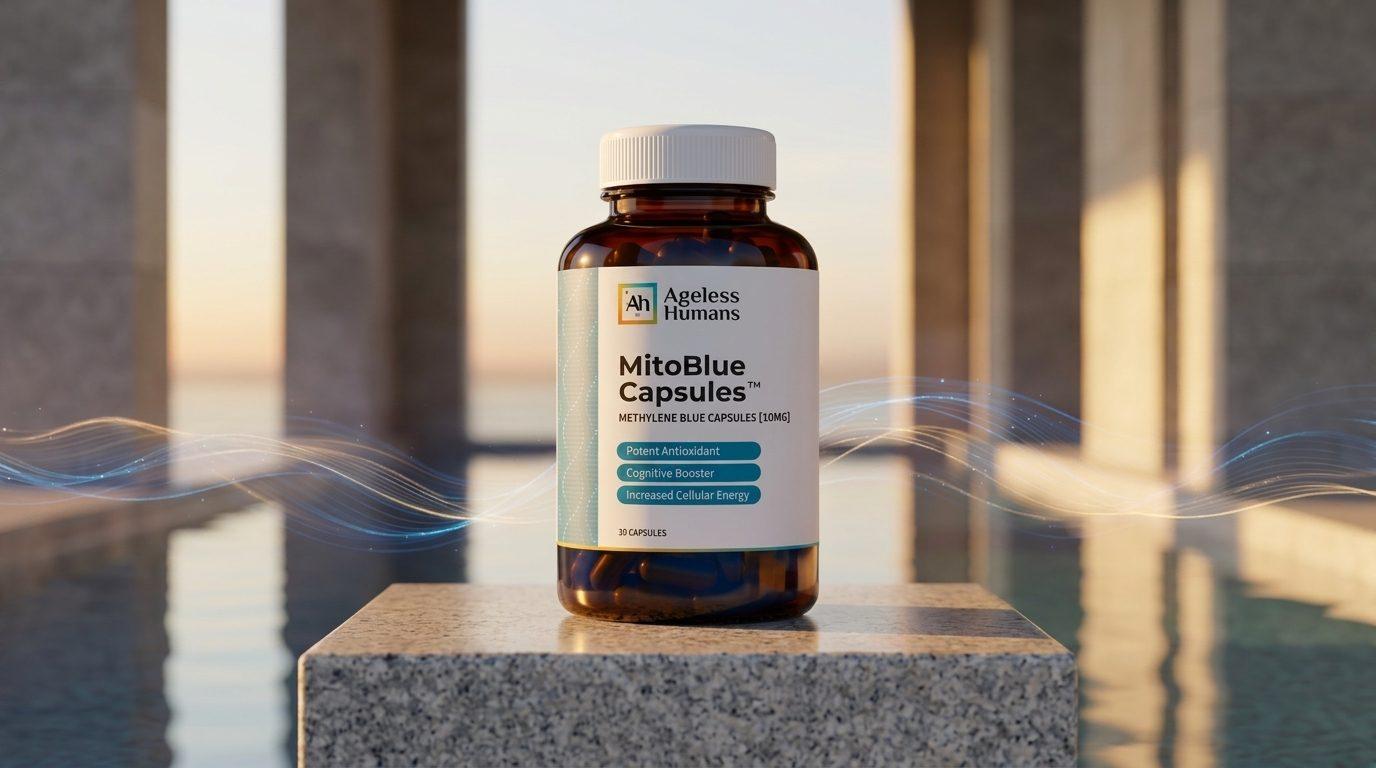
CoQ10 and methylene blue both support cellular energy at the mitochondrial electron transport chain, but they work in different ways. CoQ10 is a natural part of the chain that your body already makes and uses. Methylene blue is a synthetic compound studied for its ability to carry electrons around parts of the chain. CoQ10 has much more human research behind it, while methylene blue is an emerging option with stronger mechanistic interest and more safety considerations.
The Short Answer: Same Assembly Line, Different Jobs
CoQ10 is a built-in part of your energy machinery. Methylene blue is an outside compound studied as an alternative route through that machinery. Both support the same process: moving electrons through the mitochondrial electron transport chain (ETC) so your cells can make ATP, the molecule cells use for energy.
Think of the ETC as a relay race. Electrons from the food you eat get handed from one protein complex to the next (Complexes I through IV). Each handoff helps pump protons, and that proton gradient powers ATP production. CoQ10 is one of the official runners in this race. Methylene blue is more like a substitute runner. It can pick up electrons early in the chain and deliver them further down.
That difference shapes everything else: how much research exists, who tends to choose each one, and what safety questions come with it. If you want the bigger picture of how ATP production works, start with our complete guide to cellular energy.
How CoQ10 Works in the Electron Transport Chain
CoQ10 (coenzyme Q10) shuttles electrons from Complexes I and II to Complex III. It is a required step in normal mitochondrial energy production. It is fat-soluble and sits inside the inner mitochondrial membrane. There it moves back and forth between its oxidized form (ubiquinone) and its reduced form (ubiquinol).
CoQ10 also has a second role. In its ubiquinol form, it works as a fat-soluble antioxidant that helps protect cell membranes and lipids from oxidative stress. That dual role is a big reason it shows up so often in cellular-energy and healthy-aging formulas.
Your body makes CoQ10 on its own, using the same mevalonate pathway that produces cholesterol. Research suggests that the body's own production tends to decline with age. Certain medications that act on the mevalonate pathway are also known to lower the body's CoQ10 production. This is the main argument for supplementing it: you are topping up a molecule you already depend on, not adding a new mechanism.
The practical limit is absorption. CoQ10 is a large, fat-soluble molecule, so formulation matters. Taking it with a meal that contains fat is commonly recommended. You will also see both ubiquinone and ubiquinol forms on the market.
How Methylene Blue Works: The Electron Bypass
Methylene blue is a redox-active compound. It can accept electrons and pass them along, and research suggests it can route electrons around Complexes I and III to deliver them toward cytochrome c and Complex IV. That is why researchers describe it as an alternative electron carrier. It does not replace CoQ10. It offers a possible detour when parts of the main route are under strain.
Methylene blue cycles between an oxidized blue form and a reduced colorless form (leucomethylene blue). That cycling lets it act as an electron shuttle inside cells. Preclinical research has studied it for supporting oxygen use, ATP production, and the protection of mitochondria from oxidative stress, particularly in brain cells, which use a lot of energy.
Two details matter here:
- Dose-dependent behavior. Research describes a hormetic, or biphasic, response. Low amounts have been studied for supporting mitochondrial function, while higher amounts can have the opposite effect. This is one reason to follow label directions exactly.
- It does more than one thing. Methylene blue also interacts with enzymes outside the ETC, including monoamine oxidase (MAO). That matters a great deal for safety. See the safety section below.
Methylene blue also has a long history as a prescription drug in hospital settings. Its use as a daily wellness supplement is much newer. For a full rundown, see our deep dive on methylene blue benefits.
Research Depth: Honest Evidence Labels
CoQ10 has decades of human clinical research. Methylene blue's evidence for everyday mitochondrial support is mostly preclinical, with a small but growing amount of human data. Here is how we would label each area, without overstating either one.
CoQ10
- Role in the ETC: Established. This is basic biochemistry.
- Antioxidant role (ubiquinol): Established at the mechanism level.
- Age-related decline in the body's own production: Well supported by research.
- Supplementing to support energy and healthy aging: Moderate. There are many human trials, but results vary by population, form, and study design.
Methylene blue
- Alternative electron carrier mechanism: Well characterized in cell and animal research.
- Supporting mitochondrial function in brain cells: Emerging. Most data comes from preclinical studies.
- Cognitive and energy support in healthy adults: Preliminary. There are only a few small human studies, and no large long-term trials.
- Long-term daily supplement use: Not well studied. That is an honest gap.
None of this means methylene blue does not work. It means the evidence is younger. Anyone who says methylene blue is 'proven' to outperform CoQ10 is getting ahead of the research.
Side-by-Side: Methylene Blue vs CoQ10
Main difference: CoQ10 supports the normal energy pathway, while methylene blue is studied as a supplemental detour within it.
- What it is: CoQ10 is made by your body and is also found in foods like organ meats and fatty fish. Methylene blue is a synthetic compound.
- ETC role: CoQ10 is a native carrier from Complexes I and II to Complex III. Methylene blue is an alternative carrier that may bypass Complexes I and III.
- Antioxidant activity: CoQ10 acts as a membrane antioxidant in its ubiquinol form. Methylene blue has been studied for reducing oxidative stress tied to electron leakage.
- Solubility: CoQ10 is fat-soluble. Methylene blue is water-soluble and crosses into the brain readily, according to research.
- Research depth: CoQ10 has extensive human research. Methylene blue's research is mostly preclinical, with limited human studies.
- Interaction profile: CoQ10 is generally considered well tolerated. Methylene blue has meaningful interactions, especially with serotonergic medications.
- Noticeable effects: CoQ10 is subtle and builds over time. Methylene blue harmlessly turns urine blue-green, and some people report a more noticeable mental energy effect.
- Best fit: CoQ10 suits people with a foundational, long-term approach. Methylene blue suits informed users who want a targeted, research-forward approach.
Who Picks Which
Choose CoQ10 if you want a well-studied foundation. Consider methylene blue if you already have the basics covered and want a more targeted tool for mental energy, and you have checked your medications.
CoQ10 tends to fit people who:
- Want the option with the deepest human research
- Are focused on healthy aging and want to replenish a molecule that declines over time
- Take medications that act on the mevalonate pathway and have discussed CoQ10 with their clinician
- Prefer a low-drama, take-it-daily supplement
Methylene blue tends to fit people who:
- Are interested in focus, mental clarity, and brain energy, which are the areas most studied for methylene blue
- Are comfortable with emerging research and follow label directions exactly
- Do not take antidepressants or other serotonergic medications, or have cleared it with their healthcare provider
- Want to try a mechanism that differs from standard antioxidants
If you are unsure, the honest default is this: start with the fundamentals (sleep, movement, protein, and a well-researched base like CoQ10). Then add a targeted compound like methylene blue only after you understand how it works.
Safety, Interactions, and Quality: What to Check
CoQ10 is generally well tolerated. Methylene blue requires a medication check first, because it inhibits MAO and can interact with serotonergic drugs. This is the single most important difference between the two.
Methylene blue precautions:
- Serotonergic medications. Because methylene blue inhibits MAO, combining it with SSRIs, SNRIs, MAOIs, or similar medications can lead to a serious reaction called serotonin syndrome. Talk to your healthcare provider before use.
- G6PD deficiency, pregnancy, and nursing. Methylene blue is generally not recommended in these situations without medical guidance.
- Blue-green urine. This is expected and harmless.
- Purity matters. Methylene blue is also sold as an industrial and aquarium dye. Only use a product made for human consumption, with verified purity.
CoQ10 precautions:
- People taking blood thinners should talk to their clinician, since CoQ10 may affect how these medications work.
- Mild digestive upset is the most commonly reported issue.
For either supplement, look for third-party testing and a Certificate of Analysis (COA). Every Ageless Humans lot is third-party lab tested with a COA. All products are made in our FDA-registered facility in Carlsbad, California.
Can You Use Methylene Blue and CoQ10 Together?
They are mechanistically complementary, but there is very little direct research on combining them. Any stacking should be a conversation with your healthcare provider.
In theory, the two fit together well. CoQ10 supports the standard route, and methylene blue offers a backup route. CoQ10 protects membranes, and methylene blue has been studied for reducing the oxidative stress that comes from electron leakage. That logic is why some biohackers pair them.
In practice, 'makes sense on paper' is not the same as 'studied in people.' If you combine them, add one at a time so you can tell how each affects you. Follow each label's directions, and keep your clinician informed, especially about any medications you take.
How you take methylene blue also matters. Capsules give a consistent, pre-measured amount with no blue staining. Drops allow flexible use but can stain teeth and surfaces. Either way, stick to the label directions.
Frequently asked questions
Is methylene blue better than CoQ10 for energy?+
Neither is simply better. They support cellular energy in different ways. CoQ10 is a natural part of the electron transport chain and has decades of human research. Methylene blue is studied as an alternative electron carrier, but its evidence for everyday energy support is mostly preclinical so far.
What is the difference between methylene blue and CoQ10 in the mitochondria?+
CoQ10 carries electrons from Complexes I and II to Complex III as part of the normal mitochondrial electron transport chain. Methylene blue is a redox-active compound that research suggests can accept electrons and deliver them toward cytochrome c and Complex IV, bypassing parts of the chain. CoQ10 supports the standard route, while methylene blue is studied as a detour.
Can I take methylene blue and CoQ10 together?+
The two have complementary mechanisms, but there is little direct research on taking them together. If you want to combine them, talk with your healthcare provider first, add one at a time, and follow each product's label directions. This matters most if you take any prescription medications.
Who should not take methylene blue?+
People taking SSRIs, SNRIs, MAOIs, or other serotonergic medications should not use methylene blue without medical guidance, because it inhibits MAO and can cause serious interactions. It is also generally not recommended for people with G6PD deficiency or for those who are pregnant or nursing. Check with a healthcare provider before starting.
Why does methylene blue turn urine blue?+
Methylene blue is a dye, and part of it leaves the body through urine, turning it blue or blue-green. This is expected and harmless. It is not a sign that something is wrong.
Does CoQ10 decline with age?+
Research suggests the body's own production of CoQ10 tends to decline with age. Certain medications that act on the mevalonate pathway can also reduce it. This is one reason CoQ10 is a popular supplement for supporting cellular energy and healthy aging.