
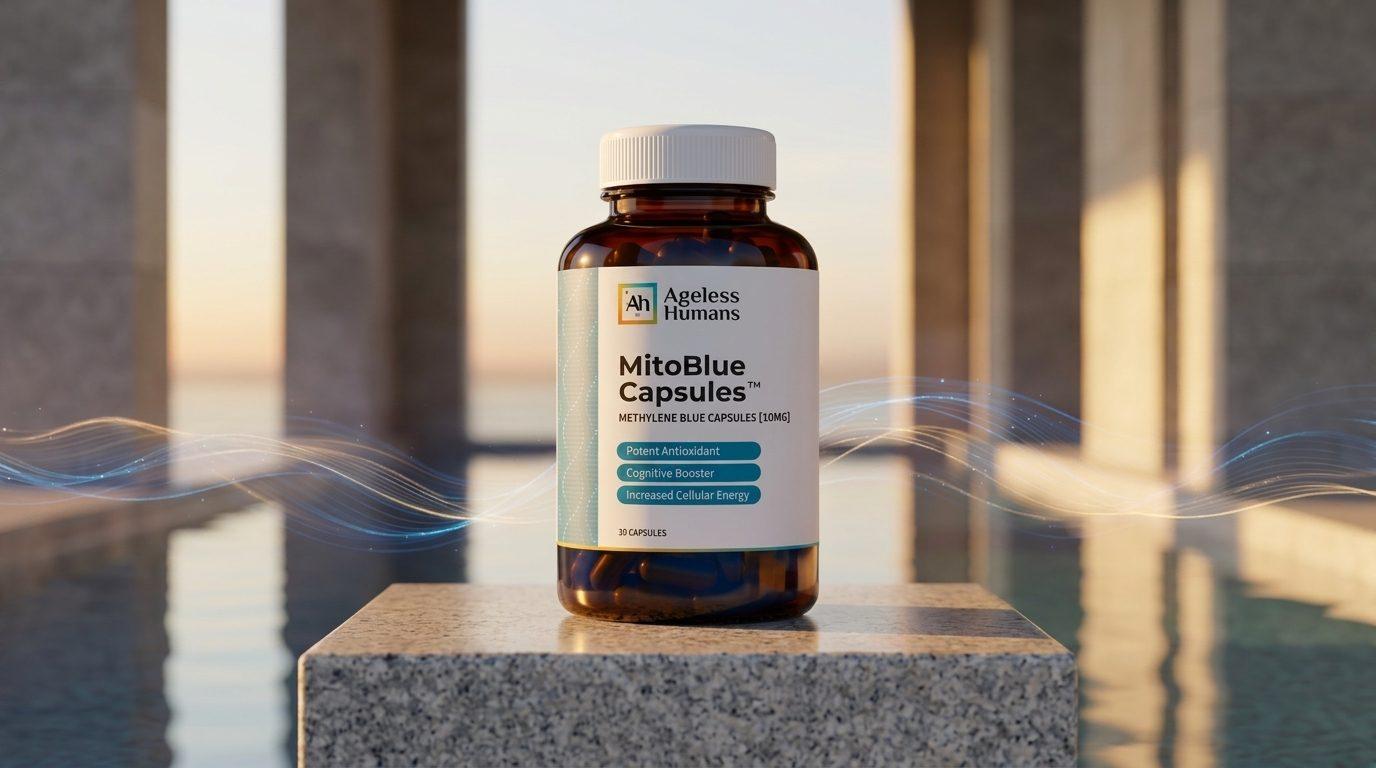
Creatine and methylene blue support brain energy in different ways. Creatine acts as an ATP buffer, a quick-release reserve that helps neurons refill energy during demanding moments. Methylene blue supports mitochondrial efficiency, helping cells move electrons through the energy-making chain. Creatine has far more human research behind it. Methylene blue's research is mostly mechanistic and early-stage, so the right choice depends on whether you want a well-studied reserve or a newer, more experimental mitochondrial approach.
The Short Answer: One Is a Battery, One Tunes the Engine
Creatine stores energy. Methylene blue helps make it. That is the core difference, and it should guide your choice.
Your brain uses a large share of your body's energy relative to its size, and it has very little room to store fuel. Every thought, recall, and shift of attention depends on ATP, the molecule cells spend as energy. There are two basic ways to support that supply:
- Buffer it. Keep a reserve on hand that can rapidly regenerate ATP when demand spikes. This is creatine's job through the phosphocreatine system.
- Produce it more smoothly. Help mitochondria, the cell's power plants, convert fuel into ATP. This is where methylene blue has been studied.
The two are not rivals so much as tools for different points in the same energy chain. For a deeper look at how that whole chain works, see our complete guide to cellular energy.
How Creatine Supports Brain Energy: ATP Buffering
Creatine supports brain energy by helping cells regenerate ATP quickly when demand outruns supply. Inside cells, creatine binds a phosphate group to become phosphocreatine. When a neuron burns through ATP, the enzyme creatine kinase uses phosphocreatine to rebuild that ATP almost instantly.
Think of it as a phone's backup battery pack. It doesn't make power, but it covers surges so the system doesn't stall. That buffering role is why creatine's cognitive research tends to focus on high-demand or depleted conditions, such as sleep loss, mental fatigue, and intense cognitive tasks.
A few practical points matter:
- The brain makes some creatine itself, and it also takes some up from the blood. Uptake into the brain appears slower and more limited than uptake into muscle. Research suggests brain levels may rise more gradually than muscle levels.
- Diet matters. People who eat little or no meat or fish get little dietary creatine, and some studies suggest they may notice more cognitive benefit from supplementing.
- Effects build over time. Creatine works by raising stored levels, so it is a daily-consistency supplement, not a same-hour boost.
How Methylene Blue Supports Brain Energy: Mitochondrial Efficiency
Methylene blue supports brain energy by acting as an electron carrier inside mitochondria. ATP production depends on the electron transport chain, a series of protein complexes that pass electrons along to drive energy production. Methylene blue can accept and donate electrons, which lets it help shuttle them through that chain, including around steps that may be running slowly.
Lab research has also studied its support for cytochrome c oxidase, the final enzyme in the chain and a key step in how cells use oxygen. The idea is not more fuel but a smoother assembly line: more ATP produced with less wasted effort.
Two details set it apart from creatine:
- Dose behavior is unusual. Research describes a hormetic, low-dose pattern. Small amounts are what researchers study for mitochondrial support, and more is not better. Follow label directions exactly.
- It does more than one thing. Methylene blue also affects certain enzymes, including monoamine oxidase. That matters for safety (see below) and is one reason it is a more pharmacologically active compound than creatine.
If foggy, slow-feeling days are your main concern, our article on methylene blue for brain fog goes deeper on that use case.
Evidence Class: How Strong Is the Research for Each?
Creatine has the stronger, broader human evidence base. Methylene blue's evidence for cognitive energy is earlier-stage and mostly mechanistic. Being honest about that gap is the most useful thing a comparison can do.
Creatine, moderate human evidence:
- Multiple randomized controlled trials in healthy adults have examined memory, reasoning, and mental fatigue.
- Results are mixed. Benefits show up more consistently under stress, such as sleep deprivation, demanding tasks, or older age, and in people with low dietary intake. Well-rested young adults on omnivorous diets often see small or no measurable changes.
- It has a long track record of study for safety in healthy adults, mostly from sports research.
Methylene blue, early and mechanistic evidence:
- Most of the research is cell, animal, and biochemical work showing how it interacts with mitochondria.
- A small number of human studies, including brain-imaging work at low doses, have explored its effects on memory-related brain activity. These are promising but small and early.
- It has a long history as a medical compound, so its pharmacology is well understood. Its use as a daily cognitive-energy supplement is the newer, less-studied part.
Bottom line: if you want the choice backed by the most human data, creatine wins. If you're interested in mitochondrial support and accept that the research is still developing, methylene blue is the more experimental option.
Which Should You Choose? A Quick Chooser
Choose based on where your energy breaks down. Use this as a starting framework, not a prescription.
Creatine may fit better if you:
- Feel mental energy crash during long, demanding stretches of work or study.
- Are often short on sleep and want support for focus under that strain.
- Eat little meat or fish.
- Want the option with the most human research and a simple daily routine.
- Also train physically, since creatine is studied for muscle performance too.
Methylene blue may fit better if you:
- Are specifically interested in mitochondrial function and cellular efficiency.
- Describe your issue as general sluggish or foggy thinking rather than crashes under load.
- Are comfortable with a more experimental compound and with following label directions precisely.
- Are not taking any medication that interacts with it (see the safety section).
If you can't decide, the evidence-weighted default is to start with creatine. That's not because methylene blue lacks a rationale. It's because creatine's research base is larger.
Can You Take Methylene Blue and Creatine Together?
There is no known reason they conflict, and in theory they complement each other. One supports how ATP is made. The other supports how quickly it is replenished during spikes. They act at different points in the same system.
That said, no research we're aware of has studied the two as a combination for cognition. Any stacking benefit is reasoning from mechanism, not demonstrated outcome.
If you want to try both, a sensible approach is to add one at a time. Use the first consistently for a few weeks before adding the second, so you can tell what's actually doing what. Follow each product's label directions, and talk with your healthcare provider first if you take any medications.
Safety: The Differences That Actually Matter
Creatine is generally well tolerated by healthy adults. Methylene blue needs more caution because of real drug interactions. This is the most important practical difference between the two.
Methylene blue cautions:
- Serotonergic medications. Methylene blue inhibits monoamine oxidase. Combining it with antidepressants such as SSRIs or SNRIs, or with other serotonergic drugs, can cause a serious interaction. If you take any of these, do not use methylene blue without your prescriber's approval.
- G6PD deficiency. People with this inherited enzyme condition should avoid methylene blue.
- Pregnancy and breastfeeding. Not appropriate without medical guidance.
- Blue-green urine is a common, expected, harmless effect, but it's worth knowing in advance.
Creatine cautions:
- Some people notice mild stomach upset or water retention.
- Anyone with kidney concerns should talk to a clinician first.
For either one, follow label directions and check with a healthcare provider if you take prescription medications or have a health condition. Quality matters too: look for products with third-party testing and a certificate of analysis (COA) for every lot.
Where NAD+ Fits: The Third Lever of Brain Energy
NAD+ is the molecule mitochondria use to carry electrons into energy production, so it sits upstream of both creatine and methylene blue. Creatine buffers ATP, methylene blue helps electrons move through the chain, and NAD+ helps feed electrons into that chain in the first place.
Research suggests NAD+ levels decline with age, which is why it's widely studied in longevity science. That makes it a natural third piece if you think about brain energy as a full system rather than a single ingredient.
In short, there are three levers: supply (NAD+), efficiency (methylene blue), and reserve (creatine). Most people don't need all three. Knowing which lever matches your experience helps you choose with purpose instead of guessing.
Frequently asked questions
Is methylene blue or creatine better for brain energy?+
It depends on the goal. Creatine supports brain energy by buffering ATP during high demand and has more human research behind it. Methylene blue supports mitochondrial efficiency as an electron carrier, but its cognitive evidence is earlier and mostly mechanistic. For the most research-backed option, creatine is the stronger default.
How does creatine support brain function?+
Creatine becomes phosphocreatine inside cells, which can rapidly regenerate ATP when neurons burn through energy. This buffering role is why research on creatine and cognition focuses on demanding conditions like sleep loss and mental fatigue. Brain levels rise gradually, so it works through consistent daily use rather than as an instant boost.
How does methylene blue work in the brain?+
Methylene blue can accept and donate electrons, letting it help shuttle electrons through the mitochondrial electron transport chain that produces ATP. Lab research has also studied its support for cytochrome c oxidase, a key energy-production enzyme. It is studied at low doses, and higher amounts do not mean more benefit.
Can you take methylene blue and creatine together?+
There is no known conflict, and their mechanisms are complementary: one supports ATP production efficiency, the other ATP reserves. However, the combination has not been studied for cognition, so any added benefit is theoretical. Adding one at a time and checking with a healthcare provider if you take medications is the sensible approach.
Who should not take methylene blue?+
People taking serotonergic medications such as SSRIs, SNRIs, or MAO inhibitors should not use methylene blue without their prescriber's approval because of a serious interaction risk. People with G6PD deficiency should avoid it, and it isn't appropriate during pregnancy or breastfeeding without medical guidance. It also commonly turns urine blue-green, which is harmless.
How long does it take to feel creatine's effects on the brain?+
Creatine works by gradually raising stored levels, and research suggests brain levels rise more slowly than muscle levels. That means any cognitive effects are more likely after weeks of consistent use than after a single serving. Follow the product's label directions for use.