
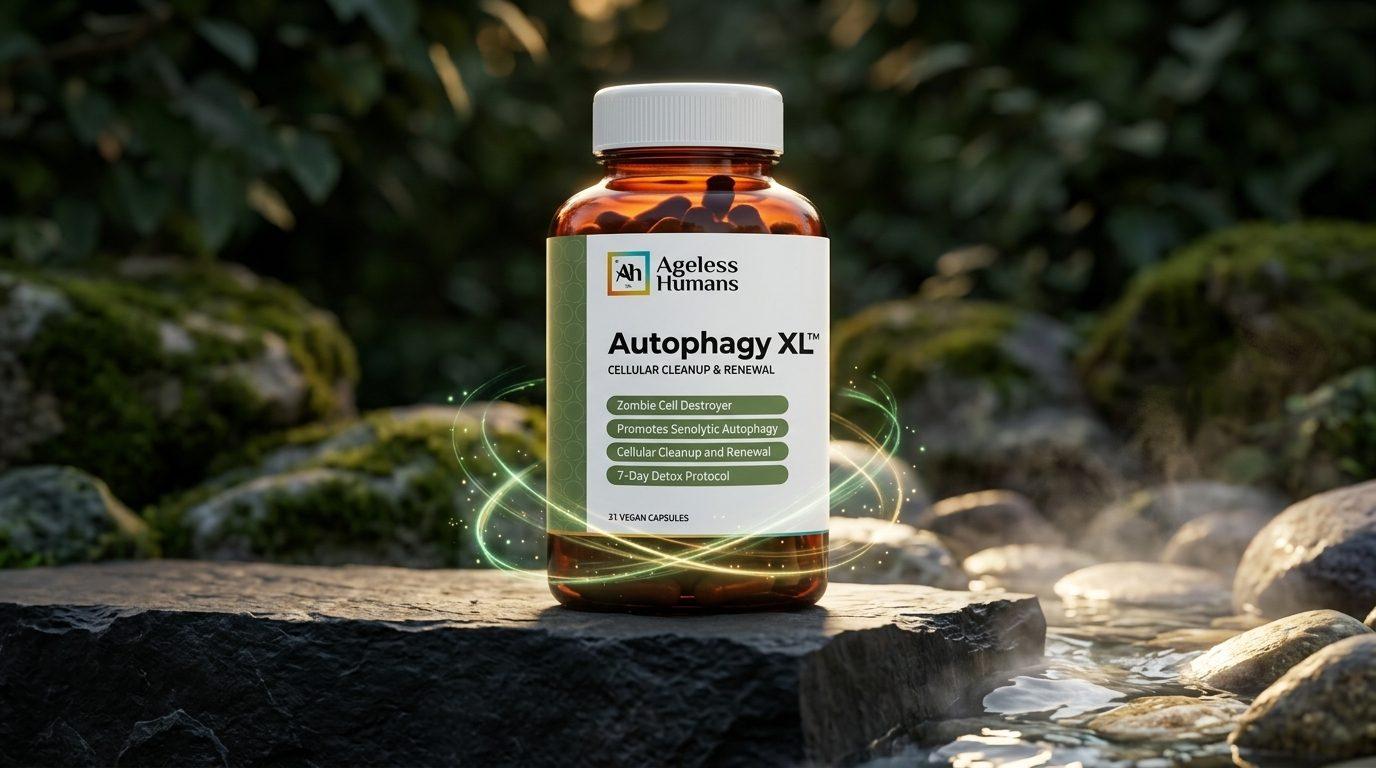
Senolytics and autophagy supplements both support cellular 'cleanup,' but they work at different levels. Senolytics are compounds studied for selectively removing senescent cells, the worn-out cells that stop dividing but won't die. Autophagy supporters help the cell's own recycling system break down damaged proteins and organelles, so healthy cells stay healthy. Most longevity protocols treat senolytic support as an occasional pulse and autophagy support as a steady daily rhythm.
The Short Answer: Removing Whole Cells vs. Cleaning Inside Them
Senolytics work on whole cells. Autophagy works inside cells. That is the core difference, and it explains almost everything else, including how each is studied, how often it's used, and why many protocols use both.
Think of your body as an office building. Autophagy is the nightly cleaning crew that empties trash, recycles paper, and fixes broken chairs in every room. Senolytics are closer to clearing out a few rooms where the occupants stopped working years ago but keep running loud machines that disrupt the floor.
Both are 'clear' strategies, and they support each other. Better autophagy may help keep cells functioning so fewer become senescent. Clearing senescent cells may reduce the stress signals that strain the cells around them. Neither one replaces the other.
What Senescent Cells Are and What Senolytics Try to Do
Senescent cells are cells that have permanently stopped dividing but resist normal cell death. Senescence is a protective response at first. When a cell takes on too much DNA damage or stress, pausing it stops the damage from being copied. The trouble starts when these cells pile up faster than the immune system can remove them, which research suggests happens more often with age.
Senescent cells aren't quiet. They release a mix of inflammatory signals, enzymes, and growth factors that researchers call the senescence-associated secretory phenotype (SASP). In lab and animal research, the SASP has been studied for its effects on neighboring healthy cells, which is why a small number of senescent cells may matter more than their count suggests.
Senolytics are compounds studied for their ability to selectively target senescent cells while leaving healthy cells alone. A related category, senomorphics, is studied for quieting SASP signaling without removing the cell. Plant compounds that come up most in this research include:
- Fisetin: a flavonoid found in strawberries, studied in animal models for senolytic activity.
- Quercetin: a common flavonoid. In research it is often paired with a prescription drug, so findings on that combination don't transfer directly to quercetin alone.
- Other polyphenols such as piperlongumine and curcumin analogs, mostly at the lab and early animal stage.
In supplement terms, the honest framing is that these ingredients support the body's natural processes for managing aging cells. They aren't proven cell-clearing therapies in humans.
What Autophagy Is and What Autophagy Supplements Support
Autophagy is the cell's built-in recycling system. The word means 'self-eating.' Cells wrap damaged proteins, worn-out mitochondria, and other debris in a membrane, deliver it to the lysosome, and break it down into raw materials they can reuse. The process is ancient and present in nearly every cell. Its discovery was recognized with a Nobel Prize in 2016.
Autophagy rises and falls with your daily rhythm. Fasting, exercise, and lower nutrient signaling tend to turn it up. Constant feeding and high growth signaling tend to turn it down. Research suggests autophagy efficiency declines with age, which is why it's a central target in longevity science.
Ingredients commonly studied for supporting autophagy include:
- Spermidine: a polyamine found in wheat germ and aged cheese, studied in animal models and early human research for supporting cellular renewal.
- Resveratrol and other polyphenols: studied for their effects on nutrient-sensing pathways linked to autophagy.
- Berberine: studied for its effects on AMPK, an energy-sensing pathway connected to autophagy.
- Urolithin A: studied for supporting mitophagy, the recycling of worn-out mitochondria.
For a full breakdown of these ingredients and how to judge a formula, see our complete guide to autophagy supplements.
Side-by-Side: How the Two Strategies Compare
The two strategies differ in target, timing, and evidence base. Here is how they line up:
- Target: Senolytics act on whole senescent cells. Autophagy acts on debris inside living cells.
- Goal: Senolytics aim to reduce the burden of aging cells and their inflammatory signals. Autophagy aims to keep healthy cells clean and functional.
- Rhythm in research: Senolytic compounds are typically studied in intermittent pulses, because senescent cells build up slowly. Autophagy is a daily cycle tied to feeding, fasting, and activity.
- Lifestyle overlap: Autophagy responds strongly to fasting and exercise. Senescent cell burden is studied in relation to exercise and overall metabolic health, but no simple lifestyle switch for it is well established.
- Maturity of evidence: Autophagy biology is very well mapped. Senolytic science is newer and moving fast, with human research still early.
The practical takeaway: autophagy support is maintenance. Senolytic support is periodic cleanup.
Evidence Tiers: What the Research Does and Doesn't Show
Both fields are strongest in cell and animal research and thinnest in large human trials. That's the honest headline, and you should be skeptical of any brand that says otherwise. It helps to sort the evidence into tiers.
Tier 1: Established biology (strong). Autophagy is a well-characterized process. Cellular senescence is a real, measurable phenomenon that increases with age. Neither claim is controversial.
Tier 2: Animal research (substantial, promising). In mice, removing senescent cells by genetic or compound-based methods has been studied for effects on healthspan markers. Animal research on spermidine and other autophagy supporters has also been encouraging. Mouse biology doesn't always translate to humans, so treat these results as direction, not proof.
Tier 3: Early human research (limited). Small human studies have looked at senolytic compounds and at autophagy-related ingredients like spermidine and urolithin A, mostly measuring biomarkers. Larger, longer trials are underway or still needed. The findings are worth watching but not settled.
Tier 4: Marketing claims (ignore). Phrases like 'eliminates zombie cells' or 'reverses aging' go beyond what any supplement research supports.
What this means for you: both strategies rest on solid biology and promising early data. Choose them as reasonable, low-drama support for natural processes, not as guaranteed outcomes.
How Protocols Sequence Senolytics and Autophagy Support
Most well-designed protocols run autophagy support as a steady daily foundation and add senolytic support in periodic pulses. The logic comes straight from the biology. Cellular debris builds up every day, so recycling support is consistent. Senescent cells build up over weeks and months, so research has favored intermittent 'hit-and-run' approaches rather than continuous use.
A typical sequencing framework looks like this:
1. Foundation (daily): Autophagy support alongside the habits that drive it: a consistent eating window, regular exercise, and quality sleep. 2. Pulse (periodic): Short, defined windows of senolytic-focused support, following label directions, separated by longer off periods. 3. Rebuild (after each pulse): A recovery emphasis on protein, nutrient density, and mitochondrial support so the body can renew tissue after cleanup. 4. Repeat: The cycle continues, with the daily foundation never switching off.
Pulses are often timed with a fasting window, since both strategies relate to lower nutrient signaling. That timing isn't required, but many protocols use it to align the 'clear' phase with the body's natural low-intake state.
We walk through the full clear, repair, and rebuild cycle, and why order matters, in our cellular repair protocol explained. Always follow product labels, and talk with your healthcare provider before starting a new regimen, especially if you take medications.
How to Choose Quality Products in Either Category
Ingredient identity, testing, and transparency matter more than the label's promises. Polyphenols like fisetin and quercetin vary widely in purity and absorption, and spermidine content is easy to overstate. A few non-negotiables:
- Third-party testing with a Certificate of Analysis (COA) for every lot, so you can confirm what's in the bottle.
- Clear, full-dose ingredient disclosure instead of proprietary blends that hide amounts.
- Known manufacturing. You should know who makes the product and where.
- Honest claims. Look for 'supports' and 'helps maintain,' not 'cures' or 'reverses.'
At Ageless Humans, every product is made in our FDA-registered facility in Carlsbad, California. Every lot is third-party lab tested with a COA, and every purchase is backed by a 60-day money-back guarantee. That's the standard we think the whole category should meet.
The Bottom Line
You don't have to pick between senolytics and autophagy. They do different jobs on different timelines. Autophagy support keeps healthy cells clean every day. Senolytic support targets the slow buildup of aging cells in occasional pulses. The evidence for both rests on strong biology and encouraging animal data, while human research is still early.
If you're starting from zero, build the daily autophagy foundation first: eating rhythm, movement, sleep, and quality support. Then consider adding periodic senolytic-focused cycles within a structured protocol.
Frequently asked questions
What is the difference between senolytics and autophagy?+
Senolytics are compounds studied for selectively removing senescent cells, which are aged cells that have stopped dividing but resist normal cell death. Autophagy is the process cells use to break down and recycle damaged proteins and organelles inside themselves. Senolytics work on whole cells, while autophagy works within cells. Both are considered 'clear' strategies in longevity science.
Can you take senolytic and autophagy supplements together?+
Many longevity protocols use both, because they support different processes on different timelines. A common approach is daily autophagy support with senolytic-focused support in periodic pulses. Follow each product's label directions, and check with your healthcare provider before combining supplements, especially if you take medications.
Are senolytic supplements proven to work in humans?+
Not yet in a definitive way. Senolytic compounds like fisetin and quercetin have shown promising results in cell and animal research, and small early human studies have explored them, but large long-term human trials are still limited. The honest framing is that they are studied for supporting the body's natural management of aging cells.
Why are senolytics taken intermittently instead of daily?+
Senescent cells build up slowly over weeks and months rather than daily, so research has generally studied senolytic compounds in short, intermittent pulses, sometimes called a 'hit-and-run' approach. Autophagy, by contrast, is a daily cycle, which is why autophagy support is usually taken consistently. Always use a product according to its label directions.
What naturally increases autophagy?+
Autophagy tends to increase with fasting or longer gaps between meals, regular exercise, and good sleep. Lower nutrient signaling, as happens during a fasting window, is one of the strongest natural triggers. Ingredients such as spermidine, resveratrol, berberine, and urolithin A are studied for supporting autophagy-related pathways.
Which should I start with, senolytics or autophagy support?+
Most protocols start with autophagy support because it acts as a daily foundation and pairs with everyday habits like an eating window, exercise, and sleep. Senolytic-focused support is usually layered in later as periodic pulses within a structured cycle. Talk with your healthcare provider if you're unsure what fits your situation.