
PDA (pentadeca arginate) is generally described as the same 15-amino-acid sequence as BPC-157, paired with an arginate salt instead of the more common acetate salt. Sellers say the arginate form is more stable, but published, independent research directly comparing PDA to BPC-157 is very limited. Nearly everything known about either one comes from BPC-157 studies, most of them in animals.
The Short Answer: One Peptide Sequence, Two Salt Forms
BPC-157 and PDA are best understood as the same core peptide in two different salt forms. BPC-157 is a 15-amino-acid chain, a pentadecapeptide. "Pentadeca" means fifteen. PDA keeps that sequence and binds it to arginine as the counter-ion. Most research-grade BPC-157 is sold as an acetate salt.
A salt form is not a new molecule doing a new job. Peptides are often prepared as salts so they are easier to purify, dry, store, and dissolve. Changing the counter-ion can affect handling properties like solubility and shelf stability. It does not automatically change what the peptide does in the body.
So the honest framing is this: PDA is BPC-157 with a different formulation story. Whether that story makes a meaningful difference has not been well established in published research.
For a deeper look at PDA on its own, see our guide to PDA (pentadeca arginate) benefits.
What BPC-157 Is and What Researchers Have Studied
BPC-157 is a synthetic peptide based on a sequence found in a protein from human gastric juice. "BPC" stands for "Body Protection Compound." Most of the published work comes from a small number of research groups, and most of it uses animal or cell models.
In that preclinical work, BPC-157 has been studied for its possible role in:
- Connective tissue: tendon, ligament, and muscle repair processes in animal models
- Gut lining: the integrity of the stomach and intestinal lining
- Blood vessel signaling: pathways tied to angiogenesis, the formation of new small blood vessels that carry nutrients to tissue
- Growth factor pathways: interactions with signaling systems involved in tissue remodeling
The key limitation is that controlled human trials are scarce. Animal findings are a reason to keep studying something. They are not proof of the same effect in people. Anyone who calls BPC-157 "clinically proven" is overstating the evidence.
This matters for the PDA comparison. If human data on BPC-157 is thin, human data on PDA, a newer variant, is thinner still.
What PDA Actually Is: The Arginate Salt Analog
PDA, or pentadeca arginate, is marketed as BPC-157's peptide sequence stabilized with arginine. Arginine is an amino acid with a positively charged side chain, which lets it pair with the peptide as a counter-ion. That pairing produces an "arginate" salt.
PDA appears mainly in compounding and wellness markets, not in a large body of peer-reviewed literature. That raises a practical problem. Different sellers describe PDA in slightly different ways, and there is no widely published reference standard that defines exactly what every "PDA" product contains.
What that means for you:
- The name alone doesn't guarantee the composition. Look for documentation that identifies the peptide sequence and the salt form.
- "Analog" gets used loosely. In strict chemistry, a salt form is not a structural analog. The peptide chain is the same, and only its pairing changes. Some marketing blurs this line.
- Arginine has its own reputation. It is studied for supporting nitric oxide production. Some sellers imply PDA gets an extra boost from that. The amount of arginine in a salt form is small, and no published data we're aware of shows it adds a meaningful effect.
The Stability Claims, Examined
The main selling point for PDA is stability, and that claim comes mostly from manufacturers, not from independent published studies. The argument is that the arginate salt makes the peptide hold up better in storage, in liquid, or in the digestive tract than BPC-157 acetate.
Here is what is reasonable and what is unproven:
Reasonable: Salt choice can affect a peptide's physical stability, solubility, and how it handles moisture. Pharmaceutical chemists choose counter-ions for these reasons all the time. It is plausible that an arginate salt behaves differently on the shelf than an acetate salt.
Unproven: That those differences produce better results in the body. We have not found published, peer-reviewed head-to-head studies showing PDA outperforms BPC-157 in absorption, tissue levels, or outcomes.
Often overlooked: BPC-157 itself has been described in the research literature as unusually stable in gastric juice. That stability is the main reason it has been studied orally at all. If the original peptide is already relatively stable, an improved salt form has less room to make a dramatic difference.
The fair conclusion: stability claims for PDA are plausible but unverified. Treat them as a hypothesis, not a settled fact.
Side by Side: What the Research Does and Doesn't Show
BPC-157 has a modest, mostly preclinical evidence base. PDA has very little independent evidence of its own. Here is the comparison laid out plainly:
| BPC-157 | PDA (Pentadeca Arginate) | |
|---|---|---|
| Peptide sequence | 15 amino acids | Same 15-amino-acid sequence |
| Common salt form | Acetate | Arginate |
| Published research | Dozens of studies, mostly animal and cell | Very limited independent literature |
| Human trials | Scarce | Essentially none published |
| Stability claims | Described as stable in gastric juice | Marketed as more stable; not independently confirmed |
| Where you see it | Research and supplement markets | Compounding and wellness markets |
The research gap, stated honestly: almost every benefit attributed to PDA is borrowed from BPC-157 studies. That borrowing is logical, since it's the same peptide chain. But it means PDA isn't backed by its own evidence. It inherits BPC-157's evidence plus a formulation claim that hasn't been tested in public.
If someone tells you PDA is "proven better," ask for the study. In most cases, one doesn't exist.
Why PDA Suddenly Became a Thing
PDA rose largely because of regulatory pressure on BPC-157, not because of new research. In 2023, the FDA placed BPC-157 in a category of bulk drug substances flagged for potential safety concerns. That category limits its use by compounding pharmacies. Shortly afterward, PDA began appearing in clinics and compounding catalogs as an alternative.
This context matters. When a product category gains momentum mainly because of a regulatory workaround, the marketing often moves faster than the science. That doesn't mean PDA is bad or useless. It means its popularity is not evidence of superiority.
Two more points worth knowing:
- Sport rules: BPC-157 appears on the World Anti-Doping Agency's prohibited list under non-approved substances. Competitive athletes should assume closely related forms carry the same risk and check with their governing body.
- Regulation keeps changing: The legal status of peptides varies by form, channel, and jurisdiction. Check current rules before buying.
How to Evaluate Either One: Form, Sourcing, and Proof
The questions that matter most are how the peptide is delivered, who made it, and whether the lot was independently tested. The choice between salt forms matters far less than whether you're getting what the label says.
1. Delivery form. BPC-157 has been studied in both oral and injected forms. Its reported gastric stability is why oral use comes up so often. Oral formats avoid needles and suit people focused on gut and whole-body support. We break down the tradeoffs in oral BPC-157 vs injection.
2. Manufacturing transparency. Know where the product is made. A named facility with regulatory registration is a different standard from an anonymous overseas reseller.
3. Third-party testing. Ask for a Certificate of Analysis (COA) for the specific lot you are buying. A COA should confirm identity and purity. For PDA in particular, it should confirm the salt form you're paying for.
4. Label directions. Follow the product label. Any reputable seller should state directions clearly and not encourage you to exceed them.
5. Claims language. Be wary of any seller promising to cure, heal, or fix a medical condition. Honest companies describe what a supplement supports and say where the evidence ends.
The Bottom Line on BPC-157 vs PDA
If you are choosing between BPC-157 and PDA, you are mostly choosing between two salt forms of the same peptide, not two different compounds. BPC-157 has the larger research base, though it's mostly preclinical. PDA's stability advantage is plausible but has not been independently demonstrated.
The smarter decision is not which salt to buy. It is which source to trust. Prioritize a known manufacturer, lot-specific third-party testing, a clear delivery format, and honest claims.
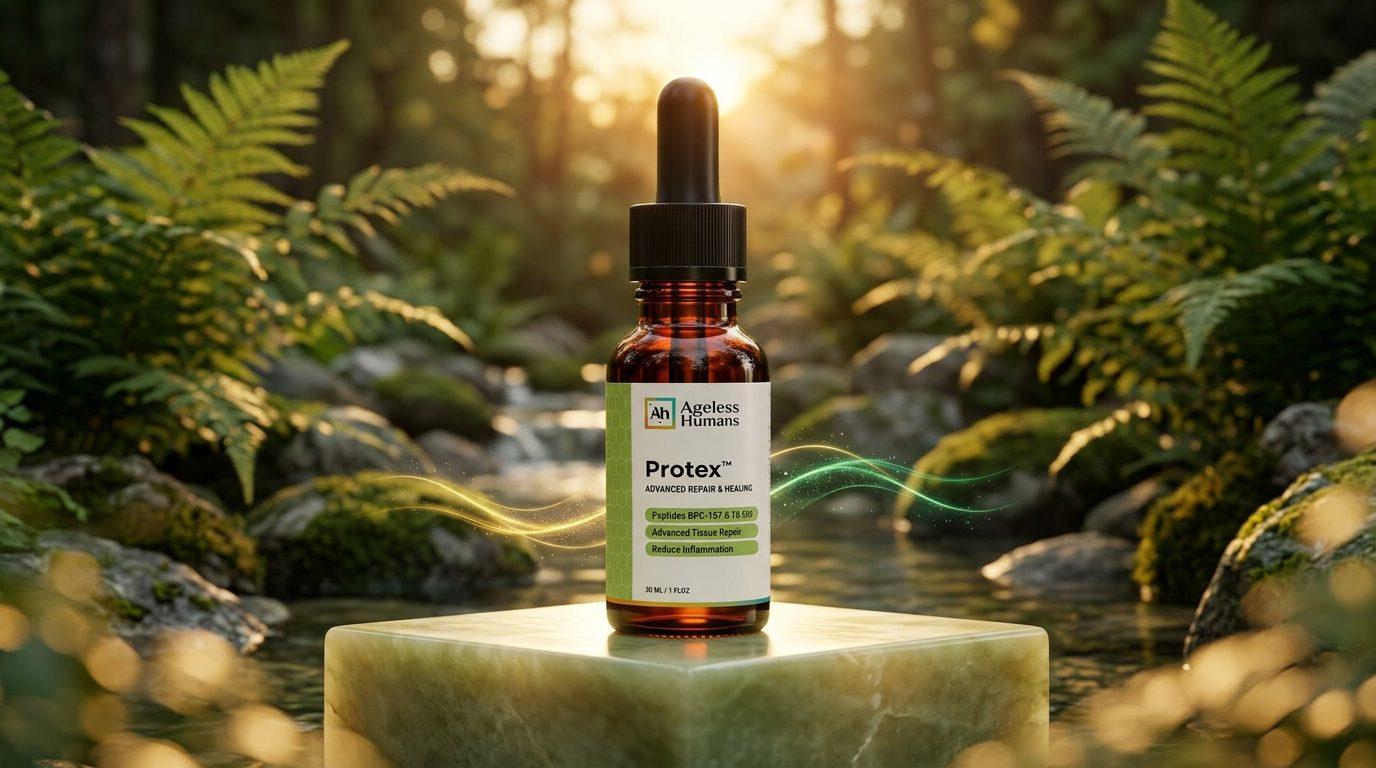
At Ageless Humans, our products are made in our own FDA-registered facility in Carlsbad, California. Every lot is third-party lab tested with a COA, and every order is backed by a 60-day money-back guarantee. Our Protex oral BPC-157 and TB-500 formula pairs BPC-157 with TB-500 in a needle-free oral format for people who want to support recovery as part of a daily routine.
As with any supplement, talk to your healthcare provider before starting, especially if you take medications, are pregnant or nursing, or compete in tested sports.
Frequently asked questions
Is PDA the same as BPC-157?+
PDA (pentadeca arginate) is generally described as the same 15-amino-acid peptide sequence as BPC-157, paired with an arginate salt instead of the more common acetate salt. The core peptide chain is the same; the salt form is what differs. Because composition can vary between sellers, a lot-specific Certificate of Analysis is the best way to confirm what a product contains.
Is PDA more stable than BPC-157?+
Sellers claim the arginate salt makes PDA more stable, and it is plausible that salt choice affects shelf stability and handling. However, independent, peer-reviewed head-to-head studies confirming better stability or better results in the body have not been published. BPC-157 itself has been described in research as relatively stable in gastric juice, which leaves less room for a dramatic improvement.
Is there research on PDA specifically?+
Published, independent research on PDA as a distinct product is very limited. Most benefits attributed to PDA are drawn from BPC-157 studies, which are largely animal and cell research with few controlled human trials. PDA's evidence base is essentially borrowed from BPC-157, not built on its own.
Why did PDA become popular?+
PDA gained traction after the FDA placed BPC-157 in a category of bulk drug substances flagged for potential safety concerns in 2023, which restricted its use in compounding. PDA then appeared in clinics and compounding catalogs as an alternative. Its rise reflects regulatory and market forces more than new scientific findings.
Should I choose BPC-157 or PDA?+
Because both share the same core peptide, the bigger decision is source quality, not salt form. Look for a known manufacturer, lot-specific third-party testing with a COA, a delivery format that fits your routine, and claims limited to what the supplement supports. Talk with a healthcare provider before starting either.
Can BPC-157 be taken orally?+
BPC-157 has been studied in oral form, largely because research describes it as relatively stable in the stomach environment. Oral formats avoid needles and are often chosen to support gut and whole-body recovery routines. Always follow the directions on the product label.