
NMN and collagen are not competing supplements. They do different jobs. NMN is a precursor to NAD+, a coenzyme your cells use to make energy and support normal repair processes, while collagen supplies amino acids for skin, joints, bones, and connective tissue. Choose NMN first if your priority is energy and cellular aging, collagen first if your priority is skin and joints, or take both, since they work through separate pathways.
The Short Answer: Two Supplements, Two Different Jobs
NMN supports what happens inside your cells, and collagen supports the structures your cells build. Comparing them is like comparing a car's fuel system to its frame. Both matter as the car ages, but you would never swap one for the other.
NMN (nicotinamide mononucleotide) is a molecule your body converts into NAD+. NAD+ is a coenzyme that hundreds of enzymes rely on, including the ones that turn food into usable cellular energy. Collagen is the most abundant protein in your body. It forms the scaffolding of skin, tendons, ligaments, cartilage, and bone.
They get compared because both rank among the most-searched longevity supplements and both connect to the same concern: what changes in the body over time. But they answer different questions. NMN asks, "How well are my cells running?" Collagen asks, "How well is my structure holding up?"
What NMN Does: Supporting the NAD+ System
NMN's job is to help maintain NAD+ levels, which supports cellular energy production and normal cellular maintenance. NMN is one step away from NAD+ in the body's production pathway, which is why it gets so much research attention.
NAD+ plays several roles:
- Energy metabolism: Mitochondria use NAD+ to convert nutrients into ATP, the energy currency of your cells.
- Sirtuin activity: Sirtuins are a family of proteins involved in cellular stress responses and metabolic regulation. They depend on NAD+ to function.
- DNA maintenance: Enzymes involved in routine DNA upkeep also consume NAD+.
Research suggests NAD+ levels tend to decline with age. That observation is the core reason people take NMN: to support NAD+ availability as natural levels shift. For a deeper look, see our full guide to NMN benefits.
What NMN does not do is build tissue. It is not a protein and supplies no meaningful structural building blocks. Its role is functional, not structural.
What Collagen Does: The Body's Structural Scaffolding
Collagen's job is to supply the amino acids, especially glycine, proline, and hydroxyproline, that your body uses to maintain connective tissue. It is a structural protein, not a signaling molecule or a coenzyme.
There are many collagen types, but three show up most often on supplement labels:
- Type I: The main collagen in skin, bone, tendons, and ligaments.
- Type II: Concentrated in cartilage.
- Type III: Found alongside Type I in skin and blood vessel walls.
Most collagen supplements are hydrolyzed collagen peptides, meaning the protein has been broken into smaller pieces for easier digestion. Your body makes its own collagen, and production is widely understood to slow with age. That is why collagen is popular for supporting skin elasticity and hydration, healthy hair and nails, and joint comfort.
One detail people miss: your body needs vitamin C to make collagen. A collagen supplement works best alongside a diet that covers basic nutrient needs. For more on how collagen fits into a broader skin routine, read our skin longevity guide.
NMN vs Collagen Side by Side
The clearest difference is the level each works at. NMN works at the level of cellular chemistry, and collagen works at the level of tissue structure. Here is how they compare on the points that matter when you're deciding:
- What it is: NMN is a nucleotide and NAD+ precursor. Collagen is a structural protein, usually sold as hydrolyzed peptides.
- Primary role: NMN supports cellular energy metabolism and normal cellular maintenance. Collagen supplies building blocks for skin, joints, bones, and connective tissue.
- Where you'd notice it: People take NMN for energy, vitality, and metabolic support. People take collagen for skin, hair, nails, and joint comfort.
- Common format: NMN usually comes in capsules or powder. Collagen usually comes in powder, often mixed into coffee or smoothies.
- Research stage: NMN is supported by extensive animal research and a growing but still early body of human studies. Collagen peptides have been studied in humans for years, mostly for skin and joint outcomes.
- Diet overlap: Small amounts of NMN occur in some vegetables, but far below supplement levels. Collagen is in bone broth and animal skin and connective tissue, which most modern diets rarely include.
The takeaway: they don't overlap. One cannot cover for the other.
What the Research Does and Doesn't Show
Both supplements have real scientific interest behind them, but neither is a guaranteed fix, and the evidence base looks different for each. Being honest about that helps you set realistic expectations.
NMN: Much of the striking NMN research comes from animal models, where NMN has been studied for its effects on NAD+ levels, energy metabolism, and markers of aging. Human trials have grown in recent years. They generally show that NMN supplementation can raise NAD+-related markers in the blood. Whether that translates into broad, long-term benefits in people is still being studied. Anyone telling you NMN is proven to extend human lifespan is ahead of the science.
Collagen: Collagen peptides have a longer track record of human studies, mainly on skin elasticity, hydration, and joint comfort. Research suggests that some collagen peptides may signal the body's own collagen-producing cells, not just supply raw amino acids. Results vary by study design, collagen source, and the outcomes measured.
The fair summary: NMN is the more cutting-edge option, with strong mechanistic rationale and maturing human data. Collagen is the more established option, with a narrower but longer-studied focus. Neither replaces sleep, exercise, protein intake, and sun protection, which remain the foundation for both cellular and structural health.
Who Should Start With Which
Start with the supplement that matches the change you care about most. If you can only add one right now, use this framework.
Start with NMN first if:
- Your main goal is supporting daily energy and cellular vitality.
- You're interested in the biology of aging at the cellular level, such as NAD+, sirtuins, and mitochondrial function.
- You're in midlife or beyond and want to support NAD+ levels as they naturally shift.
- You already eat a protein-rich diet and your skin and joints aren't your top concern.
Start with collagen first if:
- Your main goal is supporting skin elasticity, hydration, hair, or nails.
- You're physically active and want to support joint comfort and connective tissue.
- Your diet rarely includes collagen-rich foods like bone broth.
- You want a supplement with a longer history of human research on visible outcomes.
Consider both if you care about energy and appearance or mobility. Most people interested in longevity eventually do, because aging shows up both inside the cell and in the tissues you can see and feel. If you want to compare NAD+ support formats before choosing, browse our NAD+ and NMN supplements.
Can You Take NMN and Collagen Together?
Yes. NMN and collagen work through separate pathways, and there's no known mechanism by which one blocks the other. That's why many people pair them as a two-part routine: one for cellular function, one for structural support.
A few practical points:
- Follow each product's label directions. Don't adjust amounts on your own.
- Timing is flexible. Many people take NMN in the morning as part of an energy-focused routine. Collagen powder mixes easily into morning coffee or a smoothie, so stacking them at breakfast is simple.
- Add one at a time. Starting with one supplement for a few weeks before adding the second makes it easier to notice how each fits your routine.
- Check with your healthcare provider if you're pregnant, nursing, taking medications, or managing a health condition.
Give each one time. Structural tissues like skin and cartilage renew slowly, so collagen is usually assessed over weeks to months. NMN is also best judged as part of a consistent daily routine, not after a single dose.
How to Choose a Quality NMN or Collagen Supplement
Quality comes down to three things: verified purity, a clear label, and a brand that stands behind the product. Both NMN and collagen are crowded categories, and quality varies.
For NMN, look for:
- Third-party testing with a published Certificate of Analysis (COA) confirming identity and purity.
- A clear amount of NMN per serving on the label.
- Transparent manufacturing, so you know where and how it's made.
For collagen, look for:
- Hydrolyzed collagen peptides for easy mixing and digestion.
- A stated source (bovine, marine, etc.) and collagen types.
- Third-party testing for purity and contaminants.
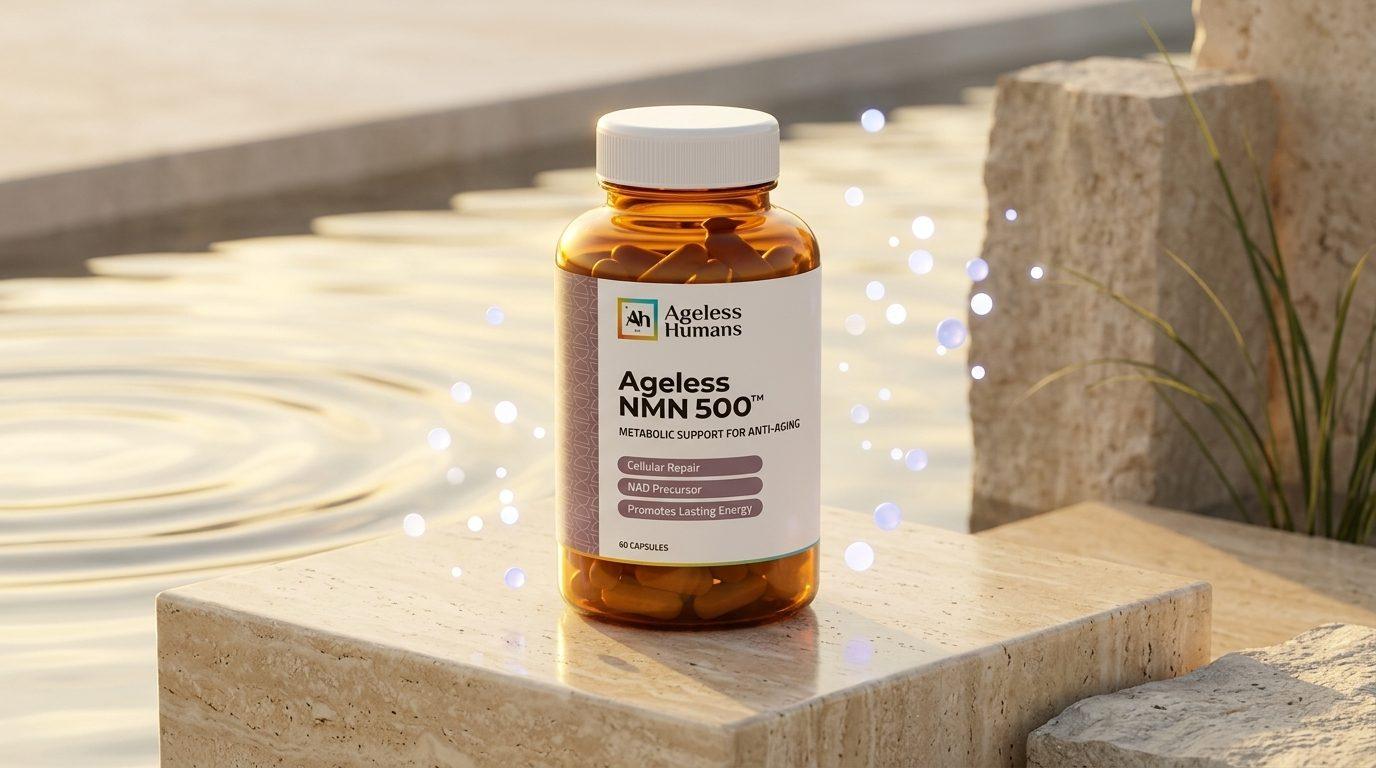
At Ageless Humans, our NMN 500 capsules are made in our own FDA-registered facility in Carlsbad, California. Every lot is third-party lab tested, with a COA available, and backed by a 60-day money-back guarantee. Whatever brand you choose, hold it to that standard: if a company won't show you its testing, keep looking.
Frequently asked questions
Is NMN better than collagen?+
Neither is better, because they do different jobs. NMN is a precursor to NAD+ and supports cellular energy production and normal cellular maintenance. Collagen is a structural protein that supplies building blocks for skin, joints, bones, and connective tissue. The better choice depends on whether your priority is cellular energy or structural support.
Can I take NMN and collagen at the same time?+
Yes. NMN and collagen work through separate pathways, and there is no known mechanism by which one interferes with the other. Many people take both in the morning, such as NMN capsules alongside collagen mixed into coffee. Follow each product's label directions and talk to your healthcare provider if you take medications or have a health condition.
Does NMN help skin like collagen does?+
NMN and collagen support skin in different ways. Collagen directly supplies amino acids used to maintain skin structure and has been studied in humans for skin elasticity and hydration. NMN supports NAD+, which skin cells use for energy and normal maintenance, but research on NMN specifically for skin appearance is still early.
Which should I take first, NMN or collagen?+
Start with NMN if your main goal is supporting energy and cellular vitality as NAD+ levels naturally shift with age. Start with collagen if your main goal is supporting skin, hair, nails, or joint comfort. If both matter to you, add one first, give it a few weeks, then add the other.
Does the body make its own NMN and collagen?+
Yes, the body makes both. It produces NMN as part of its NAD+ pathway, and it produces collagen from amino acids with the help of vitamin C. Research suggests NAD+ levels and collagen production both tend to decline with age, which is why people turn to these supplements for support.
How long does it take to notice NMN or collagen?+
Both are best judged over consistent use, not a single dose. Skin and connective tissue renew slowly, so collagen is typically evaluated over weeks to months. NMN works at the cellular level and should be taken as part of a steady daily routine according to label directions.